
Real-World Failures Caused by Missed Contract Renewals
Picture this: your operations team gets a call on a Monday morning that a critical vendor has stopped delivering services. There is no warning, no transition plan, and no backup. The reason? A contract expired over the weekend and nobody noticed. It sounds dramatic, but it happens more often than most organizations want to admit.
Missed contract renewals are one of the most preventable - yet surprisingly common - causes of business disruption. Whether it is a lapsed insurance policy, an expired vendor agreement, or a service contract that quietly auto-renewed on unfavorable terms, the consequences are real, costly, and far-reaching.
In this article, we will walk through real-world scenarios where missed contract renewals led to serious business failures. More importantly, we will explore how you can prevent these situations from happening in your own organization.
The Scale of the Problem
Before diving into specific failures, it helps to understand just how widespread this issue is. Research from the World Commerce and Contracting organization found that nearly 50% of organizations fail to effectively track at least some of their contracts, leading to overlooked renewal dates. According to industry estimates, organizations lose up to 9% of annual revenue due to poor contract management — and missed renewals are a major contributor.
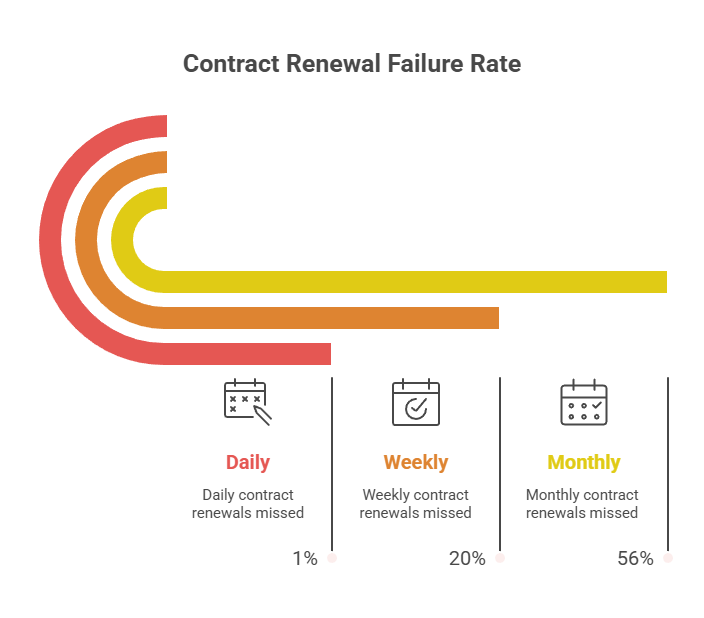
The numbers get more granular when you look at how frequently businesses miss deadlines: approximately 1% miss expirations daily, 20% weekly, and a staggering 56% on a monthly basis. When you consider that 92% of contract management errors are human errors, often stemming from manual spreadsheet tracking, the pattern becomes clear. The problem is not carelessness — it is the absence of reliable systems.
Real-World Failure Scenarios
The Healthcare Provider Who Lost Network Status
A multi-physician medical practice in the southeastern United States relied on a small administrative team to manage payer contracts and credentialing renewals. When a key staff member left the organization, several credentialing files went unattended. Within three months, two providers were flagged as out-of-network by a major insurance company — not because their credentials had lapsed, but because the renewal paperwork for their participation agreements was never submitted.
The practice continued delivering care for weeks before discovering the issue through rejected claims. By the time it was resolved, the practice had accumulated tens of thousands of dollars in non-billable services and had to renegotiate its contract from a weakened position. Patients were confused, referrals dried up, and the practice's reputation with that payer took years to fully recover.
The Contractor Who Lost Preferred Vendor Status
A mechanical contractor in Michigan was awarded a subcontract for an $8 million hospital renovation project. The general contractor required a certificate of insurance with $5 million in general liability coverage. However, the subcontractor's certificate on file showed only $1 million — the old policy limit from a previous contract period that had not been updated at renewal.
The emergency purchase of additional coverage cost $12,000. Project delays while the paperwork was sorted out cost another $18,000. But the real damage was reputational: the contractor lost preferred vendor status with the healthcare system, which represented approximately $48,000 in annual revenue. A single missed renewal detail cascaded into nearly $80,000 in combined losses.
The Business With a Lapsed Insurance Policy
A mid-sized construction firm let its general liability insurance lapse for just eleven days due to an administrative oversight during a payment processing transition. During that gap, a worker was injured on a job site. Because the policy was inactive at the time of the incident, the insurance company denied the claim entirely. The business was fully liable for the medical costs, legal defense fees, and eventual settlement — a total that exceeded $200,000.
Beyond the immediate financial hit, the lapse triggered a review by the firm's bonding company, which raised their premiums significantly. Several project owners required proof of continuous coverage, and the gap in their insurance history made future bids more difficult to win.
The Software Vendor Agreement That Auto-Renewed at Double the Cost
A regional healthcare network used an electronic health records (EHR) system under a three-year contract that included an automatic renewal clause. The contract stipulated that unless written notice was provided 90 days before expiration, the agreement would renew at the then-current list price — which had increased substantially since the original agreement was signed.
Nobody on the IT or procurement team flagged the renewal deadline. The contract auto-renewed at a rate roughly 40% higher than what the organization had budgeted. Because the renewal was legally binding, the healthcare network was locked into the higher rate for another three years, costing an additional $350,000 over the contract period. That money could have been redirected to patient care or staff training.
The Expired Lease That Disrupted Operations
A growing HR consulting firm operating out of leased office space failed to initiate renewal negotiations in time. The lease expired, and while the landlord allowed them to continue occupying the space on a month-to-month basis, the new terms included a 25% rent increase and the elimination of a tenant improvement allowance that had been part of the original lease.
When the firm eventually tried to negotiate a new long-term lease, they had lost all leverage. The landlord had already begun marketing the space to other tenants. The firm was forced to relocate on short notice, spending over $60,000 on moving costs, new build-outs, and the productivity lost during the transition.
Why These Failures Keep Happening
These scenarios share common root causes that most organizations will recognize.
Over-Reliance on Manual Tracking
Spreadsheets, calendar reminders, and sticky notes are still the primary tracking tools for many organizations. Research shows that about 33% of businesses manually track contract expiration dates, and 9% do not track them at all. Manual systems work until they do not — and the failure usually happens at the worst possible time.
Key-Person Dependencies
When contract knowledge lives in one person's head or inbox, the organization is one resignation, illness, or vacation away from a missed deadline. This is especially common in small to mid-sized businesses where one person wears multiple hats.
Complex Renewal Terms
Not all contracts renew the same way. Some require 30 days' notice, others 90 or even 180 days. Some auto-renew, others terminate. Some require specific documentation or updated insurance certificates. Keeping track of these variations across dozens or hundreds of contracts is nearly impossible without a structured system.
Organizational Silos
In many organizations, contracts are managed by different departments — procurement handles vendors, HR handles employee agreements, legal handles partnerships, and operations handles leases. Without a centralized system, there is no single view of what is expiring and when.
The True Cost of a Missed Renewal
The direct financial cost is only part of the story. Missed contract renewals create ripple effects that can persist for months or years.
How to Prevent Contract Renewal Failures
The good news is that every one of these failures was preventable. Here is what effective contract renewal management looks like.
Centralize Your Contract Repository
Every contract your organization holds — vendor agreements, insurance policies, leases, service contracts, employee agreements — should live in one searchable, accessible system. This eliminates the problem of contracts scattered across email inboxes, shared drives, and filing cabinets.
Build in Early Warning Systems
Waiting until a contract is about to expire is too late. Effective organizations set up tiered reminders — at 180 days, 90 days, 60 days, and 30 days before expiration — to give themselves enough time to review terms, gather requirements, and negotiate if needed.
Automate Expiration Tracking
Replacing manual tracking with an automated system is the single most impactful change you can make. Tools like Expiration Reminder allow you to set expiration dates once and receive automatic notifications well in advance. You get a centralized dashboard showing everything that is coming due, who is responsible, and what action needs to be taken — no spreadsheets required.
Assign Clear Ownership
Every contract should have a designated owner who is responsible for monitoring its status and initiating the renewal process. This does not mean one person manages all contracts — it means every contract has someone accountable for it.
Document Renewal Terms Upfront
When a new contract is signed, record the key renewal details immediately: renewal date, notice period, auto-renewal terms, required documentation, and any price adjustment clauses. Capturing this information at the start prevents surprises later.
Frequently Asked Questions
What happens when a business contract expires without renewal?
When a contract expires without renewal, the legal obligations and protections defined in that agreement cease to apply. In some cases, both parties may continue operating under an implied contract, but the terms become vague and difficult to enforce. This creates significant legal and financial exposure for both sides.
Can an expired contract still be enforced?
Generally, the specific terms of an expired contract are no longer enforceable. However, certain obligations — such as confidentiality clauses, indemnification provisions, or payment obligations for work already completed — may survive expiration depending on the contract language. Always consult legal counsel for specific situations.
What is an auto-renewal clause, and why is it risky?
An auto-renewal clause automatically extends a contract for a specified period unless one party provides written notice of termination within a defined window (often 30 to 90 days before expiration). The risk is that if you miss the notice window, you are locked into the renewal — often at updated pricing or less favorable terms — with no ability to renegotiate.
How far in advance should you start the contract renewal process?
Best practice is to begin the renewal review at least 90 to 180 days before expiration, depending on the complexity of the agreement. High-value or mission-critical contracts may require even more lead time to allow for competitive bidding, internal approvals, and negotiation.
What industries are most affected by missed contract renewals?
Healthcare, construction, financial services, and government contracting are among the most affected due to the volume of regulatory requirements, vendor relationships, and compliance obligations they manage. However, any organization with multiple contracts is at risk.
How do you track contract expiration dates effectively?
The most effective approach is to use a dedicated expiration tracking system that centralizes all contract dates, sends automated reminders, and provides a dashboard view of upcoming renewals. This replaces error-prone manual methods like spreadsheets and calendar entries.
What is the financial impact of poor contract management?
Studies estimate that poor contract management costs organizations up to 9% of annual revenue. This includes direct costs like overpayment and penalties, as well as indirect costs like lost negotiating leverage, service disruptions, and compliance failures.
Who should be responsible for contract renewal tracking in an organization?
Responsibility depends on your organization's size and structure. In smaller companies, this often falls to office managers or operations leads. In larger organizations, procurement, legal, or compliance departments typically manage contract lifecycles. Regardless of who owns the process, using a centralized tracking system ensures nothing falls through the cracks.
Moving Forward With Confidence
The failures described in this article are not outliers. They are everyday occurrences in organizations that lack the systems and processes to stay ahead of their contract deadlines. The common thread in every scenario is the same: the expiration date was knowable, the renewal was manageable, and the failure was preventable.
You do not need to overhaul your entire operations to fix this. Start by identifying your most critical contracts, centralizing their key dates, and setting up automated reminders so that nothing slips through the cracks. A platform like Expiration Reminder can help you build that system quickly, giving you a single dashboard for all your expiration dates and automated alerts that keep your team ahead of every deadline.
The best time to prevent a contract renewal failure is before it happens. Take stock of where your organization stands today, and take the first step toward a more proactive approach. Your future self — and your bottom line — will thank you.