

What Inspectors Actually Look For
It was a Tuesday morning when the inspector walked through the front door unannounced. The safety manager at a mid-size manufacturing facility had known the visit was coming—eventually—but “eventually” had turned into “right now.” She scrambled to pull training records for twelve employees, hunted through three different shared drives for equipment maintenance logs, and spent two hours answering questions she should have been able to answer in minutes.
The inspection passed. Barely. And the experience left her team shaken for weeks.
Sound familiar? Most compliance inspections are not failed because organizations are actually non-compliant. They fail—or come dangerously close—because the documentation is scattered, the records are stale, and no one has run a real drill. The good news is that passing compliance inspections without stress is absolutely achievable, and it comes down to a handful of consistent habits rather than one frantic scramble before the inspector arrives.
This guide walks you through exactly how to prepare for a compliance inspection, organize your records, and build a team culture that makes audits feel routine rather than terrifying.
Before you can prepare effectively, it helps to understand what a compliance inspector is evaluating. Whether it is an OSHA general industry inspection, a state health department visit, a fire marshal walkthrough, or a regulatory agency review, inspectors tend to focus on three core areas:
- Documentation: Are your records accurate, up to date, and easy to access?
- Physical conditions: Does your facility match what your records say?
- Employee knowledge: Do your team members understand their own compliance requirements?
Inspectors are not trying to catch you off guard—they are trying to verify that you have a working compliance system. A well-organized team with current records will almost always come out ahead, even if a minor item needs corrective action.
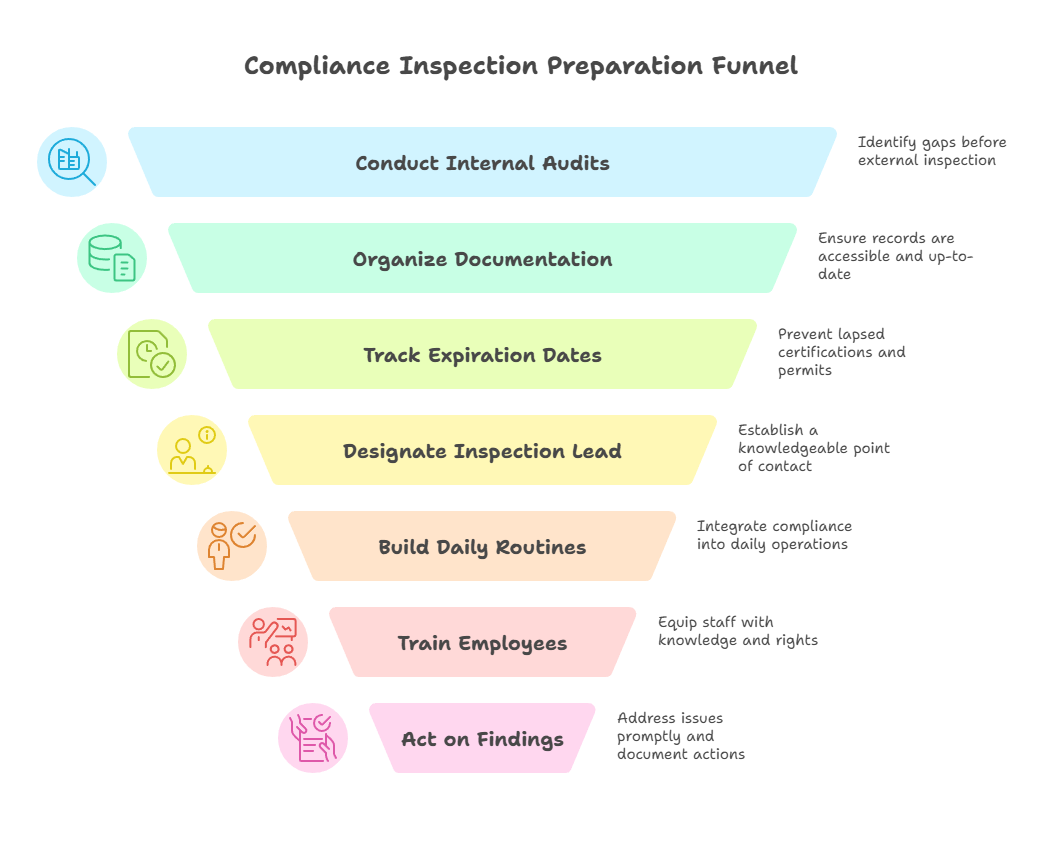
The 7 Steps to Pass Compliance Inspections With Confidence
Step 1: Conduct Regular Internal Audits
The single biggest predictor of a smooth external inspection is a strong internal audit routine. Running your own mock inspections before the real thing exposes gaps while you still have time to fix them. Schedule internal walkthroughs quarterly or monthly, depending on your industry risk level.
During your internal audit, work through the same checklist an actual inspector would use. The SafetyCulture OSHA inspection template library is a useful starting point. Note every deficiency, assign an owner, and set a resolution deadline. Treat these findings as seriously as you would a real citation.
Step 2: Organize Your Documentation Before You Need It
Scrambling to find records during an inspection is one of the fastest ways to undermine an inspector’s confidence—even if the records exist. Your documentation system needs to answer one simple test: can any authorized team member pull a specific record in under two minutes?
Key documents that inspectors commonly review include:
- Employee training logs and certification records
- Equipment inspection and maintenance records
- Injury and illness logs (OSHA Forms 300, 300A, 301)
- Safety Data Sheets (SDS)
- Written safety programs and hazard assessments
- Licenses, permits, and their expiration dates
Step 3: Track Expiration Dates Proactively
One of the most common compliance inspection failures is discoverable and preventable: expired certifications, licenses, and permits. An employee whose CPR certification lapsed three months ago, equipment that missed its annual inspection, or a permit that expired last quarter—these are the findings that show up on citations and that managers feel worst about, because they were entirely avoidable.
Proactive expiration tracking means you know about these issues before an inspector does. Set reminders 30, 60, and 90 days before key dates so your team has enough lead time to schedule renewals. Platforms like Expiration Reminder are designed precisely for this—automatically tracking certifications, licenses, and permits across your entire organization and sending alerts before anything lapses.
Step 4: Designate and Train an Inspection Lead
When an inspector arrives, someone needs to be the calm, knowledgeable point of contact. This person should know where every document is, understand your safety programs deeply, and be trained to take detailed notes throughout the visit. Designate both a primary and a backup contact—inspections do not reschedule around vacation calendars.
Your inspection lead should practice the opening conference, the walkaround, and the closing conference as distinct phases. According to the OSHA inspection process overview, inspectors will want to review credentials, discuss the scope of their visit, and explain employee rights.
Step 5: Build Compliance Into Daily Routines
The difference between organizations that pass inspections consistently and those that scramble every time usually comes down to one thing: daily habits. Compliance is not a box you check before an inspection—it is a set of routines your team follows every day.
Regular safety walkthroughs become standing calendar events. Training records get updated the day a course is completed. Equipment maintenance schedules run on time because someone is responsible and gets a reminder when it is due—not after it is overdue.
Step 6: Train Employees on What to Expect
Compliance inspectors frequently interview employees as part of their evaluation. An employee who is surprised by the question “What do you do if you encounter a hazardous spill?” creates more risk than an employee who answers confidently. Annual training is not enough—frequent, short reinforcement keeps compliance knowledge current.
Train your team on their rights during an OSHA inspection, including the right to have a representative present and the right to speak privately with the inspector if they choose.
Step 7: Act on Findings Quickly
Whether from an internal mock inspection or the real thing, every finding needs a documented corrective action. Inspectors who return for a follow-up visit will check whether previous issues were resolved. Organizations that can show a clear record of identifying problems and resolving them demonstrate exactly the systemic compliance culture that inspectors want to see.
The Most Common Compliance Inspection Failures (and How to Avoid Them)
Expired Records and Certifications
An employee with a lapsed certification working in a regulated role is a citation waiting to happen. Without a proactive expiration tracking system, it is easy for dates to slip past busy managers. Automating renewal reminders eliminates this risk entirely.
Inaccessible Documentation
Records that exist but cannot be found quickly are nearly as problematic as records that do not exist. Organize your documents so any authorized staff member can retrieve them without assistance.
Inconsistency Between Records and Reality
If your training log shows that all employees completed forklift certification, but three of them cannot recall taking the course, you have a serious problem. Make sure records reflect what actually happened, not what was planned.
Lack of a Documented Safety Program
Many inspection failures trace back to the absence of a written safety program. OSHA and most regulatory bodies require documented programs for hazard communication, emergency response, and other core areas.
Untrained Inspection Lead
An inspection lead who is flustered, unfamiliar with documents, or unclear on procedures creates a poor impression even when the underlying compliance is solid. Invest in training your designated contact just as you invest in keeping records current.
How to Build an Inspection-Ready Culture Year-Round
The best organizations do not prepare for inspections—they live in a state of continuous readiness. Building this culture requires three things working together:
- Clear ownership: Every compliance item has a named person responsible for it—not a department, but a specific individual.
- Reliable reminders: Automated alerts ensure that no expiration date or renewal slips through the cracks.
- Visible status: Leaders can see the compliance status of their entire organization in real time.
Your Compliance Inspection Preparation Checklist
- Schedule and complete an internal mock inspection using an industry-appropriate checklist
- Review all employee certification and license expiration dates—flag anything expiring within 90 days
- Audit equipment maintenance and inspection logs for completeness
- Confirm all required written safety programs are current and accessible
- Verify injury and illness records (OSHA Forms 300, 300A, 301) are complete
- Ensure Safety Data Sheets are current, properly labeled, and accessible to all employees
- Designate and brief your inspection lead and backup
- Brief employees on what to expect during an inspector visit
- Document all open corrective actions from previous audits with resolution status
- Set automated reminders for all upcoming renewal and inspection dates
How Technology Closes the Inspection Readiness Gap
The organizations that pass compliance inspections most consistently are not necessarily the most compliant—they are the most organized. They have systems that keep records current, surface expiration dates before they become problems, and give managers real-time visibility into their compliance status.
Expiration Reminder was built for exactly this purpose. Whether you are managing staff licenses in healthcare, contractor certifications in construction, or employee training records in HR, the platform tracks every critical date and sends automated reminders long before anything expires. Start a free trial of Expiration Reminder and walk into your next inspection with confidence.
Key Takeaways
- Most compliance inspection failures trace to disorganized documentation and expired records—not to actual non-compliance.
- Regular internal mock inspections identify gaps while you still have time to fix them.
- Proactively tracking expiration dates prevents the most common and avoidable citation types.
- Designating a well-trained inspection lead creates a calm, professional experience during the actual visit.
- Building compliance into daily routines—with clear ownership, automated reminders, and visible status—creates year-round readiness.
- Technology that centralizes records and automates renewal alerts removes the manual burden that makes inspections stressful.
Frequently Asked Questions
How often do compliance inspections happen?
Inspection frequency depends on your industry, location, and history of compliance. OSHA may inspect following an employee complaint, a workplace injury, or as part of a targeted enforcement program. The safest approach is to operate as if an inspection could happen any day.
What documents should I always have ready for a compliance inspection?
Core documents include employee training logs, equipment inspection records, injury and illness logs, written safety programs, Safety Data Sheets, and copies of all current licenses and permits. Having these organized in a centralized, easily searchable system is essential.
Can expired certifications cause an inspection to fail?
Yes. Expired certifications—especially for employees working in regulated roles—are a common citation trigger. Inspectors cross-reference your training records with the roles employees currently perform. Setting automated reminders for upcoming expirations is the most reliable way to prevent this.
What happens if you fail a compliance inspection?
Depending on the regulatory body and severity, consequences can include written citations, monetary fines, mandatory corrective action plans, and follow-up inspections. Most inspectors prefer to see organizations take corrective action promptly, but documented violations do carry real consequences.
How far in advance should I start preparing for a compliance inspection?
Preparation should be continuous. A structured review 90 days before a known inspection gives you time to identify gaps, schedule renewals, update records, and train your team without rushing.
What is the biggest mistake organizations make during compliance inspections?
The most common mistake is not having documents ready to produce on demand. Inspectors interpret difficulty retrieving records as a sign of a weak compliance system. Centralized, well-organized documentation is your strongest asset during any inspection.
PS: A missed certification or lapsed permit is one of the easiest compliance inspection failures to prevent—and one of the hardest to explain after the fact. With automated expiration tracking, your team is always ready, no matter when the inspector shows up.


-1.png?width=400&height=300&name=69a9a1304b174916d7412fc6__-%20visual%20selection%20(1)-1.png)