
Imagine you're the safety manager at a midsize construction firm, mid-morning on a Tuesday. An OSHA compliance officer shows up unannounced for a focused inspection on jobsite credentials. Within twenty minutes, she asks to see current forklift certifications for the crew on site. You pull up your team's tracker — the same spreadsheet that's served you reliably for five years — and your stomach drops. Eighteen of your forty-seven supervisors have expired certifications. Nobody noticed.
This is what "set and forget" really looks like in compliance. The system did exactly what you asked it to do. It stored certificates. It just never told you when they went stale, and nobody else in the chain was paid to remember. Compliance isn't a one-time setup; it's a continuous obligation that quietly accumulates risk every day you stop paying attention.
The phrase "set and forget" gets used in compliance circles the way "fire and forget" gets used in software — implying autonomy and confidence. In reality, most compliance programs that lean on it are running on assumptions that stopped being true months ago. This post walks through why the set-and-forget mindset breaks compliance programs, what the hidden cost actually looks like, and how active compliance practices preserve the operational efficiency you wanted while closing the gaps that quietly grow.
The appeal of "set and forget" — and why it's a trap
Set-and-forget compliance has obvious appeal. Compliance teams are stretched thin. The Bureau of Labor Statistics tracks compliance officers as a growing professional category, but the rate of new regulations has grown faster still. The natural response is to systematize: pick a tool, load in your documents, set up some folders, train the team, and move on to the next priority.
The trap isn't the systematization. It's the assumption that systematization equals supervision. A filing system stores what you give it. It doesn't ask if anything is missing. It doesn't notice when a name on a certificate stops working for your company. It doesn't tell you when a regulator changes the renewal window from 12 months to 9 months. The system is passive. Compliance, almost by definition, is not.
The other reason set-and-forget feels safe is psychological. When you can see the documents in your tracker, your brain marks the work as done. Audit prep starts feeling like a formality. The day a regulator actually shows up — and that day always comes — the gap between what you assumed and what's actually true gets exposed in front of the worst possible audience.
That gap is what we mean by compliance debt: the silent accumulation of expired credentials, outdated policies, and unaddressed regulatory changes that exists in every set-and-forget program and only surfaces under stress.
Three forces that quietly break your compliance system
Set-and-forget programs don't fail because someone made a mistake. They fail because three forces continuously act on every compliance program, and a passive system can't respond to any of them.
Regulations move
The federal regulatory environment alone publishes thousands of new rules and amendments each year. The Federal Register publication statistics make this visible — well over 3,000 final rules have been published in recent annual cycles, not counting state-level updates, OSHA standard interpretations, or industry-specific guidance from bodies like the Joint Commission or NIOSH.
Every one of those changes is a potential change to your compliance posture. Most won't apply to you. Some will. The ones that do may shift renewal cadences, change documentation requirements, or expand the scope of who needs what credential. Set-and-forget programs catch none of this. The tool you configured eighteen months ago doesn't know the rule has changed.
Documents expire
This is the obvious one and also the most underrated. Every credential, license, permit, COI, training certificate, and policy attestation has a date attached to it. That date is doing work whether you're paying attention or not. The day after expiration, the person carrying that credential is, from a regulator's standpoint, uncertified.
What makes this dangerous in set-and-forget systems is the scale problem. A single safety manager might be responsible for 30 employees, 90 credentials, and 20 different renewal cadences (annual, biennial, triennial). Multiply across the organization and you're looking at hundreds or thousands of expiration dates moving asynchronously through time. No human reviews that calendar reliably without help.
People change
Every personnel change creates a compliance event. A new hire arrives needing onboarding credentials. An existing employee transfers to a role with different certification requirements. A long-tenured supervisor retires and takes with them (often informal) knowledge of which subcontractor's COI is due when. A contractor's project ends and the credentials they held suddenly stop being your concern — until a regulator asks who was responsible last quarter.
Set-and-forget systems treat people as static records. They aren't. A program that doesn't trigger on personnel changes will be perpetually out of date on the credentials those changes affect.
The hidden cost of compliance complacency
The cost of set-and-forget compliance shows up in four places, and most of them are invisible until they aren't.
The first is direct financial penalty. OSHA's penalty schedule lists maximum civil penalties of over $16,000 per serious violation and over $160,000 for willful or repeat violations. Healthcare compliance failures can be worse: the HHS Office for Civil Rights HIPAA enforcement page catalogs settlements that routinely exceed $1 million for systemic recordkeeping or training failures. State licensing boards add their own penalty regimes. None of these accrue gradually; they hit on the day a regulator decides to look.
The second is operational disruption. An expired permit can shut down a jobsite. A lapsed nursing license can pull a hospital unit short-staffed. A missing contractor COI can stop a project payment in its tracks. Each of these problems is solvable, but the cost of solving them on emergency timelines is many multiples of the cost of preventing them.
The third is reputation. Audit findings are increasingly disclosable — to clients, to insurance carriers, to acquirers in due diligence, sometimes to the public. A pattern of compliance failures, even minor ones, can disqualify your firm from contracts you'd otherwise win.
The fourth, and least talked about, is team morale. When a compliance failure surfaces, someone has to absorb the fire drill. That person is almost always your most reliable compliance contributor — the one who already carries the program. Set-and-forget systems quietly punish your best people by making them responsible for the gap between assumed compliance and actual compliance, with no tools that would have helped them notice the gap earlier.
What active compliance actually looks like
Active compliance isn't the opposite of automation. It's automation with the right job description. The difference is whether the system is configured to do work on your behalf, or simply to hold information until someone asks.
Automation isn't neglect
A well-configured compliance system does three things a filing cabinet can't. It tracks expiration dates and alerts owners ahead of renewal windows. It logs every change, creating an audit trail that didn't exist before. And it routes work — assignments, approvals, follow-ups — to specific people with deadlines attached. None of this is "set and forget." It's "set up correctly so the system can actively do its job."
The mental shift is from passive storage to active workflow. Document expiration tracking software, used well, doesn't replace the compliance program. It replaces the assumption that someone will remember.
Owners, alerts, and audit trails
Active compliance programs assign a human owner to every category of credential. They configure alerts at multiple horizons — sixty days, thirty days, seven days before expiration — so the work distributes evenly rather than landing as a last-minute panic. They produce audit trails that don't require reconstruction from email threads or spreadsheets.
The audit trail piece matters more than people realize. Regulators routinely ask not just whether you complied, but how you knew you were complying. A timestamped log of alerts sent, renewals confirmed, and exceptions escalated is the cleanest answer to that question.
Reviewing your inputs, not just your outputs
The other shift in active compliance is reviewing the inputs to the system periodically, not just the outputs. Outputs are the credentials, dates, and tracker dashboards. Inputs are: who is on this list, what regulations apply, what new roles or sites changed the requirements. Quarterly reviews of the inputs catch the drift that documents-only reviews always miss.
A concrete example: the contractor COI problem
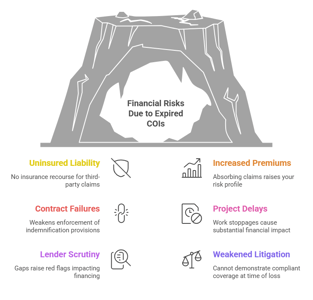
Consider a common scenario in construction and facilities management. Your firm requires every subcontractor on site to maintain a current Certificate of Insurance with specific coverage limits. In a set-and-forget program, COIs get uploaded when subcontractors are onboarded, then sit in a folder. Six months later, a subcontractor's insurance lapses. Nobody catches it because the COI is still in the folder where you left it. A worker gets injured. Your firm's general liability carrier finds out the subcontractor was uninsured and questions the claim.
In an active compliance program, the same COI is loaded into a system that knows the expiration date. Sixty days before expiration, an alert fires to the subcontractor liaison. Thirty days out, if no updated COI has arrived, the system escalates to the project manager. Seven days out, the system blocks the subcontractor from being scheduled until a new COI is on file. The same set of facts produces a completely different outcome — not because anyone worked harder, but because the system was configured to do work, not just store information.
Building a compliance program that won't drift
The best compliance programs aren't the ones with the fanciest tools or the largest teams. They're the ones built on three principles that resist drift.
First, single source of truth. Every credential, every renewal date, every policy attestation lives in one system. Email threads, paper files, and individual managers' personal calendars are not the source of truth — they're at best a backup. When the system is canonical, you reduce the surface area where stale data hides.
Second, named ownership. Every category has a human owner. "The team handles it" is a euphemism for "no one handles it." When something slips, you should be able to answer the question "who was supposed to catch this?" without a meeting.
Third, automation with human override. Alerts go out automatically. Owners can respond, snooze, or escalate. The system never silently closes a loop — every renewal either gets completed and logged, or escalated to someone with the authority to accept the risk.
A compliance program built this way isn't harder to run than set-and-forget. It's actually easier, because the system bears the cognitive load that human memory was failing to carry.
If you're tired of finding compliance gaps the hard way, see how Expiration Reminder's automated alerts keep credentials, permits, and policies from quietly going stale. Start a free trial and watch your renewal calendar populate itself.
Implementation checklist
If you want to move your compliance program out of set-and-forget mode this quarter, here are seven concrete steps you can take starting today.
- Inventory every credential type your organization is responsible for. Don't aim for perfection — aim for a complete-enough list you can refine in 30 days.
- Assign a named owner to every credential category. The owner doesn't do all the work; they answer for whether the work happens.
- Pick a single canonical system to hold every credential and renewal date. Decide which existing trackers are getting retired and on what schedule.
- Configure multi-horizon alerts — at minimum, 60 days, 30 days, and 7 days before expiration — routed to the credential owner.
- Establish a quarterly inputs review. Once a quarter, sit down and confirm the list of credentials, owners, and applicable regulations is still right.
- Document the audit trail format you'd use if a regulator showed up next week. Practice pulling it for one credential category to find the gaps.
- Pick one credential category to migrate to active compliance this month. Don't try to do all of them at once. Pick the highest-risk category and learn from it.
Key takeaways
- Set-and-forget compliance feels efficient but quietly accumulates risk because three forces — changing regulations, expiring documents, and personnel changes — work on your program continuously.
- The cost of compliance debt shows up as penalties, operational disruption, reputational damage, and burnout on your best people. Most of it stays invisible until a regulator surfaces it.
- Active compliance isn't more work than passive systems. It's the same work, organized so the system does the remembering instead of the human.
- Named ownership, single source of truth, and multi-horizon alerts are the three principles that resist program drift.
- Quarterly reviews of your compliance inputs — not just your outputs — catch the regulatory and personnel changes that automation alone misses.
Frequently asked questions
How is "active compliance" different from just having a good compliance tracking tool?
A tool is necessary but not sufficient. Active compliance combines the tool with named human ownership, multi-horizon alerts that route work to those owners, and a regular review of whether the inputs to your system are still correct. A tool with no owner and no review schedule is still set-and-forget.
We're a small team. Do we really need automated reminders for compliance?
Especially as a small team. Smaller organizations have fewer people to absorb the fire drill when something slips, and a single missed renewal can disrupt a larger share of operations. Automation reduces the cognitive load on your team and makes audit trails defensible without dedicated compliance headcount.
What's the biggest mistake organizations make when moving away from set-and-forget?
Trying to migrate every credential category at once. The faster path is to pick one high-risk category, build the active compliance workflow for it, learn what you'd do differently, then expand. A perfect rollout that takes six months is worse than an iterative rollout that delivers value in two weeks.
How often should we review our compliance program?
Documents-level reviews should happen monthly — are alerts firing, are renewals completing? Inputs-level reviews, where you confirm the list of credentials, owners, and applicable regulations is current, should happen quarterly. Annual reviews are too infrequent for most organizations.
Doesn't automation introduce its own risk if it fails silently?
Yes, which is why active compliance includes audit trails that record every alert sent and every action taken or skipped. A silent automation failure is a configuration problem you can catch by reviewing the audit trail. Set-and-forget systems lack that trail entirely.
What's the first thing a regulator looks at during a compliance audit?
Most regulators want to see two things quickly: a current credential roster and a documented process for keeping it current. The first is easy if you have a system. The second is what active compliance gives you that set-and-forget cannot. If you can produce both inside of fifteen minutes, you've already changed the tone of the inspection.
What does a good audit trail actually contain?
A defensible audit trail captures four things for every compliance event: what was tracked (the credential, policy, or attestation), who owned it, when alerts fired and to whom, and what action was taken (renewed, escalated, or accepted as a documented risk). The point isn't paperwork for its own sake — it's the ability to answer the regulator's follow-up question, which is almost always "how do you know?" An audit trail that can survive that question without a Slack search or an apology is the difference between a finding and a clean walkthrough.
How do we get buy-in from leadership for moving away from set-and-forget?
Frame it in terms of risk concentration, not tool selection. Set-and-forget programs concentrate the operational risk of compliance into a single point of failure: the memory of one or two people. Active compliance distributes that risk across a system with alerts, named owners, and audit trails. Most leadership teams respond to the risk framing better than to a tool pitch — because they recognize key-person dependencies as a problem in every other part of the business.
If your compliance program would survive a Tuesday-morning OSHA inspection only because someone on your team has been carrying it in their head, it's time to give them — and your organization — a better margin. Active compliance isn't more work. It's the work you're already doing, organized so the small misses stop becoming the expensive ones.
P.S. Missed renewals don't announce themselves until a regulator does. Automating the alerts and audit trail takes a fraction of the time it takes to clean up after one missed deadline.