

Read time:
11
min

ISO Certification Tracking Best Practices: How to Stay Audit-Ready All Year
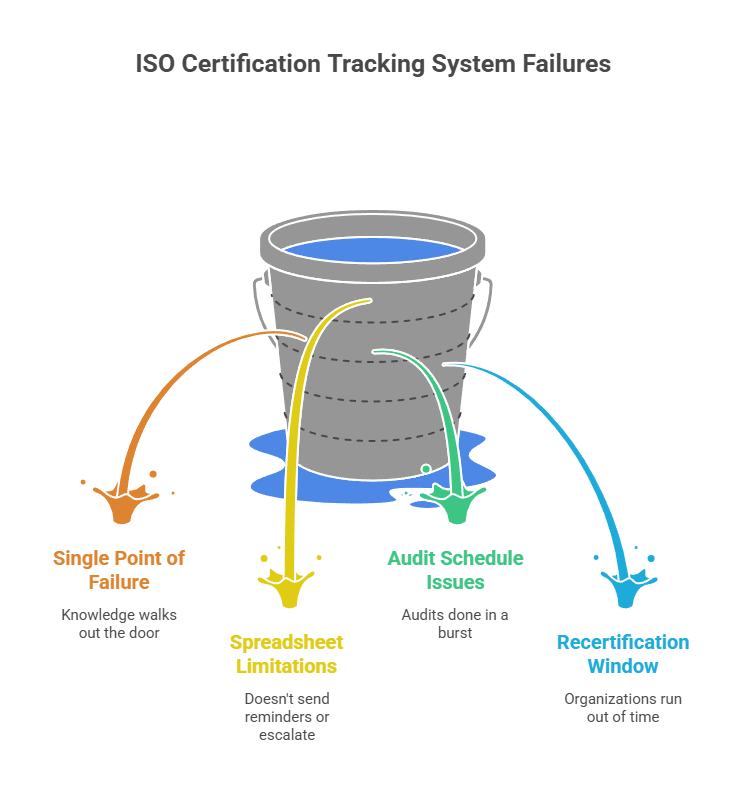
Table of Contents

Share this article
Subscribe
Thank you! Your submission has been received!
Oops! Something went wrong while submitting the form.

ISO Certification Tracking Best Practices: How to Stay Audit-Ready All Year

A mid-sized manufacturing company had held its ISO 9001 certification for six years without a single hiccup. Then a department reorganization moved the compliance lead to a new role, and nobody picked up ownership of the tracking spreadsheet. The surveillance audit reminder sat in the old lead's inbox, unread. By the time anyone noticed, the certificate had lapsed—and the company lost two major contracts that required current ISO certification before the gap was even closed.

That story is more common than most compliance teams want to admit. ISO certifications run on a strict three-year cycle with annual surveillance checkpoints, and the consequences of missing a window go well beyond paperwork. Understanding and applying solid ISO certification tracking best practices is what separates organizations that breeze through audits from those that scramble at the last minute.

This guide walks you through the full certification lifecycle, the most common tracking pitfalls, and a step-by-step system you can put in place today.

How the ISO Certification Cycle Works

Before you can track ISO certifications effectively, you need to understand what you're tracking. Most ISO standards—including ISO 9001 (quality management), ISO 14001 (environmental management), ISO 27001 (information security), and ISO 45001 (occupational health and safety)—follow the same three-year certification cycle.

Year 1: Surveillance Audit 1

Approximately 12 months after your initial certification, your registrar will conduct a surveillance audit. This is a narrower review than the full certification audit. The auditor checks specific clauses, reviews corrective actions from the previous audit, and confirms your management system is still operating as documented.

Year 2: Surveillance Audit 2

Another 12 months on, you face a second surveillance audit. The scope may differ from the first—auditors often rotate focus areas to ensure nothing gets neglected. At this point, you are also beginning the lead-up to recertification.

Year 3: Recertification Audit

The full recertification audit happens before the three-year anniversary of your original certification date. According to British Assessment Bureau, you should plan to complete this audit 3–4 months before certificate expiry to allow time for any corrective actions. If the certificate expires before recertification is complete, you lose certification status entirely—and have to restart.

The Ongoing Obligations In Between

Beyond the formal audits, most ISO standards require organizations to conduct internal audits, management reviews, and continuous monitoring of their management system throughout the year. These activities generate evidence that your auditors will want to see, so falling behind on them creates downstream problems.

Why ISO Certification Tracking Breaks Down

Most organizations do not lose ISO certification because they stopped caring about quality or security. They lose it because their tracking system failed them. Here are the four most common breakdowns.

1. Ownership Lives in One Person's Head (or Inbox)

When one compliance officer, quality manager, or EA owns all the key dates and reminders, the system is one resignation or reorganization away from collapse. The knowledge walks out the door with them, and no one else knows what deadlines are coming.

2. Spreadsheets That Age Poorly

A spreadsheet might work when you have a single certification to track. It breaks down when you have multiple ISO standards, multiple facilities, and multiple registrar relationships—each with their own timeline. Spreadsheets don't send reminders, don't escalate to supervisors, and can't tell you which certificates are within 90 days of a surveillance window.

3. Losing Track of Internal Audit Schedules

ISO standards require organizations to run internal audits on a planned schedule. Teams often knock out their internal audits in a burst before the external surveillance visit, rather than spreading them throughout the year as intended. Auditors notice this pattern and it raises questions about the health of your system.

4. Missing the Recertification Window

Recertification is not automatic. You need to contact your registrar, schedule the audit, prepare your documentation, and allow time for corrective actions. Organizations that wait until the 11th month of year three to start this process routinely run out of time. According to Compliant Ltd, organizations should begin recertification planning at least 3–4 months before the certificate expiry date.

ISO Certification Tracking Best Practices

Here is a practical framework you can apply regardless of which ISO standards your organization maintains.

1. Build a Centralized Certification Register

Every ISO certification your organization holds should live in one place. This register should capture the standard (e.g., ISO 9001:2015), the scope of certification, the certification body, the issue date, the expiry date, and the dates of upcoming surveillance and recertification audits. Anyone with a need to know should be able to find this information without hunting through email threads.

If you manage certifications across multiple sites or business units, each location should have its own entry in the register. Centralizing everything into one view makes it obvious when multiple deadlines are clustering around the same period—something a siloed approach misses entirely.

2. Set Tiered, Automated Reminders

A single reminder the week before an audit is too late. Best-practice ISO tracking uses a tiered reminder schedule that gives you enough runway to actually prepare:

  • 90 days out: Alert to compliance lead and department head. Begin scheduling the audit with the registrar and pulling together documentation.
  • 60 days out: Confirm audit date and scope. Ensure internal audits are scheduled and corrective actions from previous audits are closed.
  • 30 days out: Final documentation review and management sign-off. Ensure all records, logs, and evidence are organized.
  • 7 days out: Final checklist verification. Confirm all participants know their roles.

Manual calendar entries break when people leave or schedules change. Automated reminders that are tied to the certification dates—not a person's calendar—are far more reliable.

3. Assign Clear Ownership With Backups

Every certification should have a named primary owner and at least one backup. The primary owner is responsible for monitoring deadlines, coordinating internal preparation, and communicating with the registrar. The backup can step in immediately if the primary owner is unavailable.

Document this ownership in your certification register and review it whenever there are team changes. The five minutes it takes to update an owner record can prevent a major compliance gap.

4. Schedule Internal Audits Throughout the Year

ISO standards are explicit that internal audits should be conducted at planned intervals—not in a rush before the surveillance visit. Build your internal audit schedule at the beginning of each calendar year. Spread the audits across departments and processes, and record the completion dates. This gives you a continuous trail of evidence that your management system is genuinely maintained.

5. Track Corrective Actions to Closure

Every nonconformity raised in an internal or external audit must be closed out with a documented corrective action. These open action items are among the first things an external auditor reviews. Organizations that track corrective actions in a separate spreadsheet or, worse, in email chains, frequently arrive at surveillance audits with items that should have been closed months ago.

Your certification tracking system should link open corrective actions to the relevant certification so you can see at a glance what is outstanding before each audit window.

6. Monitor ISO Standard Revisions

ISO periodically revises its standards. The 2026 ISO revision cycle, for example, introduces changes around climate change considerations, stakeholder engagement, and ethical leadership requirements across several management system standards, according to Management Systems International. When a standard is revised, certified organizations typically have a transition period to update their systems and demonstrate conformance to the new version.

If your certification tracking doesn't include a flag for pending standard revisions that affect your certifications, you can easily miss a transition deadline—resulting in certification to an obsolete standard version.

7. Maintain Audit-Ready Documentation at All Times

The best ISO organizations don't scramble to produce evidence when auditors arrive. They maintain their records continuously in a structured format that makes retrieval fast. This means storing policies, procedures, training records, calibration logs, and audit reports in an organized, version-controlled location with clear naming conventions.

When an auditor asks to see evidence of a specific control or activity, your team should be able to retrieve it within minutes, not days.

How Automation Transforms ISO Certification Tracking

There is a meaningful difference between tracking ISO certifications manually and managing them with an automated platform. Manual approaches—spreadsheets, shared calendars, email reminders—require someone to remember to update the system. That dependency on human memory is exactly where things go wrong.

Automated certification tracking platforms change the equation. Instead of relying on someone to check a spreadsheet, the system proactively sends reminders to the right people at the right time. Deadlines don't slip because an employee forgot to look at the file this week.

Expiration Reminder is built precisely for this use case. You can store every ISO certification with its full lifecycle dates, configure multi-tiered reminder schedules for surveillance audits and recertification windows, assign ownership, and generate audit-ready reports at the click of a button. When a team member changes roles, the certification record stays in the system—the knowledge doesn't walk out the door. See how automated renewal tracking works for compliance teams.

For organizations managing multiple ISO standards across multiple sites, a centralized platform with automated alerts is not a nice-to-have. It is the only scalable way to stay current.

Implementation Checklist: Setting Up Your ISO Certification Tracking System

  1. Audit your current certifications. List every ISO certification your organization holds across all sites and business units. Record the standard, scope, issue date, expiry date, and next scheduled audit.
  2. Identify gaps in your current system. Are any certifications within 90 days of a surveillance or recertification deadline? Are any corrective actions overdue? Are all owners current?
  3. Choose a centralized platform. Decide whether you will manage certifications in a dedicated tracking tool, your existing document management system, or a purpose-built compliance platform. Ensure it supports automated reminders and role-based access.
  4. Load all certifications into the system. Enter each certification with its full set of dates and assign primary and backup owners.
  5. Configure reminder schedules. Set alerts at 90, 60, 30, and 7 days before each surveillance audit and recertification deadline. Include escalation alerts to managers if reminders go unacknowledged.
  6. Set up your internal audit schedule. Plan internal audits for the year ahead, distributed across your management system scope. Enter these dates as trackable items so they don't fall through the cracks.
  7. Create a corrective action log. Link open action items to the relevant certification. Review the log at least monthly.
  8. Test the system before you need it. Confirm that reminders are firing, notifications are reaching the right people, and reports are generating correctly.
  9. Review and update the register quarterly. Check that owner information is current and that no new certifications have been obtained without being entered.

Key Takeaways

  • ISO certifications follow a strict three-year cycle with annual surveillance audits—missing any window can result in full loss of certification status.
  • The most common tracking failure is over-reliance on one person or a single spreadsheet; both are fragile systems that break under normal organizational change.
  • Tiered automated reminders at 90, 60, 30, and 7 days before each audit deadline give teams the runway to prepare properly—not just to react.
  • Internal audits should be scheduled and distributed throughout the year, not compressed into a pre-audit rush.
  • Corrective action tracking is integral to certification maintenance; open items from previous audits are among the first things external auditors check.
  • The 2026 ISO revision cycle is introducing new requirements across several standards—organizations need a system that flags pending standard changes alongside expiry dates.
  • A centralized, automated platform eliminates the dependency on individual memory and makes audit readiness a continuous state rather than a periodic scramble.

Frequently Asked Questions

How long is an ISO certification valid?

Most ISO certifications are valid for three years from the date of initial certification. However, organizations must pass annual surveillance audits in years one and two to maintain their certification status during that period. The three-year certificate is not unconditional—it can be suspended or withdrawn if surveillance audits are missed or major nonconformities are left unresolved.

What happens if I miss a surveillance audit?

Missing a surveillance audit typically results in the suspension of your certification. Your registrar will notify you and allow a short window to schedule a makeup visit, but continued non-compliance can lead to withdrawal of certification altogether. Reinstatement after withdrawal usually requires a new initial certification process, which is significantly more time and cost intensive.

How early should I start preparing for ISO recertification?

Best practice is to begin 3–4 months before your certificate expiry date. This gives you time to schedule the audit with your registrar, ensure all corrective actions from previous audits are closed, conduct any outstanding internal audits, and prepare your documentation package. Organizations that wait until the last 30 days routinely run into scheduling or documentation issues that push the audit past the expiry date.

Can I track multiple ISO certifications in one place?

Yes, and you should. Whether you hold ISO 9001, ISO 14001, ISO 27001, ISO 45001, or any combination, managing all certifications in a single register gives you a unified view of upcoming deadlines, ownership, and audit status. Purpose-built tracking tools like Expiration Reminder are designed for exactly this multi-certification scenario.

What is the difference between an internal audit and a surveillance audit?

An internal audit is conducted by your own team (or a contracted internal auditor) to verify that your management system is functioning as intended. It is a self-assessment tool required by most ISO standards. A surveillance audit is conducted by your external certification body—your registrar—as a condition of maintaining your certification. Both are required, and the evidence from internal audits is typically reviewed during surveillance visits.

Do ISO standard revisions affect my existing certification?

Yes. When ISO revises a standard, certified organizations are given a transition period—often two to three years—to update their management systems and demonstrate conformance to the new version. After the transition deadline, certifications to the old version are no longer recognized. Staying on top of published revision timelines is a critical part of ISO certification management.

Start a free trial of Expiration Reminder and load your ISO certifications in minutes—no spreadsheets, no missed surveillance windows, no scramble before recertification.

P.S. A lapsed ISO certification can cost you contracts, customer trust, and significant time to reinstate. The good news is that automation makes staying current genuinely effortless—one setup, and the system handles the chasing for you.

Share this article
Subscribe
Thank you! Your submission has been received!
Oops! Something went wrong while submitting the form.

ISO Certification Tracking Best Practices: How to Stay Audit-Ready All Year

Table of Contents

Share this article

ISO Certification Tracking Best Practices: How to Stay Audit-Ready All Year

A mid-sized manufacturing company had held its ISO 9001 certification for six years without a single hiccup. Then a department reorganization moved the compliance lead to a new role, and nobody picked up ownership of the tracking spreadsheet. The surveillance audit reminder sat in the old lead's inbox, unread. By the time anyone noticed, the certificate had lapsed—and the company lost two major contracts that required current ISO certification before the gap was even closed.

That story is more common than most compliance teams want to admit. ISO certifications run on a strict three-year cycle with annual surveillance checkpoints, and the consequences of missing a window go well beyond paperwork. Understanding and applying solid ISO certification tracking best practices is what separates organizations that breeze through audits from those that scramble at the last minute.

This guide walks you through the full certification lifecycle, the most common tracking pitfalls, and a step-by-step system you can put in place today.

How the ISO Certification Cycle Works

Before you can track ISO certifications effectively, you need to understand what you're tracking. Most ISO standards—including ISO 9001 (quality management), ISO 14001 (environmental management), ISO 27001 (information security), and ISO 45001 (occupational health and safety)—follow the same three-year certification cycle.

Year 1: Surveillance Audit 1

Approximately 12 months after your initial certification, your registrar will conduct a surveillance audit. This is a narrower review than the full certification audit. The auditor checks specific clauses, reviews corrective actions from the previous audit, and confirms your management system is still operating as documented.

Year 2: Surveillance Audit 2

Another 12 months on, you face a second surveillance audit. The scope may differ from the first—auditors often rotate focus areas to ensure nothing gets neglected. At this point, you are also beginning the lead-up to recertification.

Year 3: Recertification Audit

The full recertification audit happens before the three-year anniversary of your original certification date. According to British Assessment Bureau, you should plan to complete this audit 3–4 months before certificate expiry to allow time for any corrective actions. If the certificate expires before recertification is complete, you lose certification status entirely—and have to restart.

The Ongoing Obligations In Between

Beyond the formal audits, most ISO standards require organizations to conduct internal audits, management reviews, and continuous monitoring of their management system throughout the year. These activities generate evidence that your auditors will want to see, so falling behind on them creates downstream problems.

Why ISO Certification Tracking Breaks Down

Most organizations do not lose ISO certification because they stopped caring about quality or security. They lose it because their tracking system failed them. Here are the four most common breakdowns.

1. Ownership Lives in One Person's Head (or Inbox)

When one compliance officer, quality manager, or EA owns all the key dates and reminders, the system is one resignation or reorganization away from collapse. The knowledge walks out the door with them, and no one else knows what deadlines are coming.

2. Spreadsheets That Age Poorly

A spreadsheet might work when you have a single certification to track. It breaks down when you have multiple ISO standards, multiple facilities, and multiple registrar relationships—each with their own timeline. Spreadsheets don't send reminders, don't escalate to supervisors, and can't tell you which certificates are within 90 days of a surveillance window.

3. Losing Track of Internal Audit Schedules

ISO standards require organizations to run internal audits on a planned schedule. Teams often knock out their internal audits in a burst before the external surveillance visit, rather than spreading them throughout the year as intended. Auditors notice this pattern and it raises questions about the health of your system.

4. Missing the Recertification Window

Recertification is not automatic. You need to contact your registrar, schedule the audit, prepare your documentation, and allow time for corrective actions. Organizations that wait until the 11th month of year three to start this process routinely run out of time. According to Compliant Ltd, organizations should begin recertification planning at least 3–4 months before the certificate expiry date.

ISO Certification Tracking Best Practices

Here is a practical framework you can apply regardless of which ISO standards your organization maintains.

1. Build a Centralized Certification Register

Every ISO certification your organization holds should live in one place. This register should capture the standard (e.g., ISO 9001:2015), the scope of certification, the certification body, the issue date, the expiry date, and the dates of upcoming surveillance and recertification audits. Anyone with a need to know should be able to find this information without hunting through email threads.

If you manage certifications across multiple sites or business units, each location should have its own entry in the register. Centralizing everything into one view makes it obvious when multiple deadlines are clustering around the same period—something a siloed approach misses entirely.

2. Set Tiered, Automated Reminders

A single reminder the week before an audit is too late. Best-practice ISO tracking uses a tiered reminder schedule that gives you enough runway to actually prepare:

  • 90 days out: Alert to compliance lead and department head. Begin scheduling the audit with the registrar and pulling together documentation.
  • 60 days out: Confirm audit date and scope. Ensure internal audits are scheduled and corrective actions from previous audits are closed.
  • 30 days out: Final documentation review and management sign-off. Ensure all records, logs, and evidence are organized.
  • 7 days out: Final checklist verification. Confirm all participants know their roles.

Manual calendar entries break when people leave or schedules change. Automated reminders that are tied to the certification dates—not a person's calendar—are far more reliable.

3. Assign Clear Ownership With Backups

Every certification should have a named primary owner and at least one backup. The primary owner is responsible for monitoring deadlines, coordinating internal preparation, and communicating with the registrar. The backup can step in immediately if the primary owner is unavailable.

Document this ownership in your certification register and review it whenever there are team changes. The five minutes it takes to update an owner record can prevent a major compliance gap.

4. Schedule Internal Audits Throughout the Year

ISO standards are explicit that internal audits should be conducted at planned intervals—not in a rush before the surveillance visit. Build your internal audit schedule at the beginning of each calendar year. Spread the audits across departments and processes, and record the completion dates. This gives you a continuous trail of evidence that your management system is genuinely maintained.

5. Track Corrective Actions to Closure

Every nonconformity raised in an internal or external audit must be closed out with a documented corrective action. These open action items are among the first things an external auditor reviews. Organizations that track corrective actions in a separate spreadsheet or, worse, in email chains, frequently arrive at surveillance audits with items that should have been closed months ago.

Your certification tracking system should link open corrective actions to the relevant certification so you can see at a glance what is outstanding before each audit window.

6. Monitor ISO Standard Revisions

ISO periodically revises its standards. The 2026 ISO revision cycle, for example, introduces changes around climate change considerations, stakeholder engagement, and ethical leadership requirements across several management system standards, according to Management Systems International. When a standard is revised, certified organizations typically have a transition period to update their systems and demonstrate conformance to the new version.

If your certification tracking doesn't include a flag for pending standard revisions that affect your certifications, you can easily miss a transition deadline—resulting in certification to an obsolete standard version.

7. Maintain Audit-Ready Documentation at All Times

The best ISO organizations don't scramble to produce evidence when auditors arrive. They maintain their records continuously in a structured format that makes retrieval fast. This means storing policies, procedures, training records, calibration logs, and audit reports in an organized, version-controlled location with clear naming conventions.

When an auditor asks to see evidence of a specific control or activity, your team should be able to retrieve it within minutes, not days.

How Automation Transforms ISO Certification Tracking

There is a meaningful difference between tracking ISO certifications manually and managing them with an automated platform. Manual approaches—spreadsheets, shared calendars, email reminders—require someone to remember to update the system. That dependency on human memory is exactly where things go wrong.

Automated certification tracking platforms change the equation. Instead of relying on someone to check a spreadsheet, the system proactively sends reminders to the right people at the right time. Deadlines don't slip because an employee forgot to look at the file this week.

Expiration Reminder is built precisely for this use case. You can store every ISO certification with its full lifecycle dates, configure multi-tiered reminder schedules for surveillance audits and recertification windows, assign ownership, and generate audit-ready reports at the click of a button. When a team member changes roles, the certification record stays in the system—the knowledge doesn't walk out the door. See how automated renewal tracking works for compliance teams.

For organizations managing multiple ISO standards across multiple sites, a centralized platform with automated alerts is not a nice-to-have. It is the only scalable way to stay current.

Implementation Checklist: Setting Up Your ISO Certification Tracking System

  1. Audit your current certifications. List every ISO certification your organization holds across all sites and business units. Record the standard, scope, issue date, expiry date, and next scheduled audit.
  2. Identify gaps in your current system. Are any certifications within 90 days of a surveillance or recertification deadline? Are any corrective actions overdue? Are all owners current?
  3. Choose a centralized platform. Decide whether you will manage certifications in a dedicated tracking tool, your existing document management system, or a purpose-built compliance platform. Ensure it supports automated reminders and role-based access.
  4. Load all certifications into the system. Enter each certification with its full set of dates and assign primary and backup owners.
  5. Configure reminder schedules. Set alerts at 90, 60, 30, and 7 days before each surveillance audit and recertification deadline. Include escalation alerts to managers if reminders go unacknowledged.
  6. Set up your internal audit schedule. Plan internal audits for the year ahead, distributed across your management system scope. Enter these dates as trackable items so they don't fall through the cracks.
  7. Create a corrective action log. Link open action items to the relevant certification. Review the log at least monthly.
  8. Test the system before you need it. Confirm that reminders are firing, notifications are reaching the right people, and reports are generating correctly.
  9. Review and update the register quarterly. Check that owner information is current and that no new certifications have been obtained without being entered.

Key Takeaways

  • ISO certifications follow a strict three-year cycle with annual surveillance audits—missing any window can result in full loss of certification status.
  • The most common tracking failure is over-reliance on one person or a single spreadsheet; both are fragile systems that break under normal organizational change.
  • Tiered automated reminders at 90, 60, 30, and 7 days before each audit deadline give teams the runway to prepare properly—not just to react.
  • Internal audits should be scheduled and distributed throughout the year, not compressed into a pre-audit rush.
  • Corrective action tracking is integral to certification maintenance; open items from previous audits are among the first things external auditors check.
  • The 2026 ISO revision cycle is introducing new requirements across several standards—organizations need a system that flags pending standard changes alongside expiry dates.
  • A centralized, automated platform eliminates the dependency on individual memory and makes audit readiness a continuous state rather than a periodic scramble.

Frequently Asked Questions

How long is an ISO certification valid?

Most ISO certifications are valid for three years from the date of initial certification. However, organizations must pass annual surveillance audits in years one and two to maintain their certification status during that period. The three-year certificate is not unconditional—it can be suspended or withdrawn if surveillance audits are missed or major nonconformities are left unresolved.

What happens if I miss a surveillance audit?

Missing a surveillance audit typically results in the suspension of your certification. Your registrar will notify you and allow a short window to schedule a makeup visit, but continued non-compliance can lead to withdrawal of certification altogether. Reinstatement after withdrawal usually requires a new initial certification process, which is significantly more time and cost intensive.

How early should I start preparing for ISO recertification?

Best practice is to begin 3–4 months before your certificate expiry date. This gives you time to schedule the audit with your registrar, ensure all corrective actions from previous audits are closed, conduct any outstanding internal audits, and prepare your documentation package. Organizations that wait until the last 30 days routinely run into scheduling or documentation issues that push the audit past the expiry date.

Can I track multiple ISO certifications in one place?

Yes, and you should. Whether you hold ISO 9001, ISO 14001, ISO 27001, ISO 45001, or any combination, managing all certifications in a single register gives you a unified view of upcoming deadlines, ownership, and audit status. Purpose-built tracking tools like Expiration Reminder are designed for exactly this multi-certification scenario.

What is the difference between an internal audit and a surveillance audit?

An internal audit is conducted by your own team (or a contracted internal auditor) to verify that your management system is functioning as intended. It is a self-assessment tool required by most ISO standards. A surveillance audit is conducted by your external certification body—your registrar—as a condition of maintaining your certification. Both are required, and the evidence from internal audits is typically reviewed during surveillance visits.

Do ISO standard revisions affect my existing certification?

Yes. When ISO revises a standard, certified organizations are given a transition period—often two to three years—to update their management systems and demonstrate conformance to the new version. After the transition deadline, certifications to the old version are no longer recognized. Staying on top of published revision timelines is a critical part of ISO certification management.

Start a free trial of Expiration Reminder and load your ISO certifications in minutes—no spreadsheets, no missed surveillance windows, no scramble before recertification.

P.S. A lapsed ISO certification can cost you contracts, customer trust, and significant time to reinstate. The good news is that automation makes staying current genuinely effortless—one setup, and the system handles the chasing for you.

Excel in your subscriptions management
You can eliminate challenges if you have a strong organizational development blueprint.
Read time:
This is some text inside of a div block.
min

Heading

Table of Contents

Share this article
Subscribe
Thank you! Your submission has been received!
Oops! Something went wrong while submitting the form.

What’s a Rich Text element?

What’s a Rich Text element?

The rich text element allows you to create and format headings, paragraphs, blockquotes, images, and video all in one place instead of having to add and format them individually. Just double-click and easily create content.

The rich text element allows you to create and format headings, paragraphs, blockquotes, images, and video all in one place instead of having to add and format them individually. Just double-click and easily create content.

Static and dynamic content editing

Static and dynamic content editing

A rich text element can be used with static or dynamic content. For static content, just drop it into any page and begin editing. For dynamic content, add a rich text field to any collection and then connect a rich text element to that field in the settings panel. Voila!

A rich text element can be used with static or dynamic content. For static content, just drop it into any page and begin editing. For dynamic content, add a rich text field to any collection and then connect a rich text element to that field in the settings panel. Voila!

How to customize formatting for each rich text

How to customize formatting for each rich text

Headings, paragraphs, blockquotes, figures, images, and figure captions can all be styled after a class is added to the rich text element using the "When inside of" nested selector system.

Headings, paragraphs, blockquotes, figures, images, and figure captions can all be styled after a class is added to the rich text element using the "When inside of" nested selector system.
Share this article
Subscribe
Thank you! Your submission has been received!
Oops! Something went wrong while submitting the form.

Keep on reading