

Read time:
18
min

How SMEs Can Improve Contract Lifecycle Management Without a Legal Team
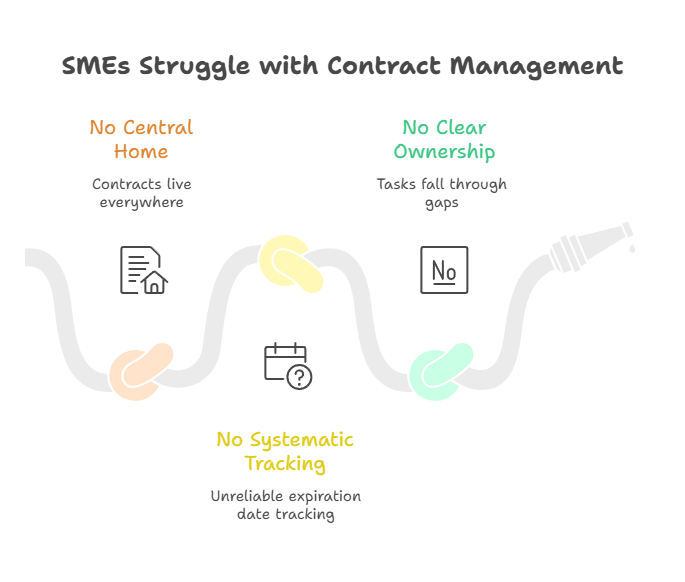
Table of Contents

Share this article
Subscribe
Thank you! Your submission has been received!
Oops! Something went wrong while submitting the form.

How SMEs Can Improve Contract Lifecycle Management Without a Legal Team

The email arrived on a Tuesday morning with an invoice attached. A SaaS tool the company had been using for two years had auto-renewed — at a rate 35% higher than the previous term, based on a pricing adjustment buried in the contract's renewal clause. The CFO remembered signing the original agreement. Nobody had flagged the auto-renewal window. Nobody had reviewed the updated pricing terms. The window to negotiate or opt out had closed 45 days earlier, unnoticed.

This is not a story about a sophisticated corporation with a complex vendor portfolio. This is the kind of thing that happens to small and mid-sized businesses (SMEs) every day — companies that have genuine contracts to manage, real obligations to track, and very little dedicated infrastructure for doing it. The result is not just a frustrating invoice. Over time, it is a measurable drain on revenue, negotiating leverage, and operational continuity.

This guide is for the SME leader who knows they need better contract lifecycle management but assumes it requires a legal department or expensive enterprise software. It does not. It requires a clear process, the right tools scaled appropriately, and a consistent habit of staying ahead of your contract timeline.

What Contract Lifecycle Management Actually Means for SMEs

Contract lifecycle management (CLM) is the practice of managing every stage of a contract's existence — from the initial negotiation and drafting through execution, ongoing monitoring, renewal, and eventual termination or expiration. For large enterprises, CLM often involves dedicated software platforms, legal operations teams, and complex workflows. For SMEs, it means something far more practical: knowing what contracts you have, what they say, when they expire, and what you need to do about them before you run out of time.

The World Commerce and Contracting Association reports that poor contract management costs businesses up to 9% of annual revenue. For an SME generating $2 million annually, that is $180,000 in avoidable losses — through missed renewals, unfavorable auto-renewals, contract value leakage, and failed obligations. These numbers accumulate quietly, across dozens of vendor agreements, service contracts, leases, and customer agreements, each expiring or renewing on its own schedule.

Why SMEs Struggle With Contract Lifecycle Management

No Central Home for Contracts

The most common CLM failure in small businesses is also the most fundamental: contracts live everywhere. The original signed agreement is in someone's email. The PDF version is in a shared drive folder that three people have access to. The renewal details are in a follow-up email that nobody can find. According to research cited by procurement professionals, 71% of companies cannot find 10% or more of their contracts at any given time. For SMEs without dedicated contract management infrastructure, that number is likely higher.

When you cannot find your contracts, you cannot manage them. You discover terms only when they become problems. You learn about auto-renewals after they have already fired. You find out about liability clauses during disputes. The lack of a central repository is not just an organizational inconvenience — it is a structural risk.

No Systematic Tracking of Expiration Dates

Even organizations that store contracts in one place often do not have a reliable system for tracking what is due when. Research from the contract management sector shows that approximately 33% of businesses manually track contract expiration dates, and 9% do not track them at all. Manual tracking might mean a shared spreadsheet, a calendar event set by whoever signed the deal, or simply a mental note made by the person who manages the vendor relationship.

All of these approaches have the same fatal flaw: they depend on one person remembering to act at the right time. When that person is busy, on leave, or has moved on, the tracking stops working. The contract keeps running. The expiration date keeps approaching. And unless someone catches it, the auto-renewal fires — or the contract simply lapses, leaving both parties in legal limbo.

No Clear Ownership or Process

In larger organizations, contracts have owners — a procurement manager who is accountable for vendor agreements, a legal operations team that manages compliance obligations, a finance lead who tracks licensing costs. In most SMEs, ownership is informal. The person who signed the deal is assumed to be responsible for managing it. When roles change, that assumption breaks down.

Without defined ownership, contract management tasks fall through the gaps between departments. Sales might sign customer agreements that operations depends on. IT might manage software licenses that finance is supposed to budget for. HR might handle vendor agreements that compliance needs to track. Nobody is coordinating the full picture.

The Five Stages of Contract Lifecycle Management for SMEs

Effective CLM does not require enterprise software or a legal team. It requires understanding the lifecycle and building a process for each stage.

Stage 1: Creation and Negotiation

The contract lifecycle begins before anything is signed. During creation, the most important CLM habits involve standardizing your contract templates, capturing key terms consistently, and ensuring that critical dates — start date, expiration date, auto-renewal window, notice period for termination — are always explicitly stated and easy to find.

For SMEs that primarily receive contracts rather than draft them (as a vendor or service provider), the negotiation phase is the moment to push for favorable terms on auto-renewal clauses, notice periods, and price escalation caps. Once a contract is signed, these terms are fixed. Trying to renegotiate after the fact, or after the auto-renewal has already fired, is an uphill battle.

Using standardized contract templates for recurring agreement types — vendor agreements, service contracts, non-disclosure agreements — reduces the risk of inconsistent terms and ensures that key tracking data is captured in a predictable location every time. According to Juro's guidance on contract management for small businesses, standardization is one of the highest-leverage CLM improvements an SME can make because it reduces both legal risk and administrative burden simultaneously.

Stage 2: Execution and Storage

Once a contract is signed, two things need to happen immediately: it needs to be stored in a designated location, and key data needs to be extracted and entered into whatever tracking system you use. These two steps are often skipped or deferred, which is where CLM problems originate.

Your contract storage system does not need to be complex. A well-organized shared drive with consistent naming conventions can work for small volumes. The important thing is that it is consistent, accessible to everyone who needs it, and has a clear structure that makes documents findable. A contract that exists but cannot be found in time to act on it is nearly as problematic as a contract that does not exist at all.

For the tracking data, at minimum you need: contract name, counterparty, start date, expiration date, auto-renewal window (if applicable), notice period for termination, primary owner, and annual value. This is the information that will drive your reminder schedule and renewal decisions.

Stage 3: Active Monitoring and Reminders

This is where most SMEs' CLM processes break down most visibly — not because they do not intend to monitor their contracts, but because they have no reliable mechanism for doing it. The auto-renewal trap is particularly common. Research shows that contracts that auto-renew at unfavorable rates can cost businesses tens or hundreds of thousands of dollars over a multi-year period. A healthcare network's contract reportedly auto-renewed at a rate roughly 40% higher than budgeted, costing an additional $350,000 over the contract period — because nobody flagged the notice window.

Effective monitoring requires reminders that go out early enough to act — not just to note. For most contracts, the decision-making process requires time: evaluating alternatives, gathering quotes, reviewing performance, consulting stakeholders. A reminder at 30 days rarely provides enough lead time for a substantive evaluation. Most contract management professionals recommend starting the renewal review at 90 to 120 days out for significant agreements.

Automated reminder tools eliminate the dependency on someone remembering to check a spreadsheet. When a contract enters your tracking system with a defined expiration date, the reminders go out automatically at the intervals you configure — regardless of what else is happening in the business.

Stage 4: Renewal and Renegotiation

The renewal stage is where proactive tracking pays its most visible dividend. Organizations that begin the renewal process with adequate lead time can evaluate whether the current agreement still meets their needs, whether the pricing reflects current market rates, whether alternative vendors should be considered, and whether the contract terms should be updated to reflect changes in the relationship.

Organizations that begin this process with 10 days until expiration make none of these evaluations. They renew because they have no choice, at whatever terms are in place, because the operational disruption of allowing a critical agreement to lapse is worse than the cost of an unfavorable renewal. This is the position that poor CLM puts SMEs in — and it costs real money.

Good renewal management also means distinguishing between contracts that should be renewed, contracts that should be renegotiated, and contracts that should be terminated. Not every auto-renewal is a failure of management. But every auto-renewal that happens without a deliberate decision to renew is a missed opportunity to exercise control over your cost base and vendor relationships.

Stage 5: Expiration and Termination

Contracts end in one of three ways: they are renewed, they expire according to their terms, or they are terminated early by one or both parties. Effective CLM means managing all three outcomes intentionally. Expired contracts that both parties continue to perform under create what legal professionals call a "holdover" or implied arrangement — a legally ambiguous situation where the enforceability of specific terms becomes murky and the organization loses the explicit protections the contract was designed to provide.

For contracts that are intentionally not renewed, proper termination procedures must be followed: sending notice within the required timeframe, documenting the termination in writing, and transitioning any ongoing obligations to alternative arrangements. Failing to follow these steps can trigger automatic renewal or breach claims, depending on the contract terms.

Practical CLM Tools for SMEs

What You Actually Need

The good news for SMEs is that effective contract lifecycle management does not require expensive enterprise CLM platforms. The core requirements are: a reliable storage system for contract documents, a tracking mechanism for key dates and obligations, and a reminder system that alerts the right people at the right times. These three capabilities can be achieved with a combination of tools scaled to your organization's size and complexity.

Expiration and Renewal Tracking

For SMEs that manage vendor agreements, insurance certificates, licenses, service contracts, and other time-sensitive documents, a dedicated expiration tracking platform handles the monitoring and reminder function automatically. Rather than manually managing a spreadsheet of renewal dates and calendar reminders, you configure each contract in the system with its expiration date, renewal window, and notification schedule. The platform sends reminders to the appropriate people at the configured intervals and escalates if action is not taken.

Platforms like Expiration Reminder are purpose-built for exactly this use case — organizations that need reliable, proactive tracking across multiple contract and document types without the complexity or cost of enterprise CLM suites. For SMEs managing dozens to hundreds of agreements, this kind of focused tool provides the core capability that makes CLM systems actually work in practice.

Contract Storage and Organization

For most SMEs, a well-organized shared drive (Google Drive, SharePoint, or similar) with consistent naming conventions and folder structure is a practical starting point for contract storage. The key is consistency: every contract goes into the system immediately upon execution, named according to a standard convention, and stored in a predictable location. The storage system only works if people trust that contracts are actually there when they need them.

Electronic Signatures

Electronic signature tools (DocuSign, Adobe Sign, and similar platforms) reduce the friction in contract execution and create automatic documentation of who signed, when, and from where. This audit trail has both legal and operational value. According to Malbek's CLM best practices guidance, adopting electronic signatures is one of the most accessible high-impact improvements SMEs can make to their contracting process.

The ROI of Better CLM for SMEs

The return on CLM investment for SMEs is tangible and often rapid. According to research by Procurement Tactics, the World Commerce and Contracting Association finds that poor contract management costs businesses up to 9% of annual revenue. The same research indicates that companies with mature contract management practices significantly outperform peers in both cost control and revenue retention from commercial agreements.

For an SME, the ROI calculation is not complex. If better CLM prevents two unfavorable auto-renewals per year (saving, say, $15,000 combined), reduces the staff time spent managing contract deadlines manually (saving 5 hours per week at $45 per hour), and avoids one compliance gap that might have produced a fine or penalty ($10,000), the total annual benefit easily exceeds $50,000. Against this, the cost of a practical CLM toolkit — a contract storage system and an expiration tracking platform — is a fraction of that figure.

Frequently Asked Questions

What is the most important first step in improving contract lifecycle management for an SME?

The most important first step is a contract audit: finding every active agreement your organization holds and creating a master list with key dates and ownership information. You cannot manage what you cannot see. Many SMEs discover contracts they had forgotten about, auto-renewals that have already fired unexpectedly, and agreements where the responsible person has long since left the organization. The audit reveals the actual state of your CLM and makes everything else possible.

How do auto-renewal clauses work, and how can SMEs protect themselves?

Auto-renewal clauses automatically extend a contract for an additional term — often at the same rate, or sometimes at an increased rate — if neither party provides notice of termination within a defined window before the expiration date. That window might be 30, 60, or 90 days before expiration. If you miss the window, you are committed to another full term. SMEs can protect themselves by: (1) reading and flagging all auto-renewal clauses before signing, (2) negotiating shorter notice windows or removing auto-renewal provisions where possible, and (3) setting reminders well before the notice window closes so there is time to make a deliberate decision about renewing.

Do SMEs need specialized CLM software, or will a spreadsheet work?

For organizations with fewer than 20 to 30 contracts, a well-maintained spreadsheet can be a workable short-term solution. Beyond that volume — or in any organization where contracts are managed across multiple departments or where auto-renewal risk is significant — a dedicated tracking and reminder system is worth serious consideration. The core limitation of spreadsheets is that they require someone to look at them proactively. When that does not happen consistently, the system fails. Dedicated tools send reminders automatically, which is the difference that matters most.

What is the difference between contract management and contract lifecycle management?

Contract management typically refers to the administrative management of existing agreements — tracking obligations, managing renewals, and ensuring compliance with terms. Contract lifecycle management is broader: it covers the full arc of a contract from initial drafting and negotiation through execution, active management, renewal, and eventual termination. For SMEs, focusing on the full lifecycle (rather than just managing existing contracts) means building better contracts at the outset, which reduces problems downstream.

How should SMEs handle contracts when an employee who managed them leaves?

This is one of the most common CLM failure points for SMEs, and the solution is process, not heroics. Before the employee leaves, conduct a structured knowledge transfer: identify every contract they managed, confirm that copies exist in the central repository, verify that key dates and terms are captured in the tracking system, and formally reassign ownership to a new role or person. If the tracking system is role-based rather than person-based, the reminders will continue to function even as individuals change — which is why configuring notifications to roles (not just named individuals) is a critical setup best practice.

What contracts should always be in a CLM system for an SME?

At minimum: vendor and supplier agreements, software and SaaS subscriptions, commercial insurance policies, commercial leases and facility agreements, customer contracts with recurring obligations, employment agreements with defined terms, professional services agreements, and any regulatory licenses or permits with defined expiration dates. These are the contract categories where a missed renewal or lapse is most likely to produce immediate operational or financial consequences.

Ready to get your contracts under control without hiring a legal team? Start a free trial with Expiration Reminder and see how automated tracking keeps your renewal deadlines visible and actionable.

PS: The contracts that hurt SMEs most are not the ones they negotiated poorly — they are the ones that auto-renewed without anyone noticing, or lapsed because the reminder never fired. Automated tracking costs less than a single missed renewal in almost every case. The math is straightforward; the decision is too.

Share this article
Subscribe
Thank you! Your submission has been received!
Oops! Something went wrong while submitting the form.

How SMEs Can Improve Contract Lifecycle Management Without a Legal Team

Table of Contents

Share this article

How SMEs Can Improve Contract Lifecycle Management Without a Legal Team

The email arrived on a Tuesday morning with an invoice attached. A SaaS tool the company had been using for two years had auto-renewed — at a rate 35% higher than the previous term, based on a pricing adjustment buried in the contract's renewal clause. The CFO remembered signing the original agreement. Nobody had flagged the auto-renewal window. Nobody had reviewed the updated pricing terms. The window to negotiate or opt out had closed 45 days earlier, unnoticed.

This is not a story about a sophisticated corporation with a complex vendor portfolio. This is the kind of thing that happens to small and mid-sized businesses (SMEs) every day — companies that have genuine contracts to manage, real obligations to track, and very little dedicated infrastructure for doing it. The result is not just a frustrating invoice. Over time, it is a measurable drain on revenue, negotiating leverage, and operational continuity.

This guide is for the SME leader who knows they need better contract lifecycle management but assumes it requires a legal department or expensive enterprise software. It does not. It requires a clear process, the right tools scaled appropriately, and a consistent habit of staying ahead of your contract timeline.

What Contract Lifecycle Management Actually Means for SMEs

Contract lifecycle management (CLM) is the practice of managing every stage of a contract's existence — from the initial negotiation and drafting through execution, ongoing monitoring, renewal, and eventual termination or expiration. For large enterprises, CLM often involves dedicated software platforms, legal operations teams, and complex workflows. For SMEs, it means something far more practical: knowing what contracts you have, what they say, when they expire, and what you need to do about them before you run out of time.

The World Commerce and Contracting Association reports that poor contract management costs businesses up to 9% of annual revenue. For an SME generating $2 million annually, that is $180,000 in avoidable losses — through missed renewals, unfavorable auto-renewals, contract value leakage, and failed obligations. These numbers accumulate quietly, across dozens of vendor agreements, service contracts, leases, and customer agreements, each expiring or renewing on its own schedule.

Why SMEs Struggle With Contract Lifecycle Management

No Central Home for Contracts

The most common CLM failure in small businesses is also the most fundamental: contracts live everywhere. The original signed agreement is in someone's email. The PDF version is in a shared drive folder that three people have access to. The renewal details are in a follow-up email that nobody can find. According to research cited by procurement professionals, 71% of companies cannot find 10% or more of their contracts at any given time. For SMEs without dedicated contract management infrastructure, that number is likely higher.

When you cannot find your contracts, you cannot manage them. You discover terms only when they become problems. You learn about auto-renewals after they have already fired. You find out about liability clauses during disputes. The lack of a central repository is not just an organizational inconvenience — it is a structural risk.

No Systematic Tracking of Expiration Dates

Even organizations that store contracts in one place often do not have a reliable system for tracking what is due when. Research from the contract management sector shows that approximately 33% of businesses manually track contract expiration dates, and 9% do not track them at all. Manual tracking might mean a shared spreadsheet, a calendar event set by whoever signed the deal, or simply a mental note made by the person who manages the vendor relationship.

All of these approaches have the same fatal flaw: they depend on one person remembering to act at the right time. When that person is busy, on leave, or has moved on, the tracking stops working. The contract keeps running. The expiration date keeps approaching. And unless someone catches it, the auto-renewal fires — or the contract simply lapses, leaving both parties in legal limbo.

No Clear Ownership or Process

In larger organizations, contracts have owners — a procurement manager who is accountable for vendor agreements, a legal operations team that manages compliance obligations, a finance lead who tracks licensing costs. In most SMEs, ownership is informal. The person who signed the deal is assumed to be responsible for managing it. When roles change, that assumption breaks down.

Without defined ownership, contract management tasks fall through the gaps between departments. Sales might sign customer agreements that operations depends on. IT might manage software licenses that finance is supposed to budget for. HR might handle vendor agreements that compliance needs to track. Nobody is coordinating the full picture.

The Five Stages of Contract Lifecycle Management for SMEs

Effective CLM does not require enterprise software or a legal team. It requires understanding the lifecycle and building a process for each stage.

Stage 1: Creation and Negotiation

The contract lifecycle begins before anything is signed. During creation, the most important CLM habits involve standardizing your contract templates, capturing key terms consistently, and ensuring that critical dates — start date, expiration date, auto-renewal window, notice period for termination — are always explicitly stated and easy to find.

For SMEs that primarily receive contracts rather than draft them (as a vendor or service provider), the negotiation phase is the moment to push for favorable terms on auto-renewal clauses, notice periods, and price escalation caps. Once a contract is signed, these terms are fixed. Trying to renegotiate after the fact, or after the auto-renewal has already fired, is an uphill battle.

Using standardized contract templates for recurring agreement types — vendor agreements, service contracts, non-disclosure agreements — reduces the risk of inconsistent terms and ensures that key tracking data is captured in a predictable location every time. According to Juro's guidance on contract management for small businesses, standardization is one of the highest-leverage CLM improvements an SME can make because it reduces both legal risk and administrative burden simultaneously.

Stage 2: Execution and Storage

Once a contract is signed, two things need to happen immediately: it needs to be stored in a designated location, and key data needs to be extracted and entered into whatever tracking system you use. These two steps are often skipped or deferred, which is where CLM problems originate.

Your contract storage system does not need to be complex. A well-organized shared drive with consistent naming conventions can work for small volumes. The important thing is that it is consistent, accessible to everyone who needs it, and has a clear structure that makes documents findable. A contract that exists but cannot be found in time to act on it is nearly as problematic as a contract that does not exist at all.

For the tracking data, at minimum you need: contract name, counterparty, start date, expiration date, auto-renewal window (if applicable), notice period for termination, primary owner, and annual value. This is the information that will drive your reminder schedule and renewal decisions.

Stage 3: Active Monitoring and Reminders

This is where most SMEs' CLM processes break down most visibly — not because they do not intend to monitor their contracts, but because they have no reliable mechanism for doing it. The auto-renewal trap is particularly common. Research shows that contracts that auto-renew at unfavorable rates can cost businesses tens or hundreds of thousands of dollars over a multi-year period. A healthcare network's contract reportedly auto-renewed at a rate roughly 40% higher than budgeted, costing an additional $350,000 over the contract period — because nobody flagged the notice window.

Effective monitoring requires reminders that go out early enough to act — not just to note. For most contracts, the decision-making process requires time: evaluating alternatives, gathering quotes, reviewing performance, consulting stakeholders. A reminder at 30 days rarely provides enough lead time for a substantive evaluation. Most contract management professionals recommend starting the renewal review at 90 to 120 days out for significant agreements.

Automated reminder tools eliminate the dependency on someone remembering to check a spreadsheet. When a contract enters your tracking system with a defined expiration date, the reminders go out automatically at the intervals you configure — regardless of what else is happening in the business.

Stage 4: Renewal and Renegotiation

The renewal stage is where proactive tracking pays its most visible dividend. Organizations that begin the renewal process with adequate lead time can evaluate whether the current agreement still meets their needs, whether the pricing reflects current market rates, whether alternative vendors should be considered, and whether the contract terms should be updated to reflect changes in the relationship.

Organizations that begin this process with 10 days until expiration make none of these evaluations. They renew because they have no choice, at whatever terms are in place, because the operational disruption of allowing a critical agreement to lapse is worse than the cost of an unfavorable renewal. This is the position that poor CLM puts SMEs in — and it costs real money.

Good renewal management also means distinguishing between contracts that should be renewed, contracts that should be renegotiated, and contracts that should be terminated. Not every auto-renewal is a failure of management. But every auto-renewal that happens without a deliberate decision to renew is a missed opportunity to exercise control over your cost base and vendor relationships.

Stage 5: Expiration and Termination

Contracts end in one of three ways: they are renewed, they expire according to their terms, or they are terminated early by one or both parties. Effective CLM means managing all three outcomes intentionally. Expired contracts that both parties continue to perform under create what legal professionals call a "holdover" or implied arrangement — a legally ambiguous situation where the enforceability of specific terms becomes murky and the organization loses the explicit protections the contract was designed to provide.

For contracts that are intentionally not renewed, proper termination procedures must be followed: sending notice within the required timeframe, documenting the termination in writing, and transitioning any ongoing obligations to alternative arrangements. Failing to follow these steps can trigger automatic renewal or breach claims, depending on the contract terms.

Practical CLM Tools for SMEs

What You Actually Need

The good news for SMEs is that effective contract lifecycle management does not require expensive enterprise CLM platforms. The core requirements are: a reliable storage system for contract documents, a tracking mechanism for key dates and obligations, and a reminder system that alerts the right people at the right times. These three capabilities can be achieved with a combination of tools scaled to your organization's size and complexity.

Expiration and Renewal Tracking

For SMEs that manage vendor agreements, insurance certificates, licenses, service contracts, and other time-sensitive documents, a dedicated expiration tracking platform handles the monitoring and reminder function automatically. Rather than manually managing a spreadsheet of renewal dates and calendar reminders, you configure each contract in the system with its expiration date, renewal window, and notification schedule. The platform sends reminders to the appropriate people at the configured intervals and escalates if action is not taken.

Platforms like Expiration Reminder are purpose-built for exactly this use case — organizations that need reliable, proactive tracking across multiple contract and document types without the complexity or cost of enterprise CLM suites. For SMEs managing dozens to hundreds of agreements, this kind of focused tool provides the core capability that makes CLM systems actually work in practice.

Contract Storage and Organization

For most SMEs, a well-organized shared drive (Google Drive, SharePoint, or similar) with consistent naming conventions and folder structure is a practical starting point for contract storage. The key is consistency: every contract goes into the system immediately upon execution, named according to a standard convention, and stored in a predictable location. The storage system only works if people trust that contracts are actually there when they need them.

Electronic Signatures

Electronic signature tools (DocuSign, Adobe Sign, and similar platforms) reduce the friction in contract execution and create automatic documentation of who signed, when, and from where. This audit trail has both legal and operational value. According to Malbek's CLM best practices guidance, adopting electronic signatures is one of the most accessible high-impact improvements SMEs can make to their contracting process.

The ROI of Better CLM for SMEs

The return on CLM investment for SMEs is tangible and often rapid. According to research by Procurement Tactics, the World Commerce and Contracting Association finds that poor contract management costs businesses up to 9% of annual revenue. The same research indicates that companies with mature contract management practices significantly outperform peers in both cost control and revenue retention from commercial agreements.

For an SME, the ROI calculation is not complex. If better CLM prevents two unfavorable auto-renewals per year (saving, say, $15,000 combined), reduces the staff time spent managing contract deadlines manually (saving 5 hours per week at $45 per hour), and avoids one compliance gap that might have produced a fine or penalty ($10,000), the total annual benefit easily exceeds $50,000. Against this, the cost of a practical CLM toolkit — a contract storage system and an expiration tracking platform — is a fraction of that figure.

Frequently Asked Questions

What is the most important first step in improving contract lifecycle management for an SME?

The most important first step is a contract audit: finding every active agreement your organization holds and creating a master list with key dates and ownership information. You cannot manage what you cannot see. Many SMEs discover contracts they had forgotten about, auto-renewals that have already fired unexpectedly, and agreements where the responsible person has long since left the organization. The audit reveals the actual state of your CLM and makes everything else possible.

How do auto-renewal clauses work, and how can SMEs protect themselves?

Auto-renewal clauses automatically extend a contract for an additional term — often at the same rate, or sometimes at an increased rate — if neither party provides notice of termination within a defined window before the expiration date. That window might be 30, 60, or 90 days before expiration. If you miss the window, you are committed to another full term. SMEs can protect themselves by: (1) reading and flagging all auto-renewal clauses before signing, (2) negotiating shorter notice windows or removing auto-renewal provisions where possible, and (3) setting reminders well before the notice window closes so there is time to make a deliberate decision about renewing.

Do SMEs need specialized CLM software, or will a spreadsheet work?

For organizations with fewer than 20 to 30 contracts, a well-maintained spreadsheet can be a workable short-term solution. Beyond that volume — or in any organization where contracts are managed across multiple departments or where auto-renewal risk is significant — a dedicated tracking and reminder system is worth serious consideration. The core limitation of spreadsheets is that they require someone to look at them proactively. When that does not happen consistently, the system fails. Dedicated tools send reminders automatically, which is the difference that matters most.

What is the difference between contract management and contract lifecycle management?

Contract management typically refers to the administrative management of existing agreements — tracking obligations, managing renewals, and ensuring compliance with terms. Contract lifecycle management is broader: it covers the full arc of a contract from initial drafting and negotiation through execution, active management, renewal, and eventual termination. For SMEs, focusing on the full lifecycle (rather than just managing existing contracts) means building better contracts at the outset, which reduces problems downstream.

How should SMEs handle contracts when an employee who managed them leaves?

This is one of the most common CLM failure points for SMEs, and the solution is process, not heroics. Before the employee leaves, conduct a structured knowledge transfer: identify every contract they managed, confirm that copies exist in the central repository, verify that key dates and terms are captured in the tracking system, and formally reassign ownership to a new role or person. If the tracking system is role-based rather than person-based, the reminders will continue to function even as individuals change — which is why configuring notifications to roles (not just named individuals) is a critical setup best practice.

What contracts should always be in a CLM system for an SME?

At minimum: vendor and supplier agreements, software and SaaS subscriptions, commercial insurance policies, commercial leases and facility agreements, customer contracts with recurring obligations, employment agreements with defined terms, professional services agreements, and any regulatory licenses or permits with defined expiration dates. These are the contract categories where a missed renewal or lapse is most likely to produce immediate operational or financial consequences.

Ready to get your contracts under control without hiring a legal team? Start a free trial with Expiration Reminder and see how automated tracking keeps your renewal deadlines visible and actionable.

PS: The contracts that hurt SMEs most are not the ones they negotiated poorly — they are the ones that auto-renewed without anyone noticing, or lapsed because the reminder never fired. Automated tracking costs less than a single missed renewal in almost every case. The math is straightforward; the decision is too.

Excel in your subscriptions management
You can eliminate challenges if you have a strong organizational development blueprint.
Read time:
This is some text inside of a div block.
min

Heading

Table of Contents

Share this article
Subscribe
Thank you! Your submission has been received!
Oops! Something went wrong while submitting the form.

What’s a Rich Text element?

What’s a Rich Text element?

The rich text element allows you to create and format headings, paragraphs, blockquotes, images, and video all in one place instead of having to add and format them individually. Just double-click and easily create content.

The rich text element allows you to create and format headings, paragraphs, blockquotes, images, and video all in one place instead of having to add and format them individually. Just double-click and easily create content.

Static and dynamic content editing

Static and dynamic content editing

A rich text element can be used with static or dynamic content. For static content, just drop it into any page and begin editing. For dynamic content, add a rich text field to any collection and then connect a rich text element to that field in the settings panel. Voila!

A rich text element can be used with static or dynamic content. For static content, just drop it into any page and begin editing. For dynamic content, add a rich text field to any collection and then connect a rich text element to that field in the settings panel. Voila!

How to customize formatting for each rich text

How to customize formatting for each rich text

Headings, paragraphs, blockquotes, figures, images, and figure captions can all be styled after a class is added to the rich text element using the "When inside of" nested selector system.

Headings, paragraphs, blockquotes, figures, images, and figure captions can all be styled after a class is added to the rich text element using the "When inside of" nested selector system.
Share this article
Subscribe
Thank you! Your submission has been received!
Oops! Something went wrong while submitting the form.

Keep on reading