Introduction
If your team operates anywhere with people, equipment, vehicles, chemicals, or moving parts, you have hazards — and the risk assessment is the document that proves you found them, ranked them, and did something about them. Auditors look for it. Insurers ask for it. Workers depend on the controls it produces.
This article explains what a workplace risk assessment is, who must perform one, what the document needs to contain, how often it should be reviewed, and what happens when assessments fall out of date. You will also see the most practical way to track review dates across multiple sites, departments, and changing operations without losing track.
For most organizations, the assessment itself is well-understood. The failure mode is almost always the review — an assessment written in 2022 that nobody has touched since, even though equipment, staff, and processes have all changed. Keeping review dates current is the easy part, once the right system is in place.
What Is a Risk Assessment?
A risk assessment is a systematic, documented process for identifying workplace hazards, evaluating the likelihood and severity of harm, and selecting controls to reduce risk to an acceptable level. It is the foundation of most workplace safety programs and is required by regulators around the world.
In the United States, OSHA does not use the term "risk assessment" universally, but it requires hazard assessment for specific topics — personal protective equipment (29 CFR 1910.132), respiratory protection, lockout/tagout, confined spaces, process safety management, and many others. OSHA also requires certified written hazard assessments for PPE selection. In the EU, UK, Australia, and Canada, risk assessment is a general legal duty under workplace health-and-safety legislation.
A complete risk assessment typically covers:
- Scope — what activity, area, equipment, or job is being assessed.
- Hazard identification — the physical, chemical, biological, ergonomic, and psychosocial hazards present.
- Risk evaluation — likelihood × severity, often using a matrix to produce a risk score.
- Control measures — engineering controls, administrative controls, and PPE, ordered by the hierarchy of controls.
- Residual risk — the risk that remains after controls are in place.
- Assigned actions and owners — who does what by when.
- Review schedule — the next planned review date.
- Certification — the assessor, the date, and a signature or formal sign-off.
Validity is set by the organization, but typical review cycles are annual for general workplace assessments, more frequently for higher-risk activities (construction, confined space, hazardous chemicals), and immediately upon any significant change — new equipment, new process, incident, new regulation, or change in personnel.
Why Risk Assessments Matter for Your Organization
Risk assessments are the foundation of every credible safety program — and the absence of a current assessment is one of the first things an OSHA inspector or insurance carrier will flag.
From a regulatory standpoint, missing or outdated assessments are a common citation across general industry, construction, healthcare, and manufacturing. Many specific OSHA standards (PPE, respiratory protection, lockout/tagout) require documented hazard assessment as a condition of compliance, and an outdated assessment fails the requirement just as completely as no assessment at all.
Insurance carriers use the existence and quality of risk assessments as one input into workers' compensation experience modifications, general liability premiums, and broader coverage decisions. A documented program that catches new hazards as they appear and updates controls accordingly is one of the strongest signals a carrier can see.
Operationally, current assessments shape every other safety activity — training requirements, PPE selection, emergency response, incident investigation. When the assessment is stale, every program that depends on it drifts out of alignment with what is actually happening on the floor.
Common Scenarios for Tracking Risk Assessment Review Dates
Tracking review dates becomes a real workload as soon as an organization has more than a handful of assessments. Here are the contexts where the work matters most.
Multi-Site Manufacturing and Industrial Operations
A manufacturer with multiple plants typically has dozens of risk assessments per site — one per process, one per work area, additional assessments for specific high-risk activities. Plant safety leads need to review each assessment on a regular cycle and immediately when operations change. Without a tracker, the smaller and older assessments are the ones that slip.
Construction Companies and Contractors
Construction work is dynamic — sites open, close, and change shape weekly. Risk assessments must be specific to each project and updated as work progresses. Contractors managing multiple concurrent projects need a way to track per-project assessments alongside the underlying organization-level assessments.
Healthcare Facilities
Hospitals, clinics, and long-term care facilities maintain risk assessments for clinical hazards (sharps, bloodborne pathogens, infection control), physical hazards (lifting, slips, workplace violence), and operational hazards (laser safety, radiation, hazardous drugs). Accreditation surveyors review these as part of standard surveys.
Office and Hybrid Workplaces
The pandemic-era shift to hybrid work expanded the scope of office risk assessments to include ergonomics in remote settings, mental health, and emergency planning across distributed locations. Workplace experience and HR teams now track assessments that did not exist five years ago.
Schools, Universities, and Public Facilities
Schools and public facilities maintain assessments for classrooms, laboratories, athletic facilities, food service, transportation, and external contractors. Risk managers in education settings coordinate reviews across a complex set of stakeholders.
How Risk Assessments Benefit Your Company and Employees
A well-run risk assessment program produces three layers of value.
For the company, current assessments support regulatory compliance, reduce incident frequency and severity, lower insurance costs, and prepare the organization for audits. They also serve as legal evidence of due diligence when an incident does occur — a documented, recent assessment with implemented controls is a fundamentally different defense than an out-of-date one.
For employees, the assessment process surfaces hazards that workers themselves often know about but have not been able to formalize. When workers participate in assessment and see resulting controls implemented, engagement with broader safety programs improves measurably.
For customers, regulators, and the broader community, the assessment program demonstrates that the organization understands its hazards and is actively managing them — which translates into clean audits, qualified-supplier status, and continued operating authority.
How to Track Risk Assessment Review Dates
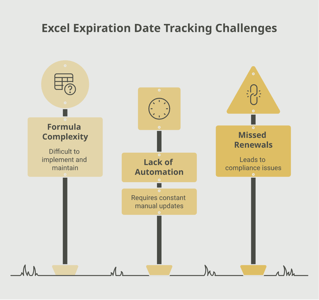
The most common tracking method is a single safety lead maintaining a master spreadsheet of all active assessments with their review dates. This works until the safety lead leaves, the spreadsheet becomes the only source of truth, and the next person inherits a file with unclear ownership.
A document management system or shared drive is a step up but does not actively flag overdue items, send reminders, or surface dependencies between assessments and other safety records.
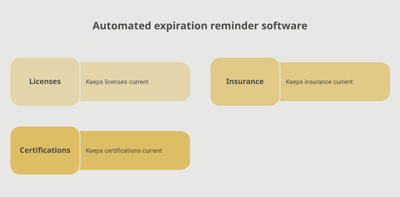
A dedicated tracking platform like Expiration Reminder stores each assessment with its scope, owner, last review date, review interval, and the actual document. Reminders fire automatically before the next review, overdue items appear on a dashboard, and the document is one click away when an auditor asks.
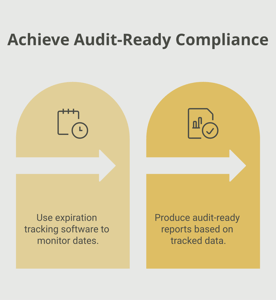
The features that matter most for risk assessment tracking include automated review reminders at configurable intervals, document storage so each assessment is attached to its tracking record, dashboard views by site, department, or risk level, audit-ready reports of all assessment status by date range, and the ability to log a new review (and reset the next due date) the moment it is complete.
The result is a program where assessments are reviewed on time, controls stay current, and the safety team can prove it.
Key Takeaways
- A risk assessment is a documented process for identifying workplace hazards, evaluating risk, and selecting controls.
- OSHA requires hazard assessment under many specific standards; EU, UK, Australia, and Canada impose it as a general workplace duty.
- Typical review cycles are annual for general assessments, more frequent for higher-risk activities, and immediately upon any significant change.
- Missing or outdated assessments are a frequent citation across industries and weaken legal defenses after an incident.
- A complete assessment includes scope, hazards, risk evaluation, controls, residual risk, actions, owners, review date, and certification.
- Manual tracking fails as the assessment portfolio grows; automated tracking with reminders and document storage is the reliable approach.
Frequently Asked Questions
How often should a risk assessment be reviewed?
Most organizations review general workplace assessments annually, higher-risk activity assessments quarterly or semi-annually, and any assessment immediately when there is a significant change in operations, equipment, personnel, or applicable regulation.
Who is responsible for completing a risk assessment?
The employer is responsible, typically delegating execution to a competent person — a safety manager, certified industrial hygienist, supervisor with appropriate training, or external consultant. Workers should be involved in the process because they often know the hazards best.
Does OSHA require a written risk assessment?
OSHA requires written hazard assessments under specific standards (PPE selection under 1910.132, respiratory protection, lockout/tagout, confined spaces, process safety management, and others). Many other standards expect documented hazard analysis even when not explicitly required.
What is the difference between a risk assessment and a job hazard analysis (JHA)?
A risk assessment is typically broader — covering an activity, area, or operation. A job hazard analysis is a specific type of risk assessment focused on the step-by-step hazards of a single job task. OSHA provides JHA templates.
What happens if my risk assessment is out of date?
An outdated assessment can trigger OSHA citations under specific standards, weaken legal defenses after an incident, raise insurance premiums, and — most importantly — leave workers exposed to hazards that current controls no longer address.
Should workers be involved in the risk assessment process?
Yes. Worker involvement improves the quality of hazard identification, increases engagement with resulting controls, and is explicitly recommended by OSHA. In some jurisdictions, worker consultation is legally required.
How do I document risk assessments effectively?
Use a consistent template covering scope, hazards, risk evaluation, controls, residual risk, actions and owners, the next review date, and the assessor's signature and date. Store assessments where they can be retrieved on demand.
Can software replace the assessment process?
Software supports the process — it cannot replace the judgment of a competent assessor walking the workplace and consulting workers. The most useful software handles tracking, reminders, document storage, and reporting, not the substantive assessment itself.
Conclusion
Risk assessments are the foundation of any credible workplace safety program. The substantive work — identifying hazards, evaluating risk, selecting controls — requires people who know the workplace and the hazards. The administrative work — keeping every assessment current, reviewed on schedule, and ready for audit — is the part where most programs stumble, and the part where software helps most.
If your assessments live in a single spreadsheet, on a shared drive nobody updates, or in the head of one safety lead, you already know how fragile that is. A purpose-built tracking platform like Expiration Reminder centralizes every assessment, sends reminders before each review date, stores the documents alongside the record, and produces audit-ready reports the moment anyone asks.
Identify the hazards, control them well, and let the system handle the review schedule.