Introduction
If your workforce lifts, lowers, carries, pushes, or pulls loads — warehouse, healthcare, hospitality, construction, manufacturing, retail, care, or any environment with physical work — manual handling training is the foundation of musculoskeletal injury prevention. Manual handling injuries are among the most common workplace injuries in nearly every industry, and training is the most consistent control.
This article explains what manual handling training is, the UK legal framework, the U.S. ergonomic context, the recommended annual refresher cadence, and the most practical way to track manual handling training across a workforce.
For most safety and EHS teams, delivering manual handling training is well understood. The hard part is the calendar — knowing whose training is current and aligning refresher courses with site-specific risk assessments.
What Is Manual Handling Training?
Manual handling training teaches workers safe techniques for moving loads — lifting, lowering, carrying, pushing, pulling, holding, and restraining. The training covers risk recognition, body mechanics, equipment use, team-lifting, and task-specific techniques.
In the UK, the Manual Handling Operations Regulations 1992 (MHOR) establish a three-step duty on employers:
1. Avoid hazardous manual handling where possible. 2. Assess risks when manual handling cannot be avoided. 3. Reduce identified risks to acceptable levels.
MHOR 1992 (amended 2002) places specific obligations on employers to provide training and to conduct risk assessments. The Care Quality Commission and HSE recommend annual manual handling refresher training to ensure techniques remain current.
In the United States, OSHA does not have a single comprehensive ergonomics or manual handling standard, but addresses musculoskeletal risks through the General Duty Clause and specific industry standards (healthcare ergonomics guidance, nursing-home guidance, others). NIOSH publishes the widely used Lifting Equation as a risk-assessment tool.
In Australia, Canada, the EU, and most developed economies, manual handling training is required under workplace health and safety legislation, with site-specific risk assessment and training expectations.
Typical refresher cadence:
- Healthcare and care settings — annual refresher is widely expected, often required by accreditation bodies and CQC guidance.
- General industry — refresher cadence is typically set by employer policy, often annual or every two years.
- High-risk operations — more frequent refresher training where risk assessments identify ongoing exposure.
Why Manual Handling Training Matters for Your Organization
Manual handling training currency protects against three concrete risks: musculoskeletal injuries, regulatory findings, and lost workdays.
From a safety standpoint, manual handling injuries account for a large share of workplace injuries across virtually every industry. Back injuries, sprains, and strains are common — and training is the primary preventive control.
From a regulatory standpoint, MHOR 1992 (UK) and equivalent legislation in other jurisdictions impose explicit duties on employers. Missing training records and unaddressed risk assessments are common findings.
From an operational standpoint, manual handling injuries drive lost workdays, workers' compensation costs, and productivity disruption. Training reduces both incident frequency and severity.
For organizations with substantial physical-work workforces, the manual handling training calendar is a foundational operational and risk-management control.
Common Scenarios for Tracking Manual Handling Training Dates
Healthcare and Care Settings
Hospitals, care homes, and home-care providers manage manual handling training for moving and assisting patients. Specific people-handling training (often Level 2) is required in addition to general manual handling.
Warehousing, Logistics, and Distribution
Warehouse workers handle goods throughout the shift. Manual handling training reduces back and shoulder injury rates and supports productivity.
Construction and Trades
Construction and trade workers handle building materials, tools, and equipment. Manual handling integrates with broader site-safety training.
Hospitality and Retail
Hotels, restaurants, and retail operations involve continuous manual handling — restocking, room setup, kitchen work, deliveries. Training is foundational.
Manufacturing and Assembly
Manufacturing and assembly operations require manual handling training for staff handling parts, sub-assemblies, and finished products. Specific equipment training (lift-assists, pallet jacks) often supplements general manual handling.
How Manual Handling Tracking Benefits Your Organization
A reliable tracking program produces measurable benefits.
For the company, current training records satisfy regulatory requirements, reduce musculoskeletal injury rates, lower workers' compensation costs, and support clean audit posture.
For safety, EHS, and HR teams, the training calendar becomes predictable. Refresher courses are scheduled with adequate lead time. Risk assessments are reviewed alongside training to keep both current.
For workers, predictable training reinforces safe techniques and reduces personal injury risk.
How to Track Manual Handling Training Expiration Dates
Learning management systems (LMS) track training completions. Many care-sector and warehouse-sector LMS platforms have specific manual handling modules.
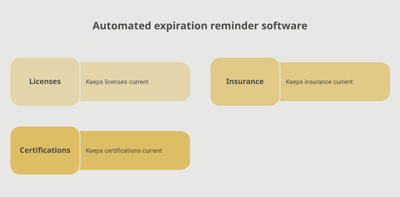
For organizations using a separate compliance tracker, a platform like Expiration Reminder stores each worker with their manual handling training, completion date, next-due date, and supporting documents. Reminders fire automatically before each refresher.
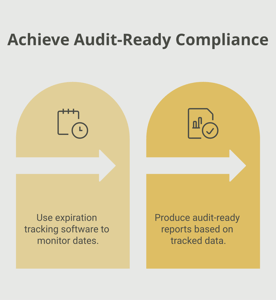
Key features include automated reminders at multiple intervals (90, 60, 30 days), document storage for training records and risk assessments, dashboard views by site, department, or expiry window, audit-ready reports for HSE, CQC, OSHA, or accreditation, and the ability to log new training events in one step.
Key Takeaways
- Manual handling training teaches workers safe techniques for lifting, lowering, carrying, pushing, and pulling loads.
- UK Manual Handling Operations Regulations 1992 (MHOR) establish a three-step duty: avoid, assess, reduce.
- The U.S. addresses manual handling through OSHA's General Duty Clause and industry-specific guidance (no comprehensive ergonomics standard).
- Healthcare settings widely expect annual manual handling refresher training; general industry varies.
- Manual handling injuries are among the most common workplace injuries across industries.
- Automated tracking with reminders is the reliable approach for any non-trivial workforce.
Frequently Asked Questions
How often is manual handling training required?
It depends on the jurisdiction and industry. UK healthcare typically expects annual refresher training; general UK industry cadence is set by employer policy. The U.S. does not have a federal manual handling training mandate.
What does the UK MHOR 1992 require?
Employers must avoid hazardous manual handling where possible, assess risks where it cannot be avoided, reduce identified risks to acceptable levels, and provide training and information to workers.
Is manual handling training the same as ergonomics training?
There is significant overlap. Manual handling focuses specifically on moving loads. Ergonomics is broader, covering workplace design, posture, repetitive motion, and other musculoskeletal risk factors.
What is people-handling training?
A subset of manual handling focused on moving and assisting patients, residents, or other people. Common in healthcare, care homes, and dental settings — usually delivered as Level 2 training in the UK.
How long should manual handling training records be kept?
UK employers typically retain training records for the duration of employment plus several years. U.S. employers follow similar practice. Specific retention is set by jurisdiction and employer policy.
What is the NIOSH Lifting Equation?
A U.S. National Institute for Occupational Safety and Health risk-assessment formula that calculates a Recommended Weight Limit (RWL) for lifting tasks based on horizontal location, vertical distance, asymmetry, frequency, duration, and coupling.
Can manual handling training be delivered online?
Theory-based training can be delivered online effectively. Practical training (especially people-handling) typically requires in-person practice with appropriate supervision and feedback.
How do organizations track manual handling training?
Combinations of LMS, training-management systems, and dedicated tracking platforms. The system that actively reminds before each refresher is the one that prevents most lapses.
Conclusion
Manual handling training is one of the most consistent controls between physical work and workplace injury. The substantive work — delivering effective training, conducting site-specific risk assessments, applying technique daily — sits with safety, EHS, and frontline supervisors. The administrative work — knowing every worker's training due date and producing the records on demand — is where most programs need help.
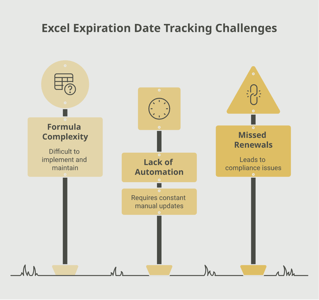
If your team tracks manual handling training through LMS or spreadsheets, you already know how easy it is for one worker's annual training to slip past. A purpose-built tracking platform like Expiration Reminder centralizes every training record, sends reminders before each due date, stores the supporting documents, and produces audit-ready reports the moment anyone asks.
Train the workforce, reduce the injuries, and let the system handle the calendar.