Fire Extinguisher Inspection
Introduction
If you have ever walked past a fire extinguisher in a hallway and wondered when it was last checked, you are already thinking like a safety manager. Those small red cylinders look unchanged from year to year, but the law and your insurance carrier expect them to be inspected on a strict schedule — monthly, annually, and on multi-year intervals — for the lifetime of the unit.
This guide explains what a fire extinguisher inspection is, why it is required, who must do it, and what happens when inspections lapse. You will also learn the most practical way to track every inspection date across your buildings without juggling spreadsheets or hoping someone remembers to check.
For most organizations, missing a single inspection is not just paperwork drama. It can trigger fines, void insurance coverage, and — in the worst case — leave staff with a non-functional extinguisher during a fire. The good news: tracking inspection dates is the easiest part of the entire compliance picture, once you have the right system in place.
What Is a Fire Extinguisher Inspection?
A fire extinguisher inspection is a structured check of a portable fire extinguisher to confirm it is in the correct location, accessible, charged, undamaged, and ready to operate. Inspections fall into three tiers under NFPA 10, the Standard for Portable Fire Extinguishers, and are enforced in workplaces by OSHA standard 1910.157.
The three tiers are:
- Monthly visual inspections — a quick check (under a minute per unit) confirming the extinguisher is in its designated location, unobstructed, with the pressure gauge in the green zone, tamper seal intact, instructions visible, and no physical damage or nozzle blockage. Trained facility staff may perform these checks; no certification is required.
- Annual maintenance inspections — a detailed examination of internal and external components performed by a trained, qualified technician. The technician verifies seals, mechanisms, hoses, the extinguishing agent, and overall condition, then attaches a service tag.
- Multi-year servicing — dry chemical extinguishers must be emptied and internally examined every six years, and most cylinders must undergo hydrostatic pressure testing every five or twelve years depending on type.
NFPA 10 is published by the National Fire Protection Association and is adopted (in whole or in part) by every U.S. state, most municipal fire codes, and many international jurisdictions. OSHA enforces inspection requirements in workplaces under federal authority.
The validity period is built into the schedule: each visual inspection is valid for 30 days, each annual service is valid for 12 months, and hydrostatic testing keeps the cylinder serviceable for either 5 or 12 years depending on the agent and shell type.
Why Fire Extinguisher Inspections Matter for Your Organization
Inspections are not paperwork for its own sake. They directly affect compliance posture, insurance, audit readiness, and worker safety.
From a compliance standpoint, OSHA explicitly assigns inspection responsibility to the employer. Failure to perform monthly visual inspections or annual maintenance is one of the most cited issues during fire-safety audits and can result in citations and fines. Insurance carriers routinely require proof of current inspection tags to validate coverage, and a lapsed tag is grounds to deny a claim after a fire.
The operational impact is equally serious. An extinguisher that has lost pressure, been damaged, or had its agent settle into a hard block will not discharge correctly in an emergency. Monthly visual checks are designed to catch all three problems before they matter.
Audit readiness becomes a non-event when records are clean. Inspectors arrive, scan the tags, see current dates, and move on. When tags are missing, illegible, or expired, the same inspectors open notebooks and start asking questions you do not want to answer in the middle of a workday.
Common Scenarios for Tracking Fire Extinguisher Inspection Expiration Dates
Tracking inspection dates touches almost every type of facility. Here are the most common contexts where teams need a reliable system.
Multi-Building Facility Management
Property and facility managers responsible for office parks, warehouses, retail centers, or campuses often manage hundreds of fire extinguishers across multiple buildings. Each unit has its own monthly check, annual service tag, and multi-year hydrostatic test date. Without a central tracker, units inevitably slip through the cracks — usually the ones in less-visited storage rooms, mechanical spaces, or back stairwells.
Manufacturing and Industrial Plants
Manufacturing environments use different classes of extinguishers (A, B, C, D, K) in different areas based on the materials present. Plant safety managers must verify each extinguisher is the correct type for its location and that all inspection dates are current. A misplaced or expired Class K unit in a kitchen, or a missing Class D unit near combustible metals, is both a compliance violation and a real safety gap.
Healthcare Facilities and Senior Living
Hospitals, clinics, and senior living facilities are subject to fire marshal inspections, accreditation surveys (such as Joint Commission), and state health department audits. Surveyors routinely sample extinguisher tags during their walkthroughs. A single expired annual service in a patient corridor can trigger findings that ripple into broader accreditation concerns.
Construction Sites
Active construction sites are required to maintain portable fire extinguishers near hot work, fuel storage, and temporary structures. Site safety managers must track inspection dates on rented or owned units as they move between projects. The portability that makes these extinguishers useful also makes them easy to lose track of.
Education and Public Buildings
Schools, libraries, and government buildings often have decades-old extinguishers that approach hydrostatic test dates years apart from each other. Coordinating tests, finding budget, and pulling units out of service for the test window requires advance planning that only works when you can see the dates approaching.
How Fire Extinguisher Inspections Benefit Your Company and Employees
When inspection programs run well, the benefits show up in three places.
For the company, current inspections mean clean audits, valid insurance coverage, and dramatically reduced exposure to fines. They also support broader fire-safety programs by surfacing units that have been moved, blocked, or removed without authorization. Audit-ready records on demand replace the scramble of digging through filing cabinets when an inspector arrives.
For employees, properly maintained extinguishers are the difference between a small contained incident and a catastrophic one. Trust in safety equipment also affects culture: staff who see fresh inspection tags know the organization takes their safety seriously, which reinforces broader engagement with workplace safety programs.
For tenants, customers, and visitors, working extinguishers contribute to the building's overall life-safety system. In commercial and retail settings, that confidence is part of the brand promise — and a single visible expired tag at a building entrance can undermine it.
How to Track Fire Extinguisher Inspection Expiration Dates
The simplest tracking method is the tag on the extinguisher itself. The simplest method is also the least reliable, because it requires someone to walk every unit on a schedule, read every tag, and remember to act on what they find.
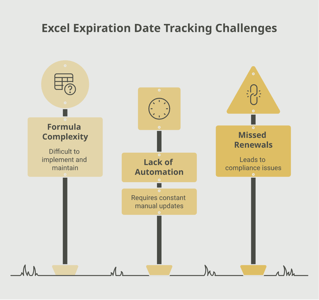
Spreadsheet trackers are the next step up. They centralize the data, but they do not send reminders, do not flag overdue units, and do not survive employee turnover well. The person who built the spreadsheet eventually leaves, and the next safety lead inherits a file they did not design and cannot fully trust.
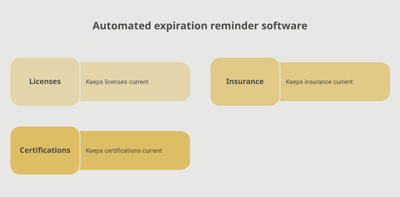
Automated tracking systems solve both problems. A dedicated platform like Expiration Reminder stores every extinguisher with its location, type, last inspection date, annual service date, and hydrostatic test schedule. Reminders fire automatically before each due date — to the safety manager, the technician, or the facility owner — and overdue items appear on a dashboard the moment they slip.
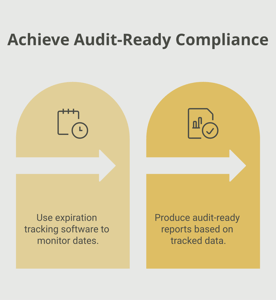
The most useful features for fire extinguisher programs include automated email and SMS reminders sent days or weeks before each due date, a centralized dashboard showing every unit across every building with its current status, audit-ready reports filtered by date range or location, and the ability to attach scanned service tags or photos to each record for inspector review.
The result is a program that runs in the background until something needs attention, instead of one that consumes a safety manager's attention every week.
Key Takeaways
- Fire extinguisher inspections are governed by NFPA 10 and enforced in U.S. workplaces by OSHA 1910.157.
- Three inspection tiers apply: monthly visual checks, annual maintenance by a qualified technician, and multi-year hydrostatic testing (every 5 or 12 years depending on the cylinder).
- The employer is responsible for ensuring all three tiers happen on time and that records are kept for at least one year.
- Monthly visual inspections can be performed by trained staff; annual maintenance must be performed by a qualified technician who attaches a dated tag.
- Lapsed inspections can void insurance, trigger OSHA fines, and — most importantly — leave staff without a working extinguisher during a fire.
- Manual tracking through tags or spreadsheets fails as inventory grows; automated tracking software prevents missed dates.
- Audit-ready records are the cheapest insurance you can buy against citation findings.
Frequently Asked Questions
How often must fire extinguishers be inspected?
Fire extinguishers require a quick visual inspection at least monthly (30-day intervals) and a detailed maintenance inspection at least annually by a qualified technician. Dry chemical units also require internal examination every six years, and most cylinders need hydrostatic pressure testing every 5 or 12 years depending on type.
Who can perform a fire extinguisher inspection?
Monthly visual inspections can be performed by any trained employee — no certification is required. Annual maintenance inspections and internal/hydrostatic testing must be performed by a qualified, trained technician, often a licensed fire-safety contractor.
What happens if a fire extinguisher inspection is missed or expired?
A missed inspection can lead to OSHA citations, fire-marshal findings, denial of insurance claims following a fire, and in some jurisdictions immediate closure orders. More importantly, an uninspected extinguisher may not function when needed.
How long should fire extinguisher inspection records be kept?
OSHA requires the annual maintenance date to be recorded and the record retained for one year after the last entry or the life of the shell, whichever is less. Many organizations keep records longer to support multi-year audits and insurance reviews.
Do I have to use an outside vendor for annual inspections?
In nearly all cases, yes. Annual inspections require a trained technician with the equipment to examine internal components, weigh the unit, and verify the agent. Most organizations contract with a licensed fire protection company for this service.
How far in advance should I schedule the next inspection?
Schedule the next monthly visual to fall within 30 days of the last one. For annual maintenance, schedule the technician 4–6 weeks in advance so units are not out of service longer than necessary. For hydrostatic testing (every 5 or 12 years), plan at least a quarter ahead so you can rotate replacement units into the affected locations.
Can I do my own fire extinguisher hydrostatic testing?
No. Hydrostatic testing requires specialized pressure-testing equipment and trained operators. It must be performed by a certified facility, and the test date is stamped on the cylinder.
What is the difference between an inspection and a maintenance check?
A visual inspection is a short check that the unit is present, charged, and undamaged. A maintenance check is a comprehensive examination of internal and external components performed annually by a qualified technician.
Conclusion
Fire extinguisher inspections are one of the most routine — and most consequential — compliance activities in any building. The rules are clear, the schedule is predictable, and the only real risk is letting a date slip without anyone noticing. Build the schedule once, automate the reminders, and the entire program runs in the background.
If your team is still tracking inspection dates on paper, in spreadsheets, or by trying to remember who walked the building last month, there is a better way. A purpose-built tracking system like Expiration Reminder takes the date math, the reminders, and the audit reporting off your plate, leaving you free to focus on the parts of fire safety that actually require a human being.
Stay current, stay ready, and let the system handle the calendar work.
Key Facts: Fire Extinguisher Inspection
- What it is: A structured check confirming a portable fire extinguisher is in place, accessible, charged, and ready to operate.
- Governing standards: NFPA 10 (Standard for Portable Fire Extinguishers); enforced in U.S. workplaces by OSHA 29 CFR 1910.157.
- Who is responsible: The employer, on behalf of the organization occupying or operating the building.
- Inspection frequency: Visual checks at least monthly (30-day intervals); detailed maintenance annually by a qualified technician.
- Multi-year servicing: Internal exam every 6 years for dry chemical units; hydrostatic test every 5 or 12 years depending on type.
- Record retention: OSHA requires the annual maintenance date to be recorded and retained for at least one year after the last entry.
- Consequences of lapse: OSHA fines, fire marshal findings, denied insurance claims, and a unit that may not function in an emergency.
Make sure your company is compliant
Say goodbye to outdated spreadsheets and hello to centralized credential management. Avoid fines and late penalties by managing your employee certifications with Expiration Reminder.