Introduction
If your business has a website, an email address, or any online presence, a domain name is the address that makes it findable. Losing a domain to a lapsed registration is one of the most damaging — and one of the most preventable — failures in digital operations. The recovery path after expiry exists, but it is expensive, time-bound, and not guaranteed.
This article explains what a domain name is, the ICANN renewal and grace-period rules, what happens at each stage after expiry, and the most practical way to track domain expirations across one domain or a portfolio of hundreds.
For most marketing and IT teams, registration and auto-renewal are routine. The hard part is making sure the auto-renewal actually works and that the team finds out fast when it does not.
What Is a Domain Name?
A domain name is a human-readable address that maps to a specific server or service on the internet (translated via the DNS system to an IP address). Domain names are registered through registrars accredited by ICANN (for generic top-level domains like .com, .net, .org) or by the country-code TLD authority (for ccTLDs like .uk, .de, .jp, .com.au).
Registration is a paid annual service. Most domains can be registered for 1 to 10 years at a time, with multi-year terms often discounted slightly.
ICANN's Expired Registration Recovery Policy (ERRP) governs what happens when a domain registration expires. Registrars must send at least two renewal reminders before expiration — one approximately one month before, and a second approximately one week before. After expiration, the domain moves through several stages:
- Auto-renew grace period (1–45 days) — optional period during which the registrar may allow renewal at standard prices. Not all registrars offer one.
- Redemption Grace Period (RGP) — 30 days — required by ICANN for gTLDs. The domain can be restored, but only with a significant restoration fee (typically $80–$200+) and only by the original registered name holder.
- PendingDelete (5 days) — the domain is queued for deletion and cannot be restored.
- Released — the domain becomes available again on a first-come, first-served basis, and may be picked up by drop-catchers or speculators.
If a domain is auctioned or registered by another party after release, recovery requires negotiating with the new owner — often at significant cost.
Why Domain Name Currency Matters for Your Organization
Domain name currency protects against three concrete risks: brand loss, operational disruption, and security exposure.
From a brand standpoint, losing a domain to drop-catchers or speculators can mean the original owner cannot regain it, or can only regain it by paying many times the original registration cost. Cases of well-known brands losing domains to lapsed registrations make headlines, and the lesson is always the same: it would have cost a tiny fraction to keep the renewal current.
From an operational standpoint, an expired domain takes down everything that depends on it: the website, the email system, the SSO infrastructure, the API endpoints, the marketing campaigns pointing to the URL. For a business of any size, this is a critical-severity outage.
From a security standpoint, an attacker who acquires an expired corporate domain can spin up phishing infrastructure that perfectly impersonates the original brand. This is particularly damaging for older domains with established reputation and email-sending history.
For multi-brand and multi-product organizations, domain portfolios can run into the dozens or hundreds, and the calendar is the single most common failure mode in domain management.
Common Scenarios for Tracking Domain Name Expiration Dates
Primary Business Domains
The main corporate domain is usually well-protected because it is so visible. The risk is concentrated in less-visible domains — defensive registrations, redirect domains, campaign domains, legacy product domains.
Multi-Brand and Acquired Brand Portfolios
Holding companies, multi-brand groups, and organizations that have acquired other companies often inherit domain portfolios with overlapping registrars, payment methods, and renewal cycles.
Marketing Campaign and Product Microsites
Marketing teams register domains for campaigns, product launches, and event sites. These are often registered by individuals using personal credit cards and are particularly likely to lapse when team members leave.
Country-Code Domains (.uk, .de, .com.au, etc.)
International ccTLDs follow their own renewal rules and grace periods, which may differ significantly from ICANN's policies. Some country-code domains have shorter grace periods or stricter restoration requirements.
Premium and Defensive Registrations
Premium domains held for branding, typo defense, or competitive purposes have the same renewal calendar as primary domains but often less visibility. They are the most common type to be lost.
How Domain Tracking Benefits Your Organization
A reliable domain tracking program produces measurable benefits.
For the company, current registrations preserve the brand, keep websites and email online, and prevent the catastrophic operational and security exposure of a lost domain.
For marketing and IT teams, the domain calendar becomes a planned activity rather than a fire drill. Defensive registrations get the same level of attention as primary domains.
For finance and procurement, accurate tracking supports better budget visibility and helps consolidate registrations onto fewer registrars where appropriate.
How to Track Domain Name Expiration Dates
Registrars send renewal notices by email — typically 30 days, 7 days, and on the date of expiry. They work as long as the emails go to a monitored inbox.
WHOIS lookups show the current expiration date for any domain — useful for spot checks, less useful for ongoing monitoring of a portfolio.
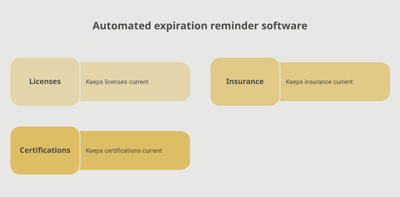
A dedicated tracking platform like Expiration Reminder stores each domain with its registrar, expiration date, payment method, DNS configuration, and responsible owner. Reminders fire automatically before each renewal — multiple intervals, redundant recipients — so a single inbox failure does not bring the domain down.
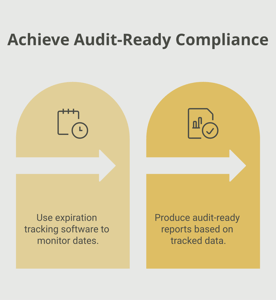
Key features include automated reminders at multiple intervals (90, 60, 30, 7 days before expiry), document storage for registration records, dashboard views by registrar, brand, or expiry window, audit-ready reports for the full domain portfolio, and the ability to log the new expiration date in one step.
Key Takeaways
- A domain name is a human-readable address registered through an ICANN-accredited registrar (gTLDs) or the country-code TLD authority (ccTLDs).
- Registrations are paid annually and can be renewed for 1–10 years at a time.
- ICANN's ERRP requires registrars to send at least two renewal reminders before expiry.
- After expiry, gTLDs go through an optional auto-renew grace period, a mandatory 30-day Redemption Grace Period (with significant restoration fees), and a 5-day PendingDelete stage before release.
- Restoration after the auto-renew grace period typically costs $80–$200+ on top of standard renewal.
- Lost domains can be picked up by drop-catchers or speculators, making recovery expensive or impossible.
- Manual tracking via registrar emails fails at portfolio scale; automated tracking with reminders is the reliable approach.
Frequently Asked Questions
How long can a domain be registered for?
Most gTLDs (.com, .net, .org) can be registered for 1 to 10 years at a time. Multi-year registrations are commonly discounted.
What happens when a domain expires?
The domain typically enters an auto-renew grace period (if the registrar offers one), then a 30-day Redemption Grace Period during which restoration is possible at a higher fee, then a 5-day PendingDelete stage, after which the domain is released for general registration.
How much does it cost to restore an expired domain?
Restoration fees during the Redemption Grace Period typically run $80–$200+ on top of the standard renewal fee, depending on the registrar and TLD.
What is the Redemption Grace Period?
ICANN's Redemption Grace Period (RGP) is a mandatory 30-day window after deletion of a gTLD registration during which the original registered name holder can restore the domain. The domain cannot be transferred during this period.
Does auto-renewal always work?
It works when the payment method on file is valid. Expired cards, declined payments, and removed payment methods break the auto-renewal flow. Renewal notices go to the email on file, which may not be monitored.
Can I lose a domain even with auto-renew on?
Yes, in two scenarios: the payment method fails and no one acts on the failure notices, or the registrar account itself becomes inaccessible (lost password, departed employee, abandoned email).
What is WHOIS?
WHOIS is the public database listing domain registration information (registrar, expiration date, name servers, and in some cases registrant contact information). It is useful for spot-checking expiration dates.
How do organizations protect against lost domains?
Best practices include consolidating onto a small number of registrars, enabling registry lock for critical domains, using corporate (not personal) payment methods, sending renewal notices to multiple recipients, and using a dedicated tracking platform to actively monitor every domain in the portfolio.
Conclusion
Domain names are the address layer for every digital business — and losing one to a lapsed registration is one of the most preventable, most damaging failures any organization can suffer. The registration itself is trivial; the calendar discipline is where most programs fall apart, especially for defensive and legacy domains.
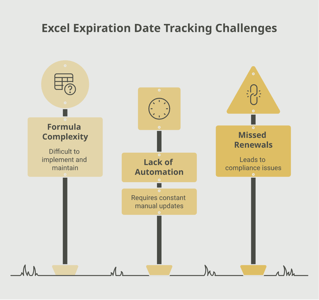
If your team tracks domains through registrar emails or a spreadsheet, you already know how easy it is for one domain to slip past. A purpose-built tracking platform like Expiration Reminder centralizes every domain, sends reminders before each renewal, stores the supporting records, and produces audit-ready reports the moment anyone asks.
Keep the brand intact, keep the systems online, and let the system handle the calendar.