Introduction
If any of your workers have reasonably anticipated occupational contact with blood or other potentially infectious materials — healthcare, first responders, labs, custodial staff in medical settings, tattoo artists, body piercers, lifeguards, school nurses, plumbers in raw-sewage environments, mortuary workers — Bloodborne Pathogens (BBP) training is a federal OSHA mandate, not an option. The annual training requirement is one of the most cited OSHA findings outside healthcare specifically because so many employers do not realize they are covered.
This article explains what Bloodborne Pathogens training is, the OSHA standard behind it, the annual training requirement, the breadth of industries covered, and the most practical way to track BBP training across a workforce.
For most safety teams in healthcare, delivering the annual training is well understood. The hard part is the calendar — and outside healthcare, the harder part is often recognizing the training is required at all.
What Is Bloodborne Pathogens Training?
Bloodborne Pathogens (BBP) training is the workplace training required under OSHA 29 CFR 1910.1030 (the Bloodborne Pathogens Standard). The standard protects workers from occupational exposure to blood and other potentially infectious materials (OPIM) that can transmit diseases such as HIV, Hepatitis B (HBV), and Hepatitis C (HCV).
Training must be provided:
- At the time of initial assignment to tasks with occupational exposure.
- At least annually thereafter.
- Whenever changes in tasks or procedures affect exposure.
Training must cover:
- A copy of and explanation of the OSHA standard.
- Epidemiology and symptoms of bloodborne diseases.
- Modes of transmission.
- The employer's Exposure Control Plan.
- Recognition of tasks with potential exposure.
- Use and limitations of engineering controls, work practices, and PPE.
- Hepatitis B vaccine information.
- Procedures for exposure incidents.
- Signs, labels, and color coding of biohazards.
Training records must be maintained for at least 3 years and include training dates, content summary, trainer qualifications, and names and job titles of attendees.
The standard is industry-neutral. Any employer whose workers have reasonably anticipated occupational exposure to blood or OPIM is covered — not just healthcare. OSHA enforcement letters have explicitly applied 1910.1030 to:
- Healthcare workers (the original target audience).
- First responders (police, fire, EMS).
- Laboratory and research staff.
- Custodial and housekeeping workers in medical settings.
- Tattoo artists and body piercers.
- Mortuary and funeral home workers.
- Lifeguards.
- School nurses and certain athletic trainers.
- Some construction workers exposed to bodily fluids (sewer work, certain demolition).
Why Bloodborne Pathogens Training Matters for Your Organization
BBP training currency protects against three concrete risks: worker disease, OSHA citations, and inadequate post-exposure response.
From a worker-health standpoint, HIV, HBV, and HCV are serious and in some cases lifelong infections. Engineering controls, work practices, PPE, and the Hepatitis B vaccine are the layered defenses — and training is the foundation.
From a regulatory standpoint, BBP citations are consistently among OSHA's most-cited healthcare standards. Outside healthcare, missed training is a common finding because many employers do not realize they are covered.
From an incident-response standpoint, exposure incidents (needlesticks, splashes, contact with OPIM) require fast, correct response. Trained workers and supervisors know what to do; untrained workers can lose critical hours in the window when post-exposure prophylaxis is most effective.
For non-healthcare employers especially, the calendar is the place where most BBP programs stumble — and the place where automated tracking pays off most quickly.
Common Scenarios for Tracking Bloodborne Pathogens Training Dates
Healthcare and Dental
Hospitals, clinics, dental practices, and similar settings are the original target audience. BBP training overlaps with broader infection control training.
First Responders
Police, fire, EMS, and other first responders face routine occupational exposure to blood and OPIM during emergency response.
Tattoo, Piercing, and Body Art
Body-art studios are squarely covered by 1910.1030. State licensing for body-art practitioners often includes BBP training as a condition.
Custodial and Janitorial Services
Cleaning and janitorial workers in medical settings, schools, gyms, and other facilities are commonly covered when they may contact blood or OPIM (cleanup, restroom maintenance).
Lifeguards, Athletic Trainers, and School Staff
Lifeguards, athletic trainers, school nurses, and certain teachers handling injuries may be covered depending on the foreseeability of exposure.
How Bloodborne Pathogens Tracking Benefits Your Organization
A reliable tracking program produces measurable benefits.
For the company, current training records satisfy OSHA, reduce worker-infection risk, and prepare the organization for fast, correct response to exposure incidents.
For safety, EHS, and HR teams, the training calendar becomes predictable. Annual refreshers are scheduled with adequate lead time. New-hire onboarding includes BBP as a structured step.
For workers, predictable training reinforces critical knowledge — particularly important in roles where exposure happens unpredictably and post-exposure decisions are time-critical.
How to Track Bloodborne Pathogens Training Expiration Dates
Learning management systems (LMS) track training completions. Many healthcare and safety LMS platforms include BBP modules.
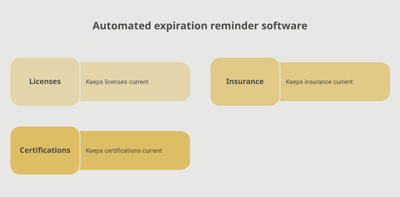
For organizations using a separate compliance tracker, a platform like Expiration Reminder stores each worker with their BBP training history, next-due date, training program details, exposure control plan version, and supporting documents. Reminders fire automatically before each annual refresher.
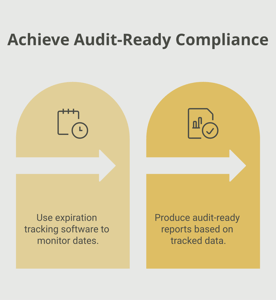
Key features include automated reminders at multiple intervals (90, 60, 30 days), document storage for training records and exposure control plans, dashboard views by site, department, or training class, audit-ready reports for OSHA, and the ability to log new training events in one step.
Key Takeaways
- Bloodborne Pathogens training is OSHA-mandated under 29 CFR 1910.1030.
- Required at initial assignment and at least annually thereafter for workers with reasonably anticipated occupational exposure to blood or OPIM.
- Covers a much broader audience than just healthcare — first responders, body artists, lifeguards, custodial, lab, mortuary, and others.
- Training records must be kept for at least 3 years and include specific content elements.
- BBP citations are consistently among OSHA's most-cited findings.
- Automated tracking with reminders is the reliable approach for any covered workforce.
Frequently Asked Questions
How often is Bloodborne Pathogens training required?
At the time of initial assignment to tasks with occupational exposure, at least annually thereafter, and whenever task or procedure changes affect exposure.
Who is covered by OSHA 1910.1030?
Any employer whose workers have reasonably anticipated occupational exposure to blood or other potentially infectious materials. This is industry-neutral and applies well beyond healthcare.
What is OPIM?
Other Potentially Infectious Materials — body fluids (semen, vaginal secretions, cerebrospinal fluid, synovial fluid, etc.), unfixed tissue or organ, cell or tissue cultures, and HIV-containing media or cultures.
What is the Hepatitis B vaccine requirement?
The standard requires employers to offer the Hepatitis B vaccine series to all employees with occupational exposure within 10 working days of initial assignment, at no cost to the employee. Employees who decline must sign a specific declination form.
What is an Exposure Control Plan?
A written plan documenting the employer's procedures for protecting workers from bloodborne pathogen exposure. The plan must be updated at least annually and accessible to employees.
How long must BBP training records be kept?
At least 3 years from the date of training, including dates, content summary, trainer qualifications, and names and job titles of attendees.
Can BBP training be delivered online?
Yes, with conditions. OSHA accepts online or computer-based training so long as the program is interactive, allows for questions, and provides a qualified person to answer questions promptly.
How is BBP training different from broader infection control training?
BBP training is OSHA-specific and focused on bloodborne pathogens. Broader infection control training covers transmission-based precautions, hand hygiene, healthcare-associated infections, and other topics typically required by accreditation bodies (Joint Commission, CMS) and CDC guidance.
Conclusion
Bloodborne Pathogens training is the foundational federal safety control for any worker with occupational exposure to blood or OPIM — and the reach of the standard is significantly broader than many non-healthcare employers realize. The substantive work — delivering training, maintaining the Exposure Control Plan, supporting Hepatitis B vaccination — sits with safety, EHS, and HR. The administrative work — knowing every worker's annual training date and producing the records on demand — is where most programs need help.
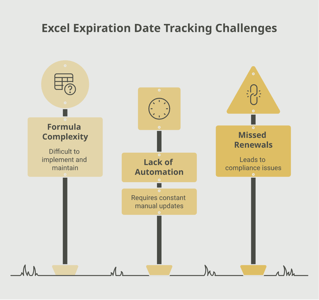
If your team tracks BBP training through LMS or spreadsheets, you already know how easy it is for one worker's annual training to slip past — particularly outside healthcare. A purpose-built tracking platform like Expiration Reminder centralizes every training record, sends reminders before each annual due date, stores the supporting documents, and produces audit-ready reports the moment anyone asks.
Train the workforce, protect against exposure, and let the system handle the calendar.