

Read time:
12
min

Why Contract Expiration Tracking Is Mission-Critical for Your Business

Table of Contents

Share this article
Subscribe
Thank you! Your submission has been received!
Oops! Something went wrong while submitting the form.

Why Contract Expiration Tracking Is Mission-Critical for Your Business

Somewhere in your organization right now, there is a contract approaching its expiration date. Maybe it is a vendor agreement with an auto-renewal clause buried in the fine print. Maybe it is an insurance policy that needs updated documentation before it can be renewed. Maybe it is a service-level agreement that your operations team depends on every single day.

The question is not whether you have contracts expiring, every business does. The question is whether you know about them in time to act. For organizations that treat contract expiration tracking as an afterthought, the answer is often no. And the consequences range from inconvenient to genuinely damaging.

This article explores why contract expiration tracking deserves a place at the center of your business operations, not tucked away in a spreadsheet that someone might remember to check.
What Is Contract Expiration Tracking?

Contract expiration tracking is the practice of monitoring the end dates of all active agreements your organization holds and taking proactive steps before those dates arrive. This includes vendor contracts, insurance policies, lease agreements, service-level agreements, licensing deals, employee contracts, and any other document with a defined term.

Effective tracking goes beyond simply recording dates. It involves understanding the renewal terms for each contract, knowing how much lead time is required, identifying who is responsible for action, and having systems in place to ensure nothing is overlooked.

At its core, contract expiration tracking is about visibility and control. When you can see what is expiring and when, you can make informed decisions instead of reacting to surprises.

Why Contract Expiration Tracking Is Mission-Critical

It Protects Your Revenue

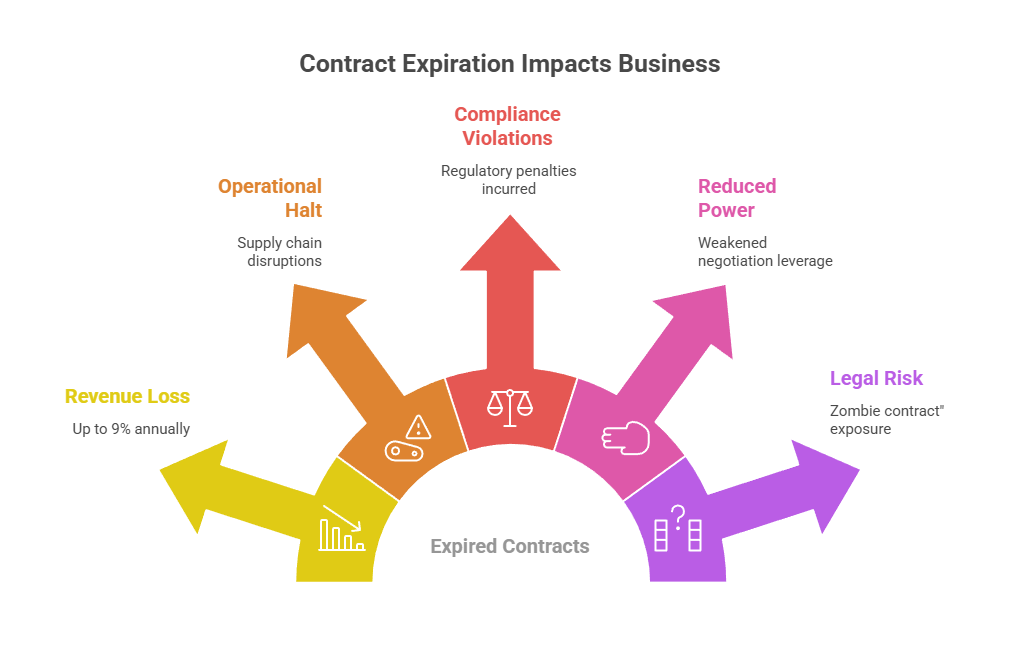
Poor contract management costs businesses up to 9% of annual revenue, according to industry research. Globally, organizations lose an estimated $50 billion annually through missed renewals, unfavorable auto-renewals, and unmanaged obligations. These are not theoretical risks, they are measurable losses that affect your bottom line.

When a contract expires without action, the financial fallout can take several forms: emergency procurement at premium prices, service gaps that halt revenue-generating activities, or auto-renewals that lock you into inflated rates. Each of these scenarios is preventable with proper tracking.

It Ensures Operational Continuity

Many contracts are tied directly to your ability to operate. If a software license expires, your team may lose access to the tools they need. If a vendor agreement lapses, supply chains break. If an equipment maintenance contract is not renewed, a breakdown could shut down production.

In industries like healthcare, construction, and manufacturing, a single expired contract can halt operations entirely. A hospital that loses a medical supply contract faces patient care disruptions. A construction firm with an expired permit or insurance policy may be forced to stop work. These are not edge cases — they are common scenarios that play out when tracking systems fail.

It Keeps You Compliant

In regulated industries, expired contracts do not just create operational inconvenience, they create compliance violations. Healthcare organizations must maintain current vendor agreements and insurance coverage to meet Joint Commission standards and CMS requirements. Construction companies need active insurance policies and permits to satisfy OSHA regulations and project owner requirements. Financial services firms face regulatory penalties for operating with expired licensing or vendor agreements.

Audit readiness depends on having current, properly documented contracts. When an auditor asks for proof of active coverage or a current vendor agreement, "we are working on the renewal" is not an acceptable answer.

It Preserves Your Negotiating Power

One of the most underappreciated benefits of contract tracking is the leverage it provides during renewal negotiations. When you know a contract is coming due well in advance, you have time to evaluate alternatives, gather competitive quotes, assess your current vendor's performance, and negotiate from a position of strength.

Without that lead time, you are forced into reactive negotiations. The vendor knows you need to renew quickly, and your leverage evaporates. Auto-renewal clauses are particularly effective at stripping away negotiating power — if you miss the notice window, you are locked in at whatever terms the contract specifies.

It Reduces Legal and Financial Risk

Operating under an expired contract creates what legal professionals call a "zombie contract", an agreement that has technically ended, but both parties continue to act as if it is still in effect. The terms of this implied arrangement are vague, difficult to enforce, and expose both sides to significant legal risk.

Expired insurance policies are perhaps the most dangerous category. If an incident occurs during a coverage gap, the organization is fully liable for all costs, including legal defense, settlements, and damages. Even a gap of just a few days can result in catastrophic financial exposure.

Common Scenarios Where Tracking Breaks Down

The Spreadsheet That Nobody Updates

Research shows that approximately 33% of businesses still manually track contract expiration dates, and 9% do not track them at all. The typical scenario involves a well-intentioned spreadsheet that is created during a cleanup effort, maintained diligently for a few months, and then gradually neglected as daily priorities take over. By the time someone remembers to check it, several contracts have already expired or auto-renewed.

The Staff Transition That Drops the Ball

When the person responsible for contract tracking leaves the organization, takes extended leave, or changes roles, institutional knowledge walks out the door with them. If contract information lives in their email, their personal files, or their memory, the organization is left scrambling to reconstruct what is due and when.

The Decentralized Organization With No Single View

In many companies, contracts are managed by the department that uses them. Procurement manages vendor contracts. HR manages employee agreements. IT manages software licenses. Legal manages partnerships. Finance manages insurance. Without a centralized system, there is no way to see the full picture of what is expiring across the organization.

The Auto-Renewal Trap

Auto-renewal clauses are designed to ensure continuity, but they can work against you when they go unmonitored. A contract that auto-renews at a 20% or 40% higher rate — because no one flagged the notice window, represents real money lost. Multiply this across dozens of contracts, and the cumulative impact is substantial.

The Compliance Audit You Were Not Ready For

Regulatory audits often require proof of current, active contracts with vendors, insurers, and service providers. Organizations that lack a centralized tracking system frequently discover gaps in their documentation only when the auditor is already on site. By then, the damage is done, findings are issued, corrective action plans are required, and in some cases, fines are levied.

How Contract Expiration Tracking Benefits Your Organization

For Leadership and Finance

Proactive contract tracking gives leadership a clear view of the organization's commitments, upcoming costs, and renewal opportunities. Finance teams can budget accurately for renewals, avoid surprise expenses, and identify contracts that should be renegotiated or terminated. This level of visibility supports better strategic decision-making and tighter financial control.

For Operations and Procurement

Operations teams gain confidence that the services, supplies, and systems they depend on will remain available without interruption. Procurement teams get the lead time they need to evaluate options, run competitive processes, and negotiate favorable terms. The result is smoother operations, better vendor relationships, and lower costs.

For Legal and Compliance

Legal teams benefit from having an organized, up-to-date contract repository that supports due diligence, risk assessment, and regulatory reporting. Compliance officers can demonstrate audit readiness at any time, with documentation that shows active contracts, renewal histories, and notification records.

For HR and Employee Management

HR departments manage a wide range of agreements, from employment contracts and non-disclosure agreements to benefits provider contracts and training vendor agreements. Tracking these expiration dates ensures that employee-facing services continue without interruption and that the organization meets its obligations as an employer.

How to Build a Mission-Critical Tracking System

Transitioning from ad-hoc tracking to a reliable system does not require a massive investment or a long implementation timeline. Here are the essential elements.

Centralize Everything

Bring all contracts into a single system where they can be searched, sorted, and monitored. This includes contracts held by every department, not just the ones managed by legal or procurement.

Record Key Dates and Terms

For each contract, capture the start date, end date, renewal notice period, auto-renewal terms, and any special conditions. This information should be entered when the contract is first signed, not months later when someone realizes they need it.

Set Up Automated Reminders

Tiered automated reminders — at 180, 90, 60, and 30 days before expiration — ensure that the right people are notified with enough time to act. A platform like Expiration Reminder provides this functionality out of the box, with customizable notification schedules, a centralized dashboard, and reporting tools that make it easy to see what is coming due across your entire organization.

Assign Ownership

Every contract needs a designated owner who is responsible for monitoring its status, initiating the renewal process, and ensuring that required documentation is submitted on time. Without clear ownership, contracts fall into the gaps between departments.

Review and Improve Regularly

Build a quarterly review process where leadership or a cross-functional team reviews upcoming renewals, evaluates contract performance, and makes decisions about renewals, renegotiations, or terminations. This turns contract management from a reactive exercise into a strategic activity.

Frequently Asked Questions

What makes contract expiration tracking "mission-critical"?

Contract expiration tracking is mission-critical because it directly affects your ability to operate, comply with regulations, and manage costs. A single missed renewal can halt services, trigger compliance violations, or lock you into unfavorable financial terms. The consequences compound across multiple contracts.

How many contracts does a typical mid-sized business manage?

A mid-sized business typically manages anywhere from 50 to several hundred active contracts, spanning vendor agreements, insurance policies, leases, software licenses, and employee-related agreements. The more contracts you manage, the higher the risk of something slipping through without a structured tracking system.

What is the biggest risk of not tracking contract expiration dates?

The biggest risk varies by organization, but the most common high-impact failures are insurance coverage gaps (which leave you fully liable for incidents), unfavorable auto-renewals (which inflate costs), and compliance violations (which trigger fines and audit findings). All three are preventable with proper tracking.

Can small businesses benefit from contract expiration tracking?

Absolutely. Small businesses are often more vulnerable to the consequences of a missed renewal because they have fewer resources to absorb unexpected costs, less negotiating leverage to recover from unfavorable auto-renewals, and smaller teams where a single person's oversight can affect the entire organization.

How does contract tracking support audit readiness?

Auditors typically require proof that key contracts, especially insurance, vendor, and compliance-related agreements, are current and properly documented. A centralized tracking system provides instant access to this documentation, along with renewal histories and notification records that demonstrate proactive management.

What types of contracts should be tracked?

Every contract with an expiration or renewal date should be tracked. This includes vendor and supplier agreements, insurance policies, real estate leases, software and technology licenses, service-level agreements, employment contracts, consulting agreements, and any regulatory permits or certifications tied to your business operations.

How far in advance should renewal reminders be set?

Best practice is to set tiered reminders starting at 180 days before expiration for complex or high-value contracts, and at minimum 90 days for simpler agreements. This provides adequate time for review, negotiation, and any internal approval processes that need to occur before renewal.

What is the difference between contract management and contract expiration tracking?

Contract management encompasses the entire lifecycle of a contract, from creation and negotiation through execution and performance monitoring. Contract expiration tracking focuses specifically on monitoring end dates, renewal deadlines, and notice windows to ensure timely action before contracts lapse or auto-renew. Expiration tracking is a critical component of the broader contract management process.

Take Control of Your Contract Lifecycle

Every contract in your organization has an expiration date. The question is not whether those dates will arrive, but whether your team will be ready when they do. Organizations that treat contract expiration tracking as a mission-critical function protect their revenue, maintain operational continuity, stay compliant, and negotiate better deals.

You do not need to be perfect, you just need to be proactive. Start by identifying the contracts that matter most, centralizing their key dates, and putting automated reminders in place so that no deadline catches your team off guard. With a tool like Expiration Reminder, you can build a reliable tracking system that scales with your organization and gives you peace of mind that every critical date is accounted for.

The difference between organizations that manage renewals well and those that do not is rarely about resources or expertise. It is about having the right system in place. Take the first step today, and make contract expiration tracking the business priority it has always deserved to be.
Share this article
Subscribe
Thank you! Your submission has been received!
Oops! Something went wrong while submitting the form.

Why Contract Expiration Tracking Is Mission-Critical for Your Business

Table of Contents

Share this article

Why Contract Expiration Tracking Is Mission-Critical for Your Business

Somewhere in your organization right now, there is a contract approaching its expiration date. Maybe it is a vendor agreement with an auto-renewal clause buried in the fine print. Maybe it is an insurance policy that needs updated documentation before it can be renewed. Maybe it is a service-level agreement that your operations team depends on every single day.

The question is not whether you have contracts expiring, every business does. The question is whether you know about them in time to act. For organizations that treat contract expiration tracking as an afterthought, the answer is often no. And the consequences range from inconvenient to genuinely damaging.

This article explores why contract expiration tracking deserves a place at the center of your business operations, not tucked away in a spreadsheet that someone might remember to check.

What Is Contract Expiration Tracking?

Contract expiration tracking is the practice of monitoring the end dates of all active agreements your organization holds and taking proactive steps before those dates arrive. This includes vendor contracts, insurance policies, lease agreements, service-level agreements, licensing deals, employee contracts, and any other document with a defined term.

Effective tracking goes beyond simply recording dates. It involves understanding the renewal terms for each contract, knowing how much lead time is required, identifying who is responsible for action, and having systems in place to ensure nothing is overlooked.

At its core, contract expiration tracking is about visibility and control. When you can see what is expiring and when, you can make informed decisions instead of reacting to surprises.

Why Contract Expiration Tracking Is Mission-Critical

It Protects Your Revenue

Poor contract management costs businesses up to 9% of annual revenue, according to industry research. Globally, organizations lose an estimated $50 billion annually through missed renewals, unfavorable auto-renewals, and unmanaged obligations. These are not theoretical risks, they are measurable losses that affect your bottom line.

When a contract expires without action, the financial fallout can take several forms: emergency procurement at premium prices, service gaps that halt revenue-generating activities, or auto-renewals that lock you into inflated rates. Each of these scenarios is preventable with proper tracking.

It Ensures Operational Continuity

Many contracts are tied directly to your ability to operate. If a software license expires, your team may lose access to the tools they need. If a vendor agreement lapses, supply chains break. If an equipment maintenance contract is not renewed, a breakdown could shut down production.

In industries like healthcare, construction, and manufacturing, a single expired contract can halt operations entirely. A hospital that loses a medical supply contract faces patient care disruptions. A construction firm with an expired permit or insurance policy may be forced to stop work. These are not edge cases — they are common scenarios that play out when tracking systems fail.

It Keeps You Compliant

In regulated industries, expired contracts do not just create operational inconvenience, they create compliance violations. Healthcare organizations must maintain current vendor agreements and insurance coverage to meet Joint Commission standards and CMS requirements. Construction companies need active insurance policies and permits to satisfy OSHA regulations and project owner requirements. Financial services firms face regulatory penalties for operating with expired licensing or vendor agreements.

Audit readiness depends on having current, properly documented contracts. When an auditor asks for proof of active coverage or a current vendor agreement, "we are working on the renewal" is not an acceptable answer.

It Preserves Your Negotiating Power

One of the most underappreciated benefits of contract tracking is the leverage it provides during renewal negotiations. When you know a contract is coming due well in advance, you have time to evaluate alternatives, gather competitive quotes, assess your current vendor's performance, and negotiate from a position of strength.

Without that lead time, you are forced into reactive negotiations. The vendor knows you need to renew quickly, and your leverage evaporates. Auto-renewal clauses are particularly effective at stripping away negotiating power — if you miss the notice window, you are locked in at whatever terms the contract specifies.

It Reduces Legal and Financial Risk

Operating under an expired contract creates what legal professionals call a "zombie contract", an agreement that has technically ended, but both parties continue to act as if it is still in effect. The terms of this implied arrangement are vague, difficult to enforce, and expose both sides to significant legal risk.

Expired insurance policies are perhaps the most dangerous category. If an incident occurs during a coverage gap, the organization is fully liable for all costs, including legal defense, settlements, and damages. Even a gap of just a few days can result in catastrophic financial exposure.

Common Scenarios Where Tracking Breaks Down

The Spreadsheet That Nobody Updates

Research shows that approximately 33% of businesses still manually track contract expiration dates, and 9% do not track them at all. The typical scenario involves a well-intentioned spreadsheet that is created during a cleanup effort, maintained diligently for a few months, and then gradually neglected as daily priorities take over. By the time someone remembers to check it, several contracts have already expired or auto-renewed.

The Staff Transition That Drops the Ball

When the person responsible for contract tracking leaves the organization, takes extended leave, or changes roles, institutional knowledge walks out the door with them. If contract information lives in their email, their personal files, or their memory, the organization is left scrambling to reconstruct what is due and when.

The Decentralized Organization With No Single View

In many companies, contracts are managed by the department that uses them. Procurement manages vendor contracts. HR manages employee agreements. IT manages software licenses. Legal manages partnerships. Finance manages insurance. Without a centralized system, there is no way to see the full picture of what is expiring across the organization.

The Auto-Renewal Trap

Auto-renewal clauses are designed to ensure continuity, but they can work against you when they go unmonitored. A contract that auto-renews at a 20% or 40% higher rate — because no one flagged the notice window, represents real money lost. Multiply this across dozens of contracts, and the cumulative impact is substantial.

The Compliance Audit You Were Not Ready For

Regulatory audits often require proof of current, active contracts with vendors, insurers, and service providers. Organizations that lack a centralized tracking system frequently discover gaps in their documentation only when the auditor is already on site. By then, the damage is done, findings are issued, corrective action plans are required, and in some cases, fines are levied.

How Contract Expiration Tracking Benefits Your Organization

For Leadership and Finance

Proactive contract tracking gives leadership a clear view of the organization's commitments, upcoming costs, and renewal opportunities. Finance teams can budget accurately for renewals, avoid surprise expenses, and identify contracts that should be renegotiated or terminated. This level of visibility supports better strategic decision-making and tighter financial control.

For Operations and Procurement

Operations teams gain confidence that the services, supplies, and systems they depend on will remain available without interruption. Procurement teams get the lead time they need to evaluate options, run competitive processes, and negotiate favorable terms. The result is smoother operations, better vendor relationships, and lower costs.

For Legal and Compliance

Legal teams benefit from having an organized, up-to-date contract repository that supports due diligence, risk assessment, and regulatory reporting. Compliance officers can demonstrate audit readiness at any time, with documentation that shows active contracts, renewal histories, and notification records.

For HR and Employee Management

HR departments manage a wide range of agreements, from employment contracts and non-disclosure agreements to benefits provider contracts and training vendor agreements. Tracking these expiration dates ensures that employee-facing services continue without interruption and that the organization meets its obligations as an employer.

How to Build a Mission-Critical Tracking System

Transitioning from ad-hoc tracking to a reliable system does not require a massive investment or a long implementation timeline. Here are the essential elements.

Centralize Everything

Bring all contracts into a single system where they can be searched, sorted, and monitored. This includes contracts held by every department, not just the ones managed by legal or procurement.

Record Key Dates and Terms

For each contract, capture the start date, end date, renewal notice period, auto-renewal terms, and any special conditions. This information should be entered when the contract is first signed, not months later when someone realizes they need it.

Set Up Automated Reminders

Tiered automated reminders — at 180, 90, 60, and 30 days before expiration — ensure that the right people are notified with enough time to act. A platform like Expiration Reminder provides this functionality out of the box, with customizable notification schedules, a centralized dashboard, and reporting tools that make it easy to see what is coming due across your entire organization.

Assign Ownership

Every contract needs a designated owner who is responsible for monitoring its status, initiating the renewal process, and ensuring that required documentation is submitted on time. Without clear ownership, contracts fall into the gaps between departments.

Review and Improve Regularly

Build a quarterly review process where leadership or a cross-functional team reviews upcoming renewals, evaluates contract performance, and makes decisions about renewals, renegotiations, or terminations. This turns contract management from a reactive exercise into a strategic activity.

Frequently Asked Questions

What makes contract expiration tracking "mission-critical"?

Contract expiration tracking is mission-critical because it directly affects your ability to operate, comply with regulations, and manage costs. A single missed renewal can halt services, trigger compliance violations, or lock you into unfavorable financial terms. The consequences compound across multiple contracts.

How many contracts does a typical mid-sized business manage?

A mid-sized business typically manages anywhere from 50 to several hundred active contracts, spanning vendor agreements, insurance policies, leases, software licenses, and employee-related agreements. The more contracts you manage, the higher the risk of something slipping through without a structured tracking system.

What is the biggest risk of not tracking contract expiration dates?

The biggest risk varies by organization, but the most common high-impact failures are insurance coverage gaps (which leave you fully liable for incidents), unfavorable auto-renewals (which inflate costs), and compliance violations (which trigger fines and audit findings). All three are preventable with proper tracking.

Can small businesses benefit from contract expiration tracking?

Absolutely. Small businesses are often more vulnerable to the consequences of a missed renewal because they have fewer resources to absorb unexpected costs, less negotiating leverage to recover from unfavorable auto-renewals, and smaller teams where a single person's oversight can affect the entire organization.

How does contract tracking support audit readiness?

Auditors typically require proof that key contracts, especially insurance, vendor, and compliance-related agreements, are current and properly documented. A centralized tracking system provides instant access to this documentation, along with renewal histories and notification records that demonstrate proactive management.

What types of contracts should be tracked?

Every contract with an expiration or renewal date should be tracked. This includes vendor and supplier agreements, insurance policies, real estate leases, software and technology licenses, service-level agreements, employment contracts, consulting agreements, and any regulatory permits or certifications tied to your business operations.

How far in advance should renewal reminders be set?

Best practice is to set tiered reminders starting at 180 days before expiration for complex or high-value contracts, and at minimum 90 days for simpler agreements. This provides adequate time for review, negotiation, and any internal approval processes that need to occur before renewal.

What is the difference between contract management and contract expiration tracking?

Contract management encompasses the entire lifecycle of a contract, from creation and negotiation through execution and performance monitoring. Contract expiration tracking focuses specifically on monitoring end dates, renewal deadlines, and notice windows to ensure timely action before contracts lapse or auto-renew. Expiration tracking is a critical component of the broader contract management process.

Take Control of Your Contract Lifecycle

Every contract in your organization has an expiration date. The question is not whether those dates will arrive, but whether your team will be ready when they do. Organizations that treat contract expiration tracking as a mission-critical function protect their revenue, maintain operational continuity, stay compliant, and negotiate better deals.

You do not need to be perfect, you just need to be proactive. Start by identifying the contracts that matter most, centralizing their key dates, and putting automated reminders in place so that no deadline catches your team off guard. With a tool like Expiration Reminder, you can build a reliable tracking system that scales with your organization and gives you peace of mind that every critical date is accounted for.

The difference between organizations that manage renewals well and those that do not is rarely about resources or expertise. It is about having the right system in place. Take the first step today, and make contract expiration tracking the business priority it has always deserved to be.

Excel in your subscriptions management
You can eliminate challenges if you have a strong organizational development blueprint.
Read time:
This is some text inside of a div block.
min

Heading

Table of Contents

Share this article
Subscribe
Thank you! Your submission has been received!
Oops! Something went wrong while submitting the form.

What’s a Rich Text element?

What’s a Rich Text element?

The rich text element allows you to create and format headings, paragraphs, blockquotes, images, and video all in one place instead of having to add and format them individually. Just double-click and easily create content.

The rich text element allows you to create and format headings, paragraphs, blockquotes, images, and video all in one place instead of having to add and format them individually. Just double-click and easily create content.

Static and dynamic content editing

Static and dynamic content editing

A rich text element can be used with static or dynamic content. For static content, just drop it into any page and begin editing. For dynamic content, add a rich text field to any collection and then connect a rich text element to that field in the settings panel. Voila!

A rich text element can be used with static or dynamic content. For static content, just drop it into any page and begin editing. For dynamic content, add a rich text field to any collection and then connect a rich text element to that field in the settings panel. Voila!

How to customize formatting for each rich text

How to customize formatting for each rich text

Headings, paragraphs, blockquotes, figures, images, and figure captions can all be styled after a class is added to the rich text element using the "When inside of" nested selector system.

Headings, paragraphs, blockquotes, figures, images, and figure captions can all be styled after a class is added to the rich text element using the "When inside of" nested selector system.
Share this article
Subscribe
Thank you! Your submission has been received!
Oops! Something went wrong while submitting the form.

Keep on reading