Introduction
If your business operates anywhere in Canada and uses, handles, stores, or disposes of hazardous products — manufacturing, healthcare, construction, agriculture, education, cleaning, automotive, virtually any workplace with chemicals — WHMIS training is the federal-and-provincial baseline for worker education on hazardous products. WHMIS 2015 aligned Canada with the Globally Harmonized System (GHS), and ongoing employer obligations to educate workers and review training keep WHMIS at the center of Canadian workplace safety programs.
This article explains what WHMIS certification is, the framework behind it, the annual review requirement, the difference between national education and workplace-specific training, and the most practical way to track WHMIS across a Canadian workforce.
For most Canadian safety and EHS teams, delivering initial WHMIS education is well understood. The hard part is the calendar — knowing whose training is current, ensuring the annual review happens, and aligning workplace-specific training with the actual products on site.
What Is WHMIS Certification?
WHMIS — the Workplace Hazardous Materials Information System — is Canada's national hazard communication system for hazardous products in workplaces. The current version, WHMIS 2015, aligns Canadian law with the Globally Harmonized System of Classification and Labelling of Chemicals (GHS).
WHMIS 2015 has three core components, all of which must be supported by employer education and training:
- Hazardous product classification and labels — supplier labels on incoming hazardous products plus workplace labels on secondary containers.
- Safety Data Sheets (SDSs) — 16-section SDSs accessible to workers for every hazardous product.
- Worker education and training — generic WHMIS education plus workplace-specific training on the actual products in use.
WHMIS is administered through a combination of federal and provincial/territorial regulators:
- Federal: Health Canada's Hazardous Products Act and Hazardous Products Regulations govern suppliers — the classification, labelling, and SDS requirements for hazardous products entering commerce.
- Provincial/territorial OHS regulators: Each province and territory has its own occupational health and safety legislation governing employer obligations — education, training, labelling on secondary containers, SDS access, and program review.
Employer obligations typically include:
- Generic WHMIS education — covers WHMIS principles, GHS pictograms, signal words, hazard statements, label elements, SDS structure, and worker rights.
- Workplace-specific training — covers the actual hazardous products used at the worksite, including specific hazards, handling procedures, storage, emergency response, and access to SDSs.
- Annual review — the employer must review the WHMIS education and training program at least annually or more often if work conditions, processes, or hazard information change.
WHMIS does not specify a fixed retraining cycle for all workers, but the annual program review and any changes in workplace hazards drive ongoing training updates.
Why WHMIS Certification Matters for Your Organization
WHMIS training currency protects against three concrete risks: chemical exposure incidents, provincial regulatory findings, and supply-chain compliance issues.
From a worker-safety standpoint, WHMIS gives workers the knowledge they need to identify and handle hazardous products safely. Chemical exposures, fires, and unintended reactions are largely preventable through proper hazard recognition and handling.
From a regulatory standpoint, provincial/territorial OHS regulators inspect workplaces and review WHMIS programs. Missing training records, outdated SDSs, and inadequate labelling are common findings.
From a supply-chain standpoint, suppliers, customers, and contractors in Canadian commercial relationships increasingly require WHMIS compliance evidence as part of vendor management and contractor onboarding.
For multi-province organizations, the variation in provincial OHS rules layers additional complexity onto the federal hazardous-products framework.
Common Scenarios for Tracking WHMIS Training Dates
Manufacturing and Industrial
Manufacturers using solvents, paints, adhesives, cutting fluids, and process chemicals run WHMIS programs covering every hazardous product on site.
Healthcare and Laboratory
Hospitals, clinics, and labs use hazardous products in clinical settings, sterilization, lab reagents, and disinfection. WHMIS overlaps with broader infection control and lab safety programs.
Construction
Construction sites use solvents, adhesives, sealants, paints, and many other hazardous products. WHMIS training is required for workers, with site-specific updates as new products arrive.
Cleaning and Janitorial Services
Cleaning contractors use a wide range of hazardous products. WHMIS training is required for staff handling chemicals.
Schools and Educational Institutions
Schools use chemicals in science labs, art programs, maintenance, and food service. Each area has its own WHMIS scope.
How WHMIS Tracking Benefits Your Organization
A reliable WHMIS tracking program produces measurable benefits.
For the company, current training and an active program review satisfy federal and provincial regulators, support contractor and customer compliance requirements, and reduce chemical-incident risk.
For safety, EHS, and HR teams, the WHMIS calendar becomes predictable. The annual program review is scheduled as a structured activity. New-product onboarding triggers workplace-specific training updates.
For workers, current training supports day-to-day safe handling of hazardous products and a culture that takes chemical hazards seriously.
How to Track WHMIS Training Expiration Dates
Learning management systems (LMS) — Canadian Centre for Occupational Health and Safety, CarriersEdge, BIS Safety Software, and many others — track WHMIS training completions.
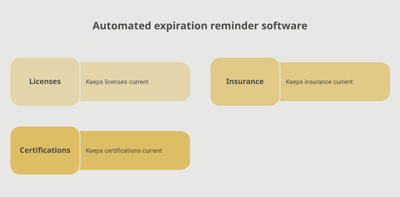
For organizations using a separate compliance tracker, a platform like Expiration Reminder stores each worker with their WHMIS training history, next-review date, workplace-specific training records, and supporting documents. Reminders fire automatically before each program review and before any required refresher.
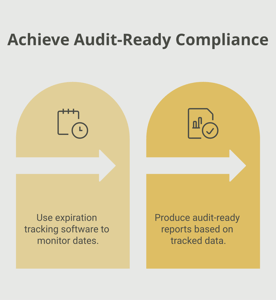
Key features include automated reminders at multiple intervals (90, 60, 30 days), document storage for training records and the WHMIS program review, dashboard views by site, role, or province, audit-ready reports for provincial OHS inspectors, and the ability to log new training events in one step.
Key Takeaways
- WHMIS is Canada's national hazard communication system for hazardous products in workplaces.
- WHMIS 2015 aligned Canada with the Globally Harmonized System (GHS).
- Three core components: classification and labels, Safety Data Sheets, and worker education and training.
- Federal regulators govern suppliers (Hazardous Products Act); provincial/territorial OHS regulators govern employers.
- Employers must review the WHMIS program at least annually and update training as workplace conditions change.
- Workplace-specific training is required in addition to generic WHMIS education.
- Automated tracking with reminders is the reliable approach across multi-site Canadian operations.
Frequently Asked Questions
How often is WHMIS training required?
Initial education for new workers, workplace-specific training for the products in use, and ongoing updates as hazards change. The employer must review the WHMIS program at least annually.
What is the difference between WHMIS 1988 and WHMIS 2015?
WHMIS 2015 aligned the system with the Globally Harmonized System (GHS), introducing standardized hazard pictograms, signal words, hazard statements, and SDS format. WHMIS 1988 used different hazard classes and label requirements.
What are the WHMIS pictograms?
WHMIS 2015 uses the GHS pictograms — red diamond symbols on white backgrounds. Common pictograms include flame (flammable), exclamation mark (irritant), health hazard, skull and crossbones (acute toxicity), corrosion, and others.
What is a Safety Data Sheet under WHMIS 2015?
A 16-section document for each hazardous product covering identification, hazards, composition, first aid, fire fighting, accidental release, handling, exposure controls, physical/chemical properties, stability, toxicology, ecology, disposal, transport, regulatory information, and other details.
How is generic WHMIS education different from workplace-specific training?
Generic WHMIS education covers the system's principles — pictograms, label elements, SDS structure. Workplace-specific training covers the actual hazardous products in use at the worksite, including specific hazards, handling, storage, and emergency response.
Are there provincial differences?
Yes. While the federal hazardous-products regime is uniform, provincial/territorial OHS regulators have their own employer obligations — periodic worker knowledge evaluations, specific record-keeping rules, and inspection programs. Confirm provincial requirements.
What is the difference between WHMIS and HazCom?
WHMIS is the Canadian equivalent of the U.S. OSHA Hazard Communication (HazCom) Standard. Both implement the GHS. Specific rules and enforcement differ by jurisdiction.
How do organizations track many WHMIS training records?
Combinations of LMS, training-management systems, and dedicated tracking platforms. The system that actively reminds before each annual review is the one that prevents most lapses.
Conclusion
WHMIS is the Canadian foundation for hazard communication in workplaces with hazardous products. The substantive work — delivering generic education, workplace-specific training, maintaining the program, providing SDS access — sits with safety, EHS, and HR. The administrative work — knowing every worker's training status and scheduling the annual program review — is where most programs need help.
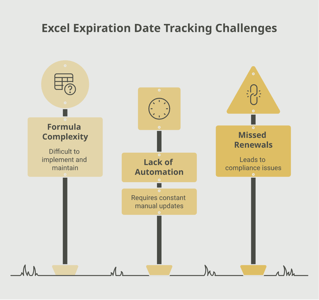
If your team tracks WHMIS through LMS or spreadsheets, you already know how easy it is for one worker's training to lapse or for the annual review to slip past. A purpose-built tracking platform like Expiration Reminder centralizes every training record, sends reminders before each due date, stores the supporting documents, and produces audit-ready reports the moment anyone asks.
Train the workforce, review the program, and let the system handle the calendar.