Introduction
If your company pays U.S. independent contractors, freelancers, vendors, or service providers, the W-9 form sits at the front of every payment relationship. Without a valid W-9 on file, you may be required to withhold 24% of every payment to that vendor and remit it to the IRS — and you may be the one explaining the situation to an auditor if 1099 reporting comes up incomplete.
This article explains what a W-9 form is, the rules behind it, who must complete one, when an updated W-9 should be requested, and what happens when forms fall out of date. You will also see the most practical way to track W-9 currency across a vendor file that might include hundreds or thousands of contractors and suppliers.
For most accounts payable and finance teams, collecting the W-9 at vendor onboarding is the easy part. The hard part is keeping the file current — knowing which vendors changed legal names, which ones moved, and which ones have a stale form sitting unverified for years.
What Is a W-9 Form?
A W-9 form — officially "Request for Taxpayer Identification Number and Certification" — is an IRS form used by U.S. persons (individuals, sole proprietors, LLCs, corporations, partnerships, and trusts) to provide their taxpayer identification number (TIN) to a payer who is required to file information returns with the IRS, such as Form 1099-NEC, 1099-MISC, 1099-K, or 1099-INT.
The form collects the vendor's legal name, business name (if different), federal tax classification, address, and TIN — either a Social Security Number (for individuals and single-member LLCs) or an Employer Identification Number (for businesses). The vendor certifies under penalties of perjury that the TIN provided is correct and that they are not subject to backup withholding.
A W-9 itself does not expire on a fixed schedule. There is no IRS-mandated "validity period." However, the form should be updated whenever the vendor's information changes — legal name, business structure, TIN, or address — and most organizations adopt a policy of refreshing W-9s on a periodic basis (often annually before 1099 preparation) and any time a vendor is reactivated after a long period of inactivity.
The 2026 W-9 includes updated reporting around digital assets and partnership classifications, with minor formatting changes to TIN certification fields.
Why W-9 Forms Matter for Your Organization
W-9 compliance protects against three concrete risks: backup withholding, 1099 reporting errors, and IRS penalties.
If a vendor fails to provide a TIN, provides one that the IRS cannot match, or has been flagged by the IRS for backup withholding, the payer must withhold 24% of every payment and remit it to the IRS. This is not a penalty on the vendor — it is an obligation on the payer. Once backup withholding starts, the payer must continue until the vendor cures the issue and the IRS releases the notice.
At year-end, payers must issue 1099s to vendors who received reportable payments. The 1099 is built from the W-9 data — name, TIN, address. When the W-9 is wrong, the 1099 is wrong, and the IRS issues B-notices, P-notices, and matching errors that the payer must reconcile.
IRS penalties for incorrect or missing 1099 information returns can reach hundreds of dollars per form, with higher penalties for intentional disregard. For a company with hundreds of contractors, the exposure adds up quickly.
Beyond the IRS, lenders, auditors, and acquirers reviewing AP processes routinely look at W-9 currency as a marker of overall vendor-management discipline. A vendor file with stale, missing, or inconsistent W-9s signals broader control gaps.
Common Scenarios for Tracking W-9 Currency
W-9 tracking touches almost every business that pays independent contractors or vendors. Here are the contexts where keeping the file current matters most.
Companies with Large 1099 Contractor Bases
Marketing agencies, consulting firms, construction companies, gig platforms, and professional services firms often pay hundreds of independent contractors each year. Every contractor needs a valid W-9 on file before payment, and many require refreshes when the relationship resumes after a gap.
Real Estate, Property Management, and Hospitality
Property managers pay maintenance vendors, repair contractors, cleaning services, landscapers, and one-off service providers. The vendor base turns over constantly, and the W-9 collection process needs to happen quickly to avoid payment delays.
Healthcare Practices Paying Locum, Travel, and Allied Health Contractors
Healthcare practices commonly engage locum tenens physicians, travel nurses, allied health professionals, and contract staff. Each engagement requires a W-9 (or W-8 for non-U.S. persons), and the tax-reporting volume during 1099 season is significant.
Nonprofits with Grant Recipients and Honorarium Payments
Nonprofits issuing grants, honoraria, or consulting payments must collect W-9s from each recipient. Many recipients are first-time vendors, and stale forms accumulate quickly as award cycles repeat.
Multi-Entity Organizations with Shared Vendor Files
Holding companies and franchise systems often share vendor files across multiple operating entities. Each entity may have its own AP team, but the W-9 needs to be current across all of them.
How W-9 Tracking Benefits Your Company and Vendors
A reliable W-9 tracking program produces measurable benefits.
For the company, current W-9s eliminate the backup-withholding surprise, support clean 1099 reporting, reduce IRS B-notice traffic, and protect against penalty exposure. They also speed up vendor onboarding because the AP team has a clear, repeatable process.
For vendors, a clear W-9 collection process reduces friction at onboarding and ensures accurate 1099s at year-end — vendors with mismatched names or TINs on their 1099s spend hours of their own time chasing corrections.
For finance teams, knowing every vendor's W-9 status removes a recurring source of audit risk. CFOs and controllers can answer "are all our W-9s current?" with confidence rather than apology.
How to Track W-9 Currency
The most common tracking approach is to collect a W-9 at vendor setup, save it in the vendor master file or a shared drive, and never look at it again. This works until the first B-notice arrives, the first 1099 fails matching, or the first audit asks for evidence of W-9 currency.
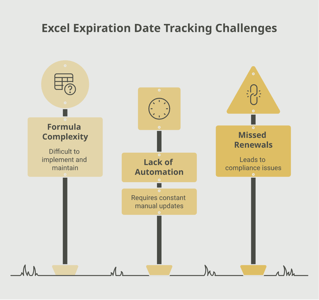
A spreadsheet listing each vendor, the date of the W-9, and the verified TIN is a step up but does not send reminders, does not flag stale forms, and rarely survives an AP team transition.
ERP and AP automation systems often store W-9 documents alongside the vendor record, but most do not actively prompt refresh requests based on age, change-of-name events, or extended inactivity.
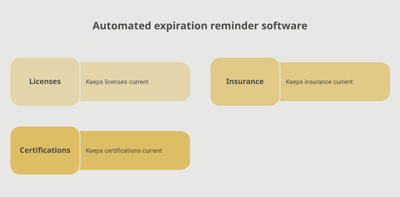
A dedicated tracking platform like Expiration Reminder stores each vendor with their W-9 collection date, expected refresh interval, TIN verification status, and the actual W-9 file. Reminders fire automatically before the refresh date, vendors with stale forms surface on a dashboard, and the W-9 is one click away when an auditor asks.
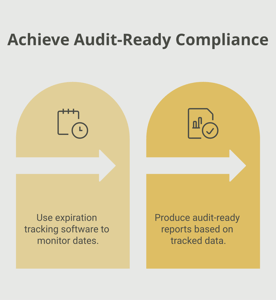
The features that matter most for W-9 tracking include automated refresh reminders at configurable intervals (often annual before 1099 season), document storage so each W-9 is attached to the vendor record, dashboard views by vendor status (current, refresh due, missing), audit-ready reports of W-9 currency across the vendor file, and the ability to log a new W-9 date the moment a refreshed form is received.
The result is a vendor file where every payee has a current W-9, every 1099 issues cleanly, and the AP team has the evidence ready.
Key Takeaways
- A W-9 is an IRS form used to collect taxpayer identification information from U.S. vendors, contractors, and other payees.
- Without a valid W-9, payers may be required to backup-withhold 24% of payments and remit to the IRS.
- W-9s do not have a fixed IRS expiration; updates should be requested whenever vendor information changes and on a periodic refresh schedule.
- Incorrect or missing W-9 data drives 1099 errors and IRS penalties at year-end.
- Most organizations adopt an annual refresh cycle, often timed to precede 1099 preparation.
- Manual tracking through spreadsheets or shared drives fails at scale; automated tracking with reminders and document storage is the reliable approach.
Frequently Asked Questions
Does a W-9 form expire?
No, the W-9 does not have an IRS-mandated expiration. However, the IRS expects payers to maintain accurate vendor information, and most organizations refresh W-9s on an annual basis or any time vendor information changes (legal name, structure, TIN, address).
When should I request an updated W-9?
Request an updated W-9 whenever a vendor changes their legal name, business structure, TIN, or address; whenever you restart work with a vendor after a long inactive period; and as part of an annual refresh policy before 1099 preparation.
What happens if I don't have a W-9 from a vendor?
You may be required to backup-withhold 24% of every payment to that vendor and remit it to the IRS. You may also face IRS penalties for incomplete or incorrect 1099 reporting at year-end.
What is backup withholding?
Backup withholding is a 24% federal tax that payers must withhold from certain payments when the payee has not provided a correct TIN or has been flagged by the IRS for failure to report or underreporting interest and dividend income.
Do I need a W-9 from corporations?
Generally, payments to corporations are exempt from 1099 reporting, with some exceptions (legal fees, medical and healthcare payments, fish purchases, others). Even when 1099 reporting is not required, collecting a W-9 documents the corporate status and supports clean records.
What is the difference between a W-9 and a W-8?
A W-9 is used by U.S. persons (citizens, residents, and U.S. entities). A W-8 (W-8BEN, W-8BEN-E, others) is used by foreign persons and entities to claim foreign status and treaty benefits. Use the right form based on the vendor's tax residency.
Where should I keep W-9 forms?
W-9s should be kept securely (they contain TINs and other sensitive information) and be retrievable on demand. Many organizations store them in the vendor master file in their ERP or AP automation system, on a secure shared drive, or in a dedicated tracking platform.
How long should I keep W-9 forms?
The IRS recommends keeping records that support an information return for at least 4 years after the return is filed. Many organizations keep W-9s for the duration of the vendor relationship plus a similar retention period.
Conclusion
W-9 forms are administrative — but the consequences of letting the file drift are very tangible. Backup withholding triggers, 1099 errors at year-end, IRS B-notices, and penalty exposure all start with stale or missing W-9 data. The collection itself is small and well-understood; the discipline of keeping every vendor's form current is where most organizations stumble.
If your AP team is tracking W-9s through your vendor master, a shared drive, or a year-end scramble, you already know how fragile that is. A purpose-built tracking platform like Expiration Reminder centralizes every vendor, sends reminders before each refresh date, stores the form alongside the record, and produces audit-ready reports the moment anyone asks.
Collect the forms, keep them current, and let the system handle the calendar.