Introduction
If your business runs on enterprise software with annual maintenance — ERP, CRM, database, design tools, vertical-industry applications, and the broader landscape of perpetual-license software — the maintenance contract is what keeps the support line answered and the updates flowing. When the maintenance lapses, the software continues to run, but it slowly ages out of the vendor's support and update window.
This article explains what a software maintenance contract is, what it typically covers, how renewals work, and what happens when coverage lapses. You will also see the most practical way to track software maintenance contracts across a portfolio.
For most IT and procurement teams, the renewal itself is straightforward — the vendor sends a quote, the order goes through, and the maintenance extends another year. The hard part is the calendar across dozens or hundreds of maintenance contracts and their auto-renewal clauses.
What Is a Software Maintenance Contract?
A software maintenance contract — sometimes called a Software Maintenance Agreement (SMA), software assurance, or support contract — is a legal agreement obligating the software vendor to provide technical support and software updates to a customer for a defined period.
A typical maintenance contract covers:
- Technical support — access to the vendor's support resources for troubleshooting and bug fixes.
- Software updates — minor releases, bug fixes, security patches.
- Major version upgrades — entitlement to new major releases during the maintenance term.
- Online resources — knowledge base, customer portal, documentation, training materials.
- Defined response times — typically tiered by severity and possibly by support level (standard, premium, mission-critical).
Maintenance contracts are typically renewed annually, with the vendor providing a renewal quote roughly 60 days before the end of the current coverage period. Many maintenance agreements include auto-renewal clauses — if neither party provides termination notice within a specified window (often 30–60 days before the renewal date), the contract automatically renews for another year.
Maintenance pricing is typically a percentage (commonly 18–25%) of the software's list price, applied annually. Some vendors apply yearly escalators in maintenance pricing on top of the base.
When a maintenance contract lapses, the underlying software typically continues to run (for perpetually licensed software) but loses access to vendor support, software updates, and major version upgrades. Reinstating maintenance after a lapse often requires paying for the lapsed period plus a reinstatement fee.
Why Software Maintenance Contracts Matter for Your Organization
Software maintenance currency protects against three concrete risks: support unavailability, security exposure, and upgrade path loss.
From a support standpoint, lapsed maintenance means no vendor help when something breaks. For mission-critical software (ERP, finance, manufacturing, healthcare systems), this is operationally serious.
From a security standpoint, security patches and CVE updates typically require active maintenance. A vulnerability disclosed after maintenance expiry remains unpatched until coverage is reinstated.
From an upgrade path standpoint, major version upgrades typically require active maintenance during the upgrade. Customers who let maintenance lapse and want to upgrade later may face back-maintenance charges, reinstatement fees, or be required to repurchase the license entirely.
For organizations running many maintenance contracts across many vendors — enterprise software estates are commonly larger than people realize — the calendar is the single most common gap in software asset management.
Common Scenarios for Tracking Software Maintenance Contract Expiration Dates
Enterprise Software Estates with Perpetual Licenses
Organizations running ERP (SAP, Oracle EBS), CRM (Salesforce on-prem variants), database (Oracle DB, SQL Server with perpetual licensing), and other enterprise software typically pay annual maintenance to keep support and updates active.
Specialty Industry Software
Vertical-industry software — engineering tools, design software, accounting systems, manufacturing control software — often runs on annual maintenance contracts that are easy to overlook because they are not the central productivity stack.
Mid-Market and SMB Software Portfolios
Mid-market and SMB organizations often run a mix of subscription (no separate maintenance) and perpetual-with-maintenance software. The maintenance contracts for the latter are easy to lose track of.
MSPs and IT Services Providers
MSPs delivering software-as-a-service for customers manage maintenance contracts on the customer's behalf. Renewal coordination across customers is a recurring operational task.
Legacy Systems and "Frozen" Software
Software no longer in active development still often carries maintenance contracts for support purposes. Tracking these matters because they often live outside the main software asset management view.
How Software Maintenance Tracking Benefits Your Organization and IT Teams
A reliable tracking program produces measurable benefits.
For the company, current maintenance keeps software supported, secure, and on a viable upgrade path. It also avoids the reinstatement fees and back-maintenance charges that follow a lapse.
For IT, procurement, and finance teams, the renewal calendar becomes predictable. Auto-renewal clauses can be acted on within the notice window. Maintenance budgets can be modeled accurately over multi-year horizons.
For executive leadership, accurate maintenance visibility supports better software portfolio decisions — including the choice to retire software, replace it, or invest in further development.
How to Track Software Maintenance Contract Expiration Dates
Vendor portals and customer success teams provide visibility into maintenance contracts for that vendor. Useful for single-vendor environments, less useful for multi-vendor portfolios.
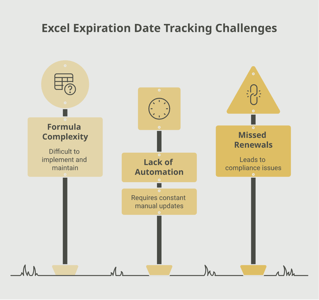
Spreadsheets are still the most common tracking method in mid-market environments. They centralize data but do not prompt anyone before expiry or termination-notice deadlines.
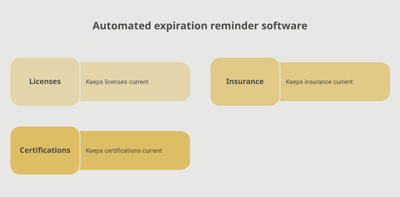
A dedicated tracking platform like Expiration Reminder stores each maintenance contract with its vendor, product, term, renewal date, auto-renewal clause, termination-notice deadline, and supporting documents. Reminders fire automatically before each renewal.
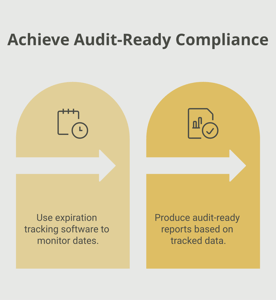
Key features include automated reminders at multiple intervals (120, 90, 60, 30 days before expiry — many enterprise maintenance contracts need lead time for evaluation and budget alignment), document storage for contracts and quotes, dashboard views by vendor, application, or expiry window, audit-ready reports for IT and finance, and the ability to log new expiration dates after each renewal.
Key Takeaways
- A software maintenance contract obligates the vendor to provide technical support and software updates for a defined period.
- Maintenance pricing is typically 18–25% of the software's list price, applied annually.
- Renewals are typically annual, with auto-renewal clauses common.
- Lapsed maintenance loses access to vendor support, software updates, and major version upgrades.
- Reinstatement after a lapse often involves back-maintenance charges plus reinstatement fees.
- Manual tracking via vendor portals or spreadsheets fails at scale; automated tracking with reminders is the reliable approach.
Frequently Asked Questions
How long does a software maintenance contract last?
Most software maintenance contracts run on annual terms. Some vendors offer multi-year terms with discounts; some support tiers run on shorter cycles.
What does software maintenance typically include?
Technical support, software updates (minor releases, bug fixes, security patches), entitlement to major version upgrades during the term, and access to vendor online resources.
What happens when software maintenance expires?
The underlying software typically continues to run, but vendor support, software updates, and major version upgrades become unavailable until coverage is reinstated.
How much does software maintenance cost?
Typically 18–25% of the software's list price per year, with vendor-specific variations and possible yearly escalators.
What is an auto-renewal clause?
A contract clause that automatically renews the maintenance for another term unless the customer provides written termination notice within a specified window (often 30–60 days before the renewal date).
Can I let maintenance lapse and reinstate later?
In some cases yes, but vendors typically charge back-maintenance for the lapsed period plus a reinstatement fee. The math rarely favors letting maintenance lapse intentionally.
Is software maintenance the same as software subscription?
No. A subscription bundles the software entitlement and support into a recurring fee. Maintenance is a separate contract on top of a perpetual software license — the license is separate from the maintenance.
How do I track maintenance contracts across many vendors?
Combine a software asset management tool with a renewal tracker that actively prompts before expiration. The tool inventory plus active calendar reminders is the combination that survives team transitions.
Conclusion
Software maintenance contracts are the support and update layer for every piece of perpetually licensed enterprise software. The substantive work — choosing tiers, negotiating renewals, evaluating value — sits with IT and procurement. The administrative work — knowing every contract's expiration date, every auto-renewal clause, and every termination-notice deadline — is where most software asset management programs stumble.
If your team tracks maintenance through vendor portals or a spreadsheet, you already know how easy it is for a renewal to land before you have planned for it. A purpose-built tracking platform like Expiration Reminder centralizes every contract, sends reminders before each expiration date, stores the supporting documents, and produces audit-ready reports the moment anyone asks.
Keep the support active, plan the renewals, and let the system handle the calendar.