Introduction
If your organization employs licensed professionals — physicians, nurses, dentists, pharmacists, attorneys, accountants, engineers, architects, real estate agents, social workers, therapists, or any of the dozens of regulated occupations — professional license currency is one of the most consequential workforce-compliance controls in the business. Every license has its own state board, its own renewal cycle, and its own continuing education requirements. Lapsed licenses immediately disqualify the worker from practicing.
This article explains what a professional license is, the state-board framework, the typical renewal cycles, continuing education (CE) requirements, and the most practical way to track professional licenses across a credentialed workforce.
For most HR, compliance, and credentialing teams, capturing license data at hire is well understood. The hard part is the calendar — knowing every worker's renewal date, every CE deadline, and which licenses are tied to which roles.
What Is a Professional License?
A professional license is a state-issued authorization permitting an individual to practice a regulated profession. Licensing is primarily a state function in the U.S., with each state's licensing board administering its own program for each licensed profession.
Common regulated professions:
- Healthcare — physicians, physician assistants, nurses (RN, LPN, NP), dentists, dental hygienists, pharmacists, pharmacy technicians, physical therapists, occupational therapists, speech therapists, psychologists, counselors, social workers, dieticians, optometrists, veterinarians.
- Legal and Financial — attorneys, certified public accountants, enrolled agents, financial advisors.
- Engineering and Architecture — professional engineers (PE), architects (AIA), land surveyors.
- Construction trades — electricians, plumbers, HVAC, general contractors.
- Real estate — real estate brokers and salespersons, appraisers, home inspectors.
- Personal services — cosmetologists, barbers, estheticians, massage therapists.
- Security and investigation — security guards, private investigators.
- Insurance and financial services — insurance producers/agents, securities representatives.
The framework includes:
- State licensing boards — administer licensure for each profession in each state.
- National certification organizations (separate from licensure) — administer specialty certifications that may supplement state licensure (ABMS for physicians, NABP NAPLEX for pharmacists, NCEES for engineers, etc.).
- State practice acts — define scope of practice and licensing requirements.
Typical renewal cadence:
- Annual — common for some trade licenses, real estate, insurance.
- 2 years — most common cycle for healthcare professions.
- 3 years — common for some legal and accounting professions.
- 5 years — for some less-frequent renewal cycles.
Continuing education (CE) requirements are typical:
- Healthcare professions — most states require CE hours per renewal cycle covering profession-specific topics, plus increasingly required courses on opioid prescribing, suicide prevention, cultural competency, implicit bias, and other emerging topics.
- Legal/accounting — CLE for attorneys, CPE for CPAs — typically 20-40 hours per cycle.
- Engineering — Professional Development Hours (PDH) per cycle.
- Trades — code-cycle training tied to building code updates.
License compact agreements (Nurse Licensure Compact, eNLC; Physical Therapy Compact; Counseling Compact; others) allow some practitioners to practice across multiple states with a single primary state license, simplifying multi-state practice.
Why Professional License Tracking Matters for Your Organization
Professional license currency protects against three concrete risks: practice without authority, regulatory and payer issues, and patient/client harm exposure.
From a practice standpoint, an unlicensed practitioner cannot legally practice. Continuing to employ or contract with someone in a licensed role without a current license violates state law and creates significant employer exposure.
From a payer standpoint, healthcare and other regulated services billed to insurance or government programs typically require current licensure. Claims submitted by unlicensed providers can be denied or recouped.
From a patient/client-harm standpoint, professional licensure exists to protect the public. Lapses can affect malpractice and liability coverage and weaken legal defenses.
For organizations employing licensed professionals, the license calendar is one of the most consequential operational and compliance controls.
Common Scenarios for Tracking Professional License Expiration Dates
Healthcare Organizations
Hospitals, health systems, large medical groups, dental and veterinary practices, and pharmacies manage licenses across hundreds or thousands of clinical workforce members.
Professional Services Firms
Law firms, accounting firms, engineering firms, and architecture firms manage state bar, CPA, PE, and AIA licenses across professional staff.
Construction and Trades
GCs and specialty contractors manage trade licenses (electrical, plumbing, HVAC) for licensed personnel.
Real Estate and Financial Services
Real estate brokerages and financial services firms manage agent and producer licenses across sales workforces.
Multi-State Operations
Organizations operating across multiple states face multiplied tracking complexity, with separate licenses required in each state of practice (unless covered by an applicable compact).
How Professional License Tracking Benefits Your Organization
A reliable program produces measurable benefits.
For the company, current licenses support payer reimbursement, regulatory compliance, and clean credentialing audits.
For HR, credentialing, and compliance teams, the license calendar becomes predictable. CE deadlines are met with adequate lead time. Renewal applications are filed on schedule.
For workers, predictable tracking supports their continued employment in licensed roles.
How to Track Professional License Expiration Dates
State licensing board databases provide primary-source verification. National practitioner databases (NPDB for healthcare) provide adverse-action history.
Credentialing platforms (Cactus, Symplr, MD-Staff, Echo, Verge, others) manage healthcare credentialing including licenses. HR and compliance platforms increasingly include license tracking for non-healthcare professions.
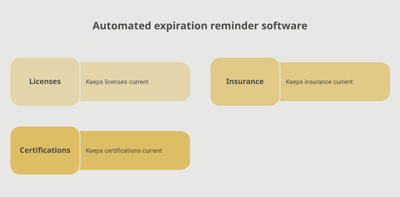
For organizations using a separate compliance tracker, a platform like Expiration Reminder stores each worker with their licensure profile (state, profession, license number, expiration, CE requirements, scope/endorsements, and supporting documents). Reminders fire automatically before each renewal milestone and CE deadline.
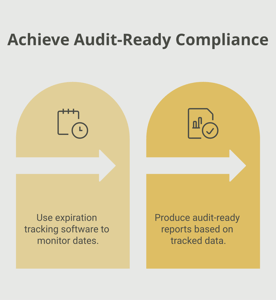
Key features include automated reminders at multiple intervals (180, 90, 60, 30 days), document storage for license certificates and CE evidence, dashboard views by profession, state, or expiry window, audit-ready reports for credentialing committees and licensing boards, and the ability to log renewals in one step.
Key Takeaways
- A professional license is a state-issued authorization permitting practice in a regulated profession.
- Licensing is primarily a state function, administered by state licensing boards.
- Renewal cadence varies: annual, 2 years (most common in healthcare), 3 years, or 5 years.
- Continuing education (CE) requirements are typical and vary by state and profession.
- Compact agreements simplify multi-state practice for some professions.
- Lapses immediately disqualify the worker from practice and create employer and payer exposure.
- Automated tracking with reminders is essential for organizations employing licensed professionals.
Frequently Asked Questions
Who needs a professional license?
Individuals practicing in a state-regulated profession. Common categories include healthcare, legal/accounting, engineering/architecture, trades, real estate, personal services, and security/investigation.
How long is a professional license valid?
Varies by state and profession. Healthcare professions commonly renew every 2 years; legal and accounting every 2-3 years; trades and real estate often annually; engineering every 2 years; cosmetology often 2 years.
What are CE requirements?
Continuing education hours required per renewal cycle, typically delivered through state-board-approved courses. Counts vary by profession (often 20-40 hours per 2-year cycle).
What is a license compact?
A multi-state agreement allowing practitioners licensed in one compact state to practice in other compact states without separate licensure. Examples: Nurse Licensure Compact (eNLC), Physical Therapy Compact, Counseling Compact.
How is licensure different from board certification?
Licensure is the state-issued authority to practice (required). Board certification is voluntary specialty credentialing (e.g., ABMS for physicians) demonstrating training in a specialty area.
What happens if a professional license expires?
The individual cannot legally practice. Employers must immediately stop assigning licensed work. Payer claims may be denied. Reinstatement typically requires application, fees, and possibly remedial CE.
Can I reinstate a lapsed license?
In most states yes, with application, fees, and (depending on length of lapse) possibly retesting or remedial CE. Long lapses may require new licensure.
How do organizations track licenses across many states or professions?
Combinations of credentialing platforms, HR systems, and dedicated tracking platforms. The system that actively reminds before each renewal and CE deadline is the one that prevents most lapses.
Conclusion
Professional licensing sits at the foundation of every regulated workforce. The substantive work — passing exams, completing CE, maintaining good standing — sits with the licensed professionals themselves. The administrative work — knowing every worker's licensure status across professions and states, scheduling CE deadlines, and managing renewals — is where most organizations need help.
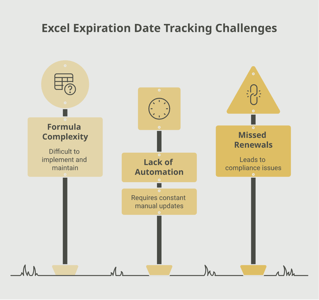
If your team tracks professional licenses through state board sites or spreadsheets, you already know how easy it is for one practitioner's CE or renewal to slip past. A purpose-built tracking platform like Expiration Reminder centralizes every worker's licensure record, sends reminders before each renewal and CE deadline, stores the supporting documents, and produces audit-ready reports the moment anyone asks.
License the workforce, complete the CE, and let the system handle the calendar.