Introduction
If your organization runs a commercial fleet of any size, "MVR" is one of the most consequential three-letter abbreviations on your compliance checklist. The annual MVR review is one of the most frequently cited violations during DOT audits, and the documentation requirements are specific: who pulled the record, when, who reviewed it, when, and where the resulting note is filed.
This article explains what an MVR is, the FMCSA rules around it for commercial drivers, who must check it, how often, and what happens when the annual review lapses. You will also see the most practical way to track MVR reviews across a driver roster of 10, 100, or 1,000 commercial drivers.
For most safety and compliance leaders, pulling the MVR is straightforward. The hard part is the calendar — making sure every driver's annual review happens within the 12-month window, with documentation that survives an audit.
What Is a Motor Vehicle Record?
A Motor Vehicle Record (MVR) is an official report from a state department of motor vehicles documenting an individual driver's license status and history. In the commercial driving context, MVR reviews are governed by the Federal Motor Carrier Safety Administration under the Federal Motor Carrier Safety Regulations (FMCSRs).
An MVR typically includes:
- License number, class, status, and expiration date
- Endorsements and restrictions
- Traffic violations and convictions
- Accidents involving the driver
- License suspensions and revocations
- DUI convictions
- Points on the license
For DOT-regulated motor carriers, the regulatory baseline is set by FMCSR § 391.25: every motor carrier must, at least once every 12 months, review the driving record of each driver it employs and place a note in the driver's qualification file documenting the review.
For pre-employment screening, carriers must pull an MVR from every state where the driver held a CDL within the previous 3 years and must review the report before allowing the driver to operate a commercial motor vehicle. Recordkeeping requirements run three years from the date of each review.
The "validity" of an MVR review is the 12-month window in § 391.25 — once a year passes from the last review, the next is required.
Why MVRs Matter for Your Organization
MVR compliance sits at the intersection of three serious risk categories: DOT enforcement, insurance, and negligent hiring liability.
From a DOT enforcement standpoint, missing or late annual MVR reviews are among the most common findings during compliance reviews and roadside investigations. Fines for missing or late MVRs can run $1,000+ per missing or late MVR, and patterns of non-compliance can lead to deeper investigations, conditional safety ratings, or unsatisfactory ratings that disrupt operations.
Insurance carriers underwriting commercial auto coverage rely on MVRs as core inputs. Drivers with deteriorating records can push premiums up at renewal, fall outside the carrier's underwriting criteria, or trigger coverage exclusions. Carriers also frequently audit insureds' MVR compliance as part of routine policy reviews.
From a negligent hiring liability standpoint, courts in many jurisdictions look at whether the employer pulled, reviewed, and acted on the driver's MVR as a key element of the duty of care. A documented, recent review demonstrates reasonable diligence; a missing review is an evidentiary problem in any post-incident litigation.
Common Scenarios for Tracking MVR Review Dates
MVR tracking touches every motor carrier and most commercial-driving operations. Here are the contexts where keeping reviews current matters most.
Long-Haul and Regional Trucking Companies
Truckload, less-than-truckload, and regional carriers must complete an annual MVR review on every CDL driver, filed in the driver qualification (DQ) file. With 50 to 5,000 drivers, the calendar becomes a real workload, and missing one is the kind of finding that compounds during audits.
Last-Mile, Parcel, and Courier Operations
Last-mile delivery, parcel, and courier operations often run high-turnover driver rosters. New driver onboarding requires pre-employment MVRs, and the annual review for retained drivers must hit every 12-month window despite churn.
Bus, Coach, and Passenger Transportation
Motor coach operators, school bus contractors, and intercity bus lines must meet both FMCSR § 391.25 requirements and any state-specific passenger-transportation overlays. Passenger-carrier MVR programs typically include continuous monitoring on top of the annual baseline.
Vocational Fleets (Construction, Utilities, Service)
Construction companies, utilities, telecom service fleets, and similar operations run mixed fleets — CDL drivers operating heavy equipment alongside non-CDL drivers in service vehicles. The CDL drivers fall under § 391.25; the non-CDL drivers fall under whatever cadence the employer or insurance carrier sets.
Owner-Operator and Leased-Operator Programs
Carriers using owner-operators or leased drivers must still meet § 391.25 requirements for those drivers — the contractor structure does not change the regulatory obligation. Tracking owner-operator MVRs alongside W-2 drivers is a common gap.
How MVR Reviews Benefit Your Company and Drivers
A reliable MVR program produces measurable benefits.
For the company, current annual MVRs support DOT compliance, lower insurance costs, sustain a Satisfactory safety rating, and preserve customer relationships in regulated supply chains where carrier safety performance is a procurement criterion. Clean MVR records also strengthen negligent-hiring defenses if an incident occurs.
For drivers, predictable annual reviews are part of professional standards rather than a surprise. Many carriers couple the annual review with safety coaching, which measurably reduces future incidents — the goal of the regulation in the first place.
For shippers, brokers, and the public, MVR-compliant carriers offer a more reliable, safer service. Many large shippers explicitly require MVR compliance evidence from carriers in their procurement and approved-carrier processes.
How to Track MVR Review Dates
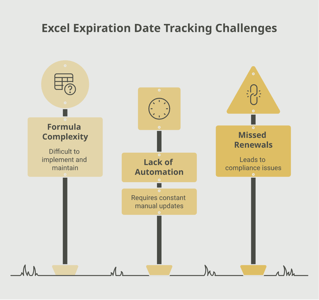
The most common tracking method is a safety lead or compliance manager working from a spreadsheet of drivers and review dates. This works for very small fleets but breaks down quickly past 20–30 drivers — and the audit consequence of a missed review is severe.
A driver qualification file management system (DQF software) is the standard mid-market tool. These systems track MVR review dates alongside medical examiner certificates, drug-and-alcohol clearinghouse queries, and other required DQ documents. The strength is in DOT-specific feature depth; the weakness is integration with non-DOT compliance (executive drivers, sales reps, light service vehicles) that exists elsewhere in the company.
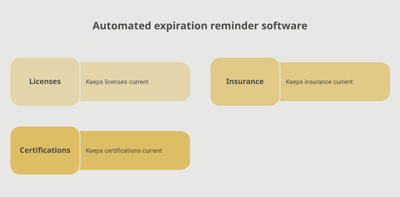
A dedicated tracking platform like Expiration Reminder handles the calendar layer alongside DQF management or as a standalone for non-DOT fleets. Each driver record tracks license, MVR review date, medical certificate, drug testing, and any other compliance dates, with the actual documents attached.
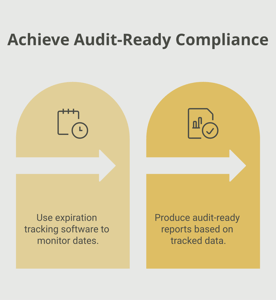
The features that matter most for MVR tracking include automated reminders before the 12-month window closes (commonly 60, 30, and 0 days before next due), document storage so each MVR is attached to the driver record, dashboard views by terminal, role, or driver class, audit-ready reports of MVR compliance across the fleet, and the ability to log a new review and reset the next-due date in one step.
The result is an MVR program where every driver's annual review happens on time, the documentation is ready, and the audit becomes a non-event.
Key Takeaways
- A Motor Vehicle Record (MVR) is an official report from a state DMV documenting a driver's license status and history.
- FMCSR § 391.25 requires motor carriers to review each driver's MVR at least once every 12 months and document the review in the driver qualification file.
- Pre-employment MVRs must be pulled from every state where the driver held a CDL within the previous 3 years.
- Missing or late MVR reviews are among the most cited findings in DOT compliance reviews; fines can exceed $1,000 per missing or late MVR.
- Insurance carriers rely on MVRs for underwriting; deteriorating records affect premiums and coverage.
- Records must be retained for 3 years from the date of each review.
- Manual tracking via spreadsheets fails at scale; automated tracking with reminders and document storage is the reliable approach.
Frequently Asked Questions
How often must DOT-regulated employers review MVRs?
At least once every 12 months under FMCSR § 391.25. The review must be documented in the driver qualification file with the name of the reviewer and the date.
How long must MVR records be retained?
Three years from the date of each review under FMCSR. Many carriers retain records longer to support multi-year audits and insurance reviews.
Do I need a separate MVR from each state where the driver has held a CDL?
For the pre-employment review, yes — you must pull an MVR from every state where the driver held a CDL within the previous 3 years. For the annual review, you generally pull the MVR from the state of current license issuance.
What happens if I miss an annual MVR review?
The driver is technically out of compliance under § 391.25. DOT can cite the carrier during a compliance review or roadside investigation. Fines can run $1,000+ per missing or late MVR. Patterns of non-compliance can affect the carrier's safety rating.
Is continuous MVR monitoring required?
Not under federal DOT regulation, which sets the annual baseline. However, many insurance carriers, safety programs, and customer contracts effectively require continuous monitoring on top of the annual review.
Who can review an MVR for compliance purposes?
The carrier must designate a person to perform the review; the regulation does not specify a credential. The reviewer's name and the date of review must be documented in the DQ file.
What is the difference between an MVR and a PSP report?
An MVR is from the state DMV. A PSP (Pre-Employment Screening Program) report is from FMCSA and shows the driver's 5 years of inspection history and 3 years of crash history from federal records. Both are commonly used in commercial driver hiring.
Can MVR reviews count for non-CDL drivers?
The annual MVR review under § 391.25 applies to drivers subject to the FMCSRs (CDL drivers and other DOT-regulated commercial drivers). For non-CDL drivers, MVR review cadence is typically set by employer policy and insurance requirements rather than federal regulation.
Conclusion
MVR compliance is one of the highest-leverage activities in DOT fleet management. The rules are clear, the schedule is fixed, and the penalty for missing the annual review is concrete. The challenge is execution — making sure every driver's MVR is pulled, reviewed, documented, and filed within the 12-month window, year after year.
If your safety team is tracking MVR dates through spreadsheets or DQF software that does not actively remind, you already know how fragile that is. A purpose-built tracking platform like Expiration Reminder centralizes every driver, sends reminders before each review date, stores the records, and produces audit-ready reports the moment anyone asks.
Pull the records, review them on time, and let the system handle the dates.