Introduction
If your workforce includes employees in safety-sensitive roles, regulated industries, or jurisdictions with statutory medical requirements, a medical certificate is the document proving each worker is medically fit to perform their job. The category is broad — fitness-for-work certificates, return-to-work clearances, occupational health certificates, school enrollment medical certificates, and many regulatory-specific medical documents. Validity is typically annual but varies significantly by purpose.
This article explains what a medical certificate is, the major use cases, the typical validity periods, and the most practical way to track medical certificates across a workforce.
For most HR and occupational health teams, obtaining the initial certificate is well understood. The hard part is the calendar — knowing whose certificate is current and ensuring no worker performs work that requires a current medical certificate without one.
What Is a Medical Certificate?
A medical certificate is a document issued by a licensed healthcare provider confirming an individual's medical status for a specified purpose. Common types include:
- Fitness-for-work certificates — confirm an employee is physically and mentally able to perform their job duties safely. Common at hire, after illness/injury, before return to work, and periodically for high-risk roles.
- Return-to-work clearances — after sick leave, surgery, injury, or extended absence.
- Occupational health surveillance certificates — under specific industry programs (e.g., asbestos workers under OSHA 1910.1001, hearing conservation under 1910.95, respirator users under 1910.134).
- Pre-employment medical exams — required for safety-sensitive roles (transportation, public safety, certain industrial operations).
- School enrollment medical certificates — required for student enrollment in many jurisdictions.
- Immigration medical exams — required for U.S. immigration (Form I-693), UK settlement applications, and equivalents.
- Drivers' medical certificates — covered separately by jurisdiction-specific rules (see Medical Card / DOT Physical for U.S. commercial drivers).
- Maritime / aviation / similar regulated medicals — covered by industry-specific schemes (FAA medical certificates, STCW medical certificates).
Validity periods vary by purpose:
- General fitness-for-work: commonly annual or as required by employer policy.
- Return-to-work: single-use for the return event.
- Occupational health surveillance under OSHA: cadence set by the specific OSHA standard (often annual; sometimes longer intervals).
- DOT medical card: up to 24 months (typically — separate article).
- FAA medical certificates: 6–60 months depending on class and age.
- Immigration medical: typically valid for 60 days to 2 years depending on jurisdiction and purpose.
The contents typically include the employee's identification, the date of examination, the examining physician's identification and signature, the specific findings (or summary thereof), any restrictions or accommodations, and the certificate's expiration or validity period.
Why Medical Certificate Tracking Matters for Your Organization
Medical certificate currency protects against three concrete risks: regulatory non-compliance, worker injury, and contractual or operational disruption.
From a regulatory standpoint, specific OSHA standards (1910.95 hearing conservation, 1910.134 respiratory protection, 1910.1001 asbestos, 1910.120 HAZWOPER, others) include explicit medical surveillance requirements. Lapses trigger citations.
From a worker-safety standpoint, fitness-for-work assessments catch conditions that could affect safe job performance — vision, hearing, cardiovascular fitness, respiratory function, musculoskeletal status. Without current assessments, organizations can place workers in roles their current health status does not support.
From an operational standpoint, customer contracts, regulatory licenses, and government programs often require current medical certificates for specific roles. Lapses can affect contract eligibility and operating authority.
For organizations with regulated workforces — transportation, healthcare, mining, construction, manufacturing with surveillance requirements — the medical certificate calendar is a foundational compliance control.
Common Scenarios for Tracking Medical Certificate Expiration Dates
Industrial and Manufacturing Workforces
Industrial workers subject to OSHA medical surveillance (respirator users, hearing conservation, asbestos workers, lead workers, HAZWOPER workers) need current surveillance certificates.
Construction and Trades
Construction workers in roles requiring fitness assessments — particularly work at height, confined space entry, respirator use — typically need current medical certificates.
Transportation and Logistics
Commercial drivers, train operators, maritime workers, and aviation personnel face industry-specific medical certificate regimes.
Healthcare
Healthcare workers may need pre-employment physicals, TB tests, immunization records, and periodic fitness assessments depending on role and employer policy.
Education and Schools
Schools require medical certificates for student enrollment in many jurisdictions, plus periodic clearances for staff in some roles.
How Medical Certificate Tracking Benefits Your Organization
A reliable tracking program produces measurable benefits.
For the company, current medical certificates satisfy regulatory and contractual requirements, reduce the risk of placing workers in roles their health does not support, and support clean audit posture.
For HR, occupational health, and operations teams, the certificate calendar becomes predictable. Annual exams are scheduled with adequate lead time. Return-to-work assessments are tracked as part of broader leave management.
For workers, predictable medical assessment cycles reduce the friction of last-minute appointments and ensure continued eligibility for the roles they were hired to perform.
How to Track Medical Certificate Expiration Dates
HRIS platforms and occupational health vendors may track certificate dates as part of broader employee data. Specialized occupational health management systems (Cority, Medgate, others) are common in large industrial workforces.
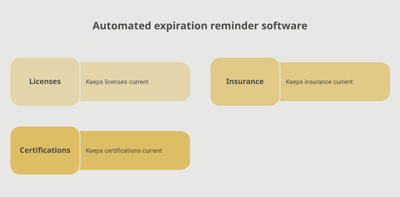
For organizations using a separate compliance tracker, a platform like Expiration Reminder stores each worker with their medical certificate type, issue date, expiration date, any restrictions, and supporting documents. Reminders fire automatically before each renewal.
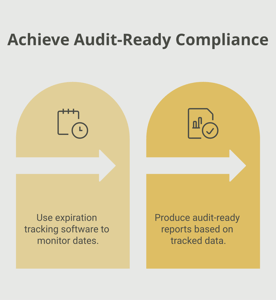
Key features include automated reminders at multiple intervals (90, 60, 30 days), document storage for certificates and supporting records (with appropriate confidentiality controls), dashboard views by role, location, or expiry window, audit-ready reports for OSHA and regulatory programs, and the ability to log new certificates in one step.
Key Takeaways
- A medical certificate is a document issued by a licensed healthcare provider confirming an individual's medical status for a specified purpose.
- Common types include fitness-for-work, return-to-work, occupational health surveillance, pre-employment medical, school enrollment, and regulatory medicals.
- Validity periods vary widely — commonly annual for general fitness-for-work; longer or shorter depending on regulatory purpose.
- OSHA medical surveillance standards (1910.95, 1910.134, 1910.1001, 1910.120, others) impose specific cadence requirements.
- Lapses can trigger regulatory citations, worker placement issues, and contractual problems.
- Automated tracking with reminders is the reliable approach for any non-trivial regulated workforce.
Frequently Asked Questions
How long is a medical certificate valid?
It depends entirely on the purpose. General fitness-for-work certificates are commonly annual. Specific regulatory medicals have specific cadences (DOT medical card up to 24 months; FAA medical certificates 6–60 months; OSHA surveillance varies by standard).
What is a fitness-for-work certificate?
A document issued by a healthcare provider confirming an individual is physically and mentally able to perform their job duties safely, often required at hire, after illness/injury, or periodically for high-risk roles.
What is occupational health surveillance?
Medical monitoring of workers exposed to specific hazards (noise, respiratory hazards, asbestos, lead, etc.) required under specific OSHA standards. Includes baseline and periodic medical exams with results reported to the worker and (in summary form) to the employer.
Are medical certificates confidential?
Yes. Medical information is protected under HIPAA (in the U.S.), GDPR (in the EU/UK), and analogous privacy laws elsewhere. Employers typically receive only the summary fitness determination (fit/unfit/restrictions) rather than detailed medical findings.
What is a return-to-work clearance?
A medical certificate documenting that an employee returning from leave (sickness, injury, surgery) is medically able to resume work, with any specified restrictions or accommodations.
Are pre-employment medicals legal?
In the U.S., pre-employment medical exams may be required only after a conditional offer of employment, under the Americans with Disabilities Act (ADA). The exam must be applied uniformly to all candidates for the position.
How do medical certificates interact with disability and accommodation laws?
Medical assessments can identify accommodations needed for workers with disabilities. Employers must engage in the interactive accommodation process under ADA (U.S.) or analogous laws — fitness-for-work assessment results inform but do not replace that process.
How long should medical records be kept?
OSHA medical records under 1910.1020 must be maintained for the duration of employment plus 30 years. Other medical records follow employer-policy or jurisdiction-specific rules.
Conclusion
Medical certificates are the documentation layer between workforce health and the regulatory and operational expectations of the work. The substantive work — examining workers, issuing certificates, applying accommodations — sits with occupational health, HR, and operations. The administrative work — knowing every worker's certificate status and producing the records on demand — is where most programs need help.
If your team tracks medical certificates through HRIS or occupational health systems, you already know how easy it is for one worker's annual cert to slip past — particularly across multiple regulatory regimes. A purpose-built tracking platform like Expiration Reminder centralizes every certificate, sends reminders before each expiration, stores the supporting documents with appropriate confidentiality controls, and produces audit-ready reports the moment anyone asks.
Monitor the workforce, document the fitness, and let the system handle the calendar.