Introduction
If your business buys or sells services on a continuing basis, a Master Service Agreement (MSA) is almost certainly part of the relationship. The MSA sets the master terms — liability, IP, data, dispute resolution, payment — that govern every subsequent statement of work, purchase order, or transaction under that customer or vendor relationship. When an MSA expires unnoticed, the relationship may continue but on murkier legal footing, and termination-notice deadlines that should have been acted on can quietly lock both parties into another full term.
This article explains what an MSA is, the typical term and renewal structures, what happens at expiration, and the most practical way to track MSA dates across many vendor and customer relationships.
For most legal, procurement, and sales teams, drafting and negotiating the MSA is well understood. The hard part is the calendar — knowing when each MSA renews, when termination notice is due, and when terms need to be renegotiated.
What Is a Master Service Agreement?
A Master Service Agreement (MSA) is a contract between two parties that establishes the baseline terms for an ongoing B2B service relationship. The MSA typically covers:
- Term and termination — how long the agreement runs, how it renews, and how either party can end it.
- Services — the general scope of what may be delivered (specific work is then defined in Statements of Work or SOWs underneath).
- Fees and payment terms — pricing structure, invoicing, late payment, currency.
- Intellectual property — ownership of pre-existing IP, new work product, licenses granted.
- Confidentiality — handling of proprietary information.
- Data protection and privacy — how personal and sensitive data is handled.
- Warranties and disclaimers — what each party promises and what is explicitly disclaimed.
- Indemnification — who covers whom for which kinds of claims.
- Limitation of liability — caps on monetary exposure.
- Insurance — required coverage types and limits.
- Dispute resolution — venue, governing law, arbitration vs litigation.
Typical MSA terms include initial periods of 12 months with auto-renewals for successive 12-month terms, or fixed multi-year terms (3 or 5 years) requiring renegotiation at end of term. Many MSAs include automatic renewal clauses requiring 60–90 days notice of termination before the end of the current term to prevent auto-renewal.
Under the MSA, specific engagements are typically captured in Statements of Work (SOWs), Order Forms, or Purchase Orders that reference the MSA. The MSA terms apply to those documents unless explicitly overridden.
When an MSA expires without renewal or active termination, the legal position becomes ambiguous. Continued performance may be treated as an implied extension, a month-to-month arrangement, or a new contract under the same terms — depending on jurisdiction and conduct. Disputes that arise after expiry can be expensive to resolve.
Why MSA Currency Matters for Your Organization
MSA currency protects against three concrete risks: legal ambiguity, unintended auto-renewal, and missed renegotiation windows.
From a legal standpoint, an MSA in clear effect provides predictable terms for liability caps, IP ownership, indemnification, and dispute resolution. An expired or ambiguous MSA leaves the parties exposed to the default rules of the governing law, which may be very different from what was negotiated.
From an auto-renewal standpoint, MSAs with automatic renewal clauses can trap a party into another full term when the relationship has run its course. Termination-notice deadlines (often 60–90 days before the end of term) must be tracked separately from the renewal date itself.
From a renegotiation standpoint, end-of-term is often the best moment to revisit pricing, terms, or scope. Missing the renegotiation window means accepting the previous terms for another period.
For organizations with many active MSAs — large procurement programs, SaaS-heavy companies, agencies, consulting firms — centralizing the MSA calendar is a strategic capability, not just a compliance task.
Common Scenarios for Tracking MSA Expiration Dates
Enterprise Procurement Programs
Large procurement organizations manage hundreds of vendor MSAs across IT, marketing, professional services, facilities, and more. Each has its own term, renewal cycle, and termination-notice window.
SaaS and Technology Vendors (as Customer)
Modern SaaS-heavy companies enter MSAs with most of their software vendors. The MSA renewal cycle interacts with the underlying subscription renewal cycle.
Marketing Agencies and Consulting Firms
Service providers operate under MSAs with each of their clients. Coordinating MSA terms across many clients — particularly when terms vary client by client — is a continuous operational task.
Construction and Project-Based Services
Construction and engineering firms use MSAs to set baseline terms with general contractors, owners, and trade subs. Project-specific SOWs sit under the MSA.
Vendor Risk and Third-Party Management
Compliance and vendor risk management programs typically require active MSAs as part of vendor onboarding. Lapsed MSAs are a routine finding in vendor management audits.
How MSA Tracking Benefits Your Organization
A reliable MSA tracking program produces measurable benefits.
For the company, current MSAs maintain clear legal terms across business relationships, prevent unintended auto-renewals, and create the visibility needed for end-of-term renegotiation.
For legal, procurement, and sales teams, the MSA calendar becomes a planned activity. Termination-notice deadlines are acted on in time. Renewal discussions happen with adequate lead time.
For finance and risk management, accurate MSA visibility supports vendor consolidation, term standardization, and stronger negotiating posture.
How to Track MSA Expiration Dates
Contract lifecycle management (CLM) platforms — Ironclad, Icertis, Sirion, Concord, and others — provide deep MSA tracking, including auto-renewal monitoring, clause-level analysis, and approval workflows.
For organizations not running a full CLM, contract repositories with renewal date fields (SharePoint, Box, DocuSign CLM-lite, etc.) provide basic tracking.
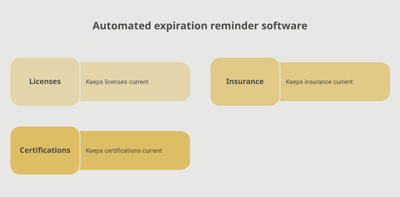
A dedicated tracking platform like Expiration Reminder stores each MSA with its counterparty, term type, expiration date, auto-renewal clause, termination-notice deadline, governing law, key terms, and supporting documents. Reminders fire automatically before each renewal — typically multiple intervals, including before the termination-notice deadline.
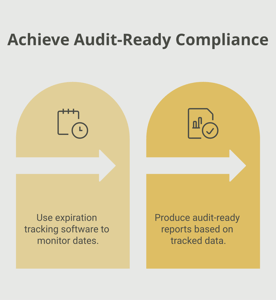
Key features include automated reminders at multiple intervals (180, 120, 90, 60 days before expiry — and separate reminders before the termination-notice deadline), document storage for the MSA and related SOWs/order forms, dashboard views by counterparty or expiry window, audit-ready reports for legal and procurement, and the ability to log new expiration dates after each renewal or amendment.
Key Takeaways
- A Master Service Agreement (MSA) is a B2B contract establishing baseline terms for an ongoing service relationship, with specific work then captured in Statements of Work or Purchase Orders.
- Typical MSA terms include 12-month initial periods with auto-renewal, or fixed multi-year terms.
- Auto-renewal clauses commonly require 60–90 days notice of termination to prevent another full term.
- Expired MSAs create legal ambiguity for ongoing performance and disputes.
- Termination-notice deadlines must be tracked separately from the renewal date itself.
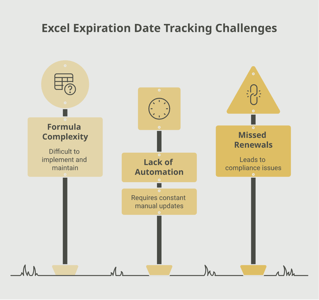
- Manual tracking via spreadsheets fails at scale; CLM platforms and dedicated tracking systems are the reliable approaches.
Frequently Asked Questions
How long is an MSA valid?
Typical MSA terms include initial periods of 12 months with auto-renewals for successive 12-month terms, or fixed multi-year terms (3 or 5 years). The specific length is negotiated and varies widely.
What is an auto-renewal clause in an MSA?
A clause that automatically extends the MSA for another term unless one party provides written notice of termination within a specified window (often 60–90 days before the end of the current term).
What is the difference between an MSA and an SOW?
The MSA sets the master terms governing the overall relationship. SOWs (Statements of Work) sit under the MSA and define specific projects, deliverables, timelines, and fees. The MSA terms apply to each SOW unless explicitly overridden.
What happens when an MSA expires?
If both parties continue to perform, the legal position becomes ambiguous — it may be treated as an implied extension, a month-to-month arrangement, or a new contract under the same terms. Disputes after expiry can be expensive to resolve.
Can an MSA be renewed after expiry?
Yes, by mutual agreement. The cleaner approach is to renew before expiry to avoid the ambiguity of a gap.
What is a termination-notice deadline?
The date by which either party must give written notice if they do not want the MSA to auto-renew. Missing this deadline locks the parties into another full term.
How do organizations manage many MSAs across vendors and customers?
Larger organizations use Contract Lifecycle Management (CLM) platforms. Smaller organizations use contract repositories combined with dedicated renewal tracking systems.
Should the MSA or the SOW take precedence?
Standard practice is the SOW for project-specific terms (scope, fees, timelines) and the MSA for general legal terms. When the documents conflict, the order of precedence is set by the MSA itself — typically with the MSA governing legal matters and the SOW governing specifics.
Conclusion
Master Service Agreements are the legal foundation of every continuing B2B service relationship. The substantive work — negotiating terms, drafting clauses, structuring SOW arrangements — sits with legal and procurement. The administrative work — knowing every MSA's expiration date, every auto-renewal clause, and every termination-notice deadline — is where most programs need help.
If your team tracks MSAs through SharePoint, a contract repository, or scattered email folders, you already know how easy it is for a termination-notice deadline to pass before anyone notices. A purpose-built tracking platform like Expiration Reminder centralizes every MSA, sends reminders before each renewal and notice deadline, stores the supporting documents, and produces audit-ready reports the moment anyone asks.
Keep the terms clear, manage the renewals, and let the system handle the calendar.