Introduction
If your workforce operates anywhere hydrogen sulfide (H2S) is present — oil and gas exploration and production, refining, wastewater treatment, pulp and paper, mining, agriculture, or any process where H2S can accumulate — H2S certification is the safety credential that prepares workers to recognize, avoid, and respond to exposures. H2S is lethal at low concentrations and frequently underestimated by people who have not been trained.
This article explains what H2S certification is, the ANSI Z390.1 standard behind it, the annual refresher requirement, the oil-and-gas industry context, and the most practical way to track H2S training across a workforce.
For most safety and EHS teams in H2S-exposed industries, delivering the training is well understood. The hard part is the calendar — knowing whose annual refresher is due and ensuring no worker is on site without a current certification.
What Is H2S Certification?
H2S certification is workplace training covering the recognition of hydrogen sulfide hazards and the safe-work practices, detection methods, and emergency response needed for H2S-exposed environments. The most widely recognized training standard is ANSI/ASSP Z390.1 (Accepted Practices for Hydrogen Sulfide Training Programs), most recently updated as Z390.1-2024.
ANSI Z390.1 sets the minimum requirements for site-specific H2S safety training, including:
- Properties and characteristics of H2S.
- Sources of H2S and areas of potential exposure.
- Health effects and exposure limits.
- Site-specific safe work practices.
- Detection methods and instruments.
- Selection, use, and care of respiratory protection appropriate for H2S concentrations above the TLV-TWA.
- Emergency response and rescue procedures.
- Refresher training requirements.
- H2S Safety Instructor qualifications.
Per ANSI Z390.1, training must be 3–4 hours in duration. The standard requires annual refresher training for all affected employees due to the extreme hazards of H2S work. Abbreviated refresher courses are no longer considered valid under the current standard.
H2S certification is not federally mandated by OSHA in the way HAZWOPER or HazCom are. However, OSHA does enforce H2S exposure limits and respiratory protection under existing standards (1910.146 for confined spaces, 1910.134 for respiratory protection, 1910.1000 for air contaminants). State and provincial regulators in oil-and-gas regions often layer specific H2S training requirements on top.
In the oil and gas industry, H2S certification is widely required by operators as a condition of site access. Contractor staffing decisions depend on workers' current H2S certification status.
Why H2S Certification Matters for Your Organization
H2S certification currency protects against three concrete risks: lethal exposure, site exclusion, and regulatory findings.
From a safety standpoint, H2S kills quickly — sometimes with no warning. At low concentrations it has a characteristic rotten-egg smell; at higher concentrations it paralyzes the sense of smell, removing the most obvious warning. Training is the primary control supporting recognition and avoidance.
From an operational standpoint, oil-and-gas operators and many other H2S-exposed industries require current certification as a condition of site access. Workers without a current card cannot perform the work.
From a regulatory standpoint, while OSHA does not impose a specific H2S training mandate, the General Duty Clause and applicable air-contaminant and respiratory protection standards still apply. State and provincial regulators in oil-and-gas regions may impose additional training requirements.
For contractors and operators in oil and gas, refining, wastewater, and similar H2S-exposed industries, the H2S certification calendar across the workforce is a foundational operational control.
Common Scenarios for Tracking H2S Certification Dates
Oil and Gas Exploration and Production
E&P operators and contractors working on drilling, completion, production, and workover operations face routine H2S exposure risk. Site access typically requires current certification.
Refining and Petrochemicals
Refineries process sour crude and intermediates containing H2S. Refinery workers, maintenance contractors, and turnaround crews all require H2S training.
Wastewater Treatment
Municipal and industrial wastewater operations generate H2S in collection systems, lift stations, and digesters. Wastewater operators and maintenance crews require H2S awareness.
Pulp and Paper, Tanneries, and Other Industrial
Pulp and paper mills (kraft process), tanneries, agricultural waste operations, and similar industries can generate H2S in production. Site-specific training is required.
Confined Space and Rescue Teams
Confined space entry and rescue teams operating in environments with H2S potential require H2S training in addition to confined space and rescue credentials.
How H2S Tracking Benefits Your Organization
A reliable tracking program produces measurable benefits.
For the company, current H2S certifications maintain site access, support oil-and-gas operator audits, and reduce the risk of catastrophic exposure incidents.
For safety, EHS, training, and operations teams, the certification calendar becomes a predictable activity. Annual refreshers are scheduled with adequate lead time. Workforce planning matches qualified workers to scheduled work.
For workers, predictable training reinforces life-safety knowledge in environments where errors are unforgiving.
How to Track H2S Certification Expiration Dates
Many H2S training providers maintain records for courses purchased through them. Some training-management systems include H2S as a tracked credential.
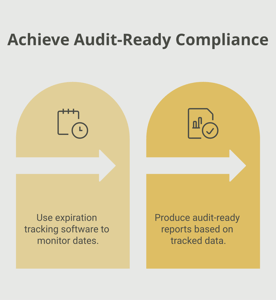
For organizations using a separate compliance tracker, a platform like Expiration Reminder stores each worker with their H2S certification, training provider, course type, issue date, expiration date, and supporting documents. Reminders fire automatically before each annual refresher.
Key features include automated reminders at multiple intervals (90, 60, 30 days), document storage for certification cards and training records, dashboard views by site, project, or expiry window, audit-ready reports for clients and operators, and the ability to log new training events in one step.
Key Takeaways
- H2S certification is workplace training covering recognition, avoidance, and response to hydrogen sulfide hazards.
- The most widely recognized standard is ANSI/ASSP Z390.1 (Accepted Practices for H2S Training Programs).
- Per ANSI Z390.1, training is 3–4 hours in duration with annual refresher required for all affected employees.
- Abbreviated refresher courses are no longer considered valid under the current ANSI Z390.1.
- OSHA does not impose a specific H2S training mandate but enforces exposure limits and respiratory protection through existing standards.
- Oil-and-gas operators typically require current certification as a condition of site access.
- Automated tracking with reminders is the reliable approach for H2S-exposed workforces.
Frequently Asked Questions
How often is H2S refresher training required?
Annually, under ANSI/ASSP Z390.1. Each affected employee should complete refresher training every 12 months.
Is H2S certification required by OSHA?
OSHA does not impose a specific H2S training mandate, but enforces exposure limits and respiratory protection through existing standards (1910.146, 1910.134, 1910.1000). Oil-and-gas operators commonly require certification as a condition of site access. State and provincial regulators may impose specific requirements.
What is ANSI Z390.1?
ANSI/ASSP Z390.1 is the U.S. consensus standard for H2S safety training programs, setting minimum requirements for content, duration, refresher training, and instructor qualification.
How long is H2S training?
Per ANSI Z390.1, training is 3–4 hours in duration. Some site-specific training is longer.
What concentration of H2S is dangerous?
H2S exposure limits typically include an OSHA PEL of 20 ppm (ceiling), 50 ppm peak for 10 minutes, an NIOSH IDLH of 100 ppm. Concentrations above 700 ppm can be immediately fatal. Symptoms vary with concentration and exposure time.
What is the rotten-egg smell warning?
At low concentrations (around 0.5 ppm), H2S has a characteristic rotten-egg odor. At higher concentrations (above approximately 100 ppm), olfactory fatigue sets in and the sense of smell is paralyzed — removing the most obvious natural warning.
Where is H2S typically encountered?
Oil and gas operations (especially sour gas), refineries processing sour crude, wastewater treatment, pulp and paper (kraft process), tanneries, agricultural waste, sewer systems, geothermal operations, and certain mining operations.
How do organizations track H2S certifications?
Combinations of training-management systems, oil-and-gas contractor management platforms (Veriforce, ISN, Avetta), and dedicated tracking systems. The system that actively reminds before each annual refresher is the one that prevents most lapses.
Conclusion
H2S certification is one of the highest-stakes credentials in oil and gas, refining, and other industries where hydrogen sulfide can accumulate. The substantive work — delivering effective training, maintaining detection equipment, applying safe-work practices — sits with safety, EHS, and field leadership. The administrative work — knowing every worker's certification date and ensuring annual refreshers happen — is where most programs need help.
If your team tracks H2S certification through training-provider portals or spreadsheets, you already know how easy it is for one worker's annual refresher to slip past. A purpose-built tracking platform like Expiration Reminder centralizes every certification, sends reminders before each refresher date, stores the supporting documents, and produces audit-ready reports the moment anyone asks.
Train the workforce, recognize the hazard, and let the system handle the calendar.