Introduction
If your operations involve powered industrial trucks — forklifts, pallet jacks, order pickers, reach trucks, side loaders, or any of the broader family — forklift certification is the OSHA-mandated credential that makes the operator legal to drive. The three-year evaluation rule sits at the heart of the program, and missed evaluations are among OSHA's most common warehouse and manufacturing citations.
This article explains what forklift certification is, the OSHA standard behind it, the three-year evaluation cycle, the refresher training triggers, and the most practical way to track forklift certifications across an operator workforce.
For most warehouse and operations teams, delivering initial training is well understood. The hard part is the calendar — knowing whose three-year evaluation is due and which operators have triggered refresher training.
What Is Forklift Certification?
Forklift certification is the documented training and evaluation OSHA requires before workers operate powered industrial trucks. The applicable standard is 29 CFR 1910.178 (Powered Industrial Trucks), which covers fork lifts, motorized hand trucks, platform lift trucks, motorized hand-rider trucks, tractors, and similar equipment.
OSHA's training program under 1910.178(l) has three components:
- Formal instruction — classroom-style training (in-person, online, or video) covering the general principles of safe operation, the specific truck type, the workplace hazards, and OSHA requirements.
- Practical training — hands-on demonstration and exercises with the actual equipment.
- Workplace evaluation — observation of the operator performing real work tasks.
Certification is required before an operator drives a powered industrial truck. The employer must certify in writing that each operator has completed the training and evaluation, identifying the operator's name, training date, evaluation date, and the person(s) performing the training or evaluation.
OSHA requires:
- Initial training and evaluation before the operator drives.
- Refresher training when:
- The operator is observed driving unsafely. - The operator is involved in an accident or near-miss. - The operator is evaluated and found to need additional training. - The operator is assigned to drive a different type of truck. - A workplace condition changes in a manner that could affect safe operation.
- Performance evaluation at least every three years (1910.178(l)(4)(iii)).
Forklift training and certification are issued by the employer, not by OSHA. Outside training providers can deliver the formal and practical training portions, but the workplace evaluation must be conducted on-site with the operator's actual equipment and workplace conditions.
Why Forklift Certification Matters for Your Organization
Forklift certification currency protects against three concrete risks: serious injury or fatality, OSHA citations, and insurance claim issues.
From a safety standpoint, forklifts are responsible for a significant share of warehouse and manufacturing fatalities and serious injuries every year. Untrained or poorly trained operators are at significantly higher risk of tip-overs, struck-by incidents, and pedestrian collisions.
From a regulatory standpoint, missed three-year evaluations and missing refresher training after incidents are common OSHA citations in warehouses, manufacturing, retail backrooms, and similar settings.
From an insurance and litigation standpoint, documented operator training is a key element of defense following an incident. Stale or missing certification records significantly weaken that defense.
For warehouses, distribution centers, manufacturers, retail backrooms, and any operation running forklifts, the certification calendar is a foundational operational and safety control.
Common Scenarios for Tracking Forklift Certification Dates
Warehouses and Distribution Centers
Warehouses and DCs run substantial forklift fleets across multiple shifts. The three-year evaluation cycle for every operator, plus refresher training after incidents, is a recurring management task.
Manufacturing and Production
Manufacturing operations use forklifts for inbound logistics, in-process material movement, and outbound shipping. Operator turnover and equipment variety add to tracking complexity.
Retail and Grocery
Retail backrooms, grocery distribution, and big-box retailers run forklifts in mixed-traffic environments. Pedestrian safety training overlaps with forklift certification.
Construction Yards and Equipment Rental
Construction material yards, equipment rental locations, and similar settings run rough-terrain forklifts (OSHA 1926 Subpart W applies in construction in addition to 1910.178 elements).
Third-Party Logistics (3PL)
3PLs running forklifts for multiple customers across multiple sites face multiplied tracking complexity, including customer-specific operator-evaluation requirements.
How Forklift Certification Tracking Benefits Your Organization
A reliable tracking program produces measurable benefits.
For the company, current certifications satisfy OSHA, reduce incident rates, and strengthen legal and insurance defenses.
For safety, EHS, and operations teams, the certification calendar becomes predictable. The three-year evaluation is scheduled with adequate lead time. Refresher training after incidents is recorded as a structured response.
For operators, predictable evaluation cycles reinforce safe operation and ensure continued authorization to drive.
How to Track Forklift Certification Expiration Dates
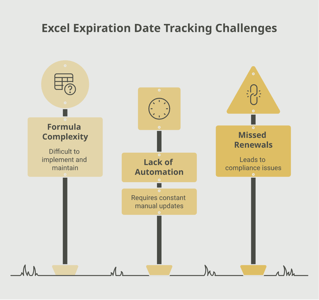
Learning management systems track training completions. Warehouse management systems and safety platforms (Vector EHS, Safesite, KPA, others) often integrate forklift records.
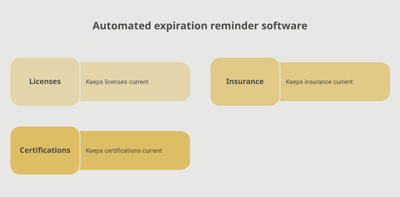
For organizations using a separate compliance tracker, a platform like Expiration Reminder stores each operator with their training history, last evaluation date, three-year next-due date, truck types qualified for, and supporting documents. Reminders fire automatically before each evaluation due date.
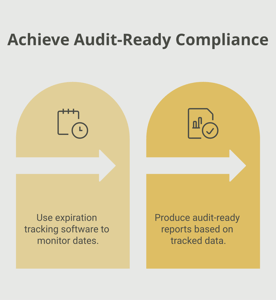
Key features include automated reminders at multiple intervals (180, 90, 60, 30 days — the three-year cycle gives time for planned evaluations), document storage for training and evaluation records, dashboard views by site, shift, or truck type, audit-ready reports for OSHA, and the ability to log new training and evaluation events in one step.
Key Takeaways
- Forklift certification is required under OSHA 29 CFR 1910.178 before workers operate powered industrial trucks.
- Training has three components: formal instruction, practical training, and workplace evaluation.
- Performance evaluation is required at least every three years.
- Refresher training is required after unsafe operation, accidents, equipment changes, or workplace condition changes.
- Certification is issued by the employer, not OSHA; the workplace evaluation must occur on site.
- Forklift incidents cause significant warehouse and manufacturing injuries each year.
- Automated tracking with reminders is the reliable approach for any forklift-operating workforce.
Frequently Asked Questions
How often must forklift operators be recertified?
OSHA requires a performance evaluation at least every three years. Refresher training is also required after unsafe operation, accidents/near-misses, equipment changes, or workplace condition changes.
Can forklift training be delivered online?
The formal instruction portion can be delivered online or via video. The practical training (hands-on) and workplace evaluation must occur in person with the actual equipment and workplace conditions.
Who can train forklift operators?
The employer is responsible for training. The trainer must have the knowledge, training, and experience to train operators and evaluate their competence. External providers can deliver the formal instruction; the workplace evaluation is internal.
What is a workplace evaluation?
An on-site observation of the operator performing real work tasks with the actual equipment, conducted by a qualified person designated by the employer.
Do operators need certification for each truck type?
Yes, in effect. Training must cover the specific type of truck being operated. An operator certified on a stand-up reach truck is not automatically certified on a rough-terrain forklift.
What if an operator is involved in an accident?
OSHA requires refresher training before the operator returns to driving — this is one of the explicit triggers under 1910.178(l)(4)(ii).
How long should forklift certification records be kept?
OSHA does not specify a retention period in 1910.178. Most employers retain records for the duration of employment plus several years to support multi-year audits and legal defenses.
Are pallet jacks covered?
Powered pallet jacks (motorized hand trucks) are covered under 1910.178. Manual pallet jacks are not — they are not powered industrial trucks.
Conclusion
Forklift certification is the foundational safety credential in any operation running powered industrial trucks. The substantive work — delivering training, conducting workplace evaluations, observing operations daily — sits with safety, supervision, and operations. The administrative work — knowing every operator's three-year evaluation date and triggering refresher training when needed — is where most programs need help.
If your team tracks forklift certifications through LMS or paper records, you already know how easy it is for an operator's three-year evaluation to slip past. A purpose-built tracking platform like Expiration Reminder centralizes every operator, sends reminders before each evaluation date, stores the supporting documents, and produces audit-ready reports the moment anyone asks.
Train the operators, evaluate on cycle, and let the system handle the calendar.