Introduction
If your organization owns or operates buildings with elevators, escalators, lifts, dumbwaiters, or any vertical-transportation equipment, the elevator operating permit is the document that authorizes daily use. Permits are issued by the state or local Authority Having Jurisdiction (AHJ) after annual safety inspection, and lapses can result in equipment shut-down, occupancy issues, and meaningful fines.
This article explains what an elevator permit is, the annual inspection cadence, the ASME A17.1 code framework, state-by-state variations, and the most practical way to track elevator permits across a real-estate portfolio.
For most facility, property management, and operations teams, scheduling individual inspections is well understood. The hard part is the calendar across dozens or hundreds of elevators in multiple buildings, often across multiple states with different inspection cadences.
What Is an Elevator Permit?
An elevator operating permit (sometimes called an elevator certificate of inspection, elevator operating certificate, or elevator license) is a document issued by the state or local Authority Having Jurisdiction certifying that the elevator has passed required safety inspections and is authorized to operate. The permit is typically posted in the elevator and serves as visible evidence of current authorization.
The framework includes:
- ASME A17.1 / CSA B44 Safety Code for Elevators and Escalators — the consensus standard for elevator and escalator design, construction, installation, operation, inspection, testing, maintenance, alteration, and repair. Adopted (in various editions) by most U.S. states and Canadian provinces.
- State and local elevator codes — each jurisdiction adopts ASME A17.1 with state- or local-specific amendments and procedures.
- Authority Having Jurisdiction (AHJ) — the regulator with authority over elevator safety in the jurisdiction (state Department of Labor, state Bureau of Elevator Safety, or municipal building department).
Inspection frequency varies:
- Most states — annual inspection by a state-certified inspector required for permit renewal.
- New York City — Building Code requires elevators to be inspected and tested twice annually.
- Some jurisdictions — quarterly or semi-annual inspections for certain elevator types (high-rise, public-use, hospital, school).
Permit issuance follows successful annual inspection. The certificate identifies the elevator, the inspection date, the next-due date, and the AHJ.
When a permit expires:
- The elevator is technically not authorized to operate.
- Continued use may trigger fines and enforcement.
- The building's occupancy or operations may be affected.
Why Elevator Permit Tracking Matters for Your Organization
Elevator permit currency protects against three concrete risks: equipment shut-down, safety incidents, and regulatory enforcement.
From an operational standpoint, an expired elevator permit can lead to AHJ-ordered shut-down. For multi-tenant buildings, hospitals, and high-rises, even brief shut-downs disrupt operations, ADA accessibility, and tenant satisfaction.
From a safety standpoint, the annual inspection is the primary control catching mechanical issues before they cause incidents. Lapsed inspections mean drifting maintenance and accelerated wear.
From a regulatory standpoint, missing permit renewals trigger fines and (in some jurisdictions) public posting. Building owners can face liability for incidents involving non-inspected elevators.
For multi-building owners, property managers, hospitals, schools, and commercial real estate operators, the elevator permit calendar is one of the most consequential facilities-compliance controls.
Common Scenarios for Tracking Elevator Permit Expiration Dates
Commercial Real Estate Portfolios
Office, retail, and mixed-use property owners manage permits across dozens or hundreds of elevators. Centralized tracking is essential.
Healthcare Facilities
Hospitals and large medical facilities have particularly complex elevator portfolios — passenger, freight, dumbwaiters, medical lifts — each with its own inspection cycle and ADA requirements.
Multifamily Residential
Apartment buildings and condominiums depend on elevator availability for tenant satisfaction, ADA compliance, and emergency egress.
Hotels and Hospitality
Hotels rely heavily on elevators for guest experience. Permit lapses cause customer-facing disruption.
Education and Public Buildings
K-12 schools, universities, libraries, and government buildings face elevator inspection requirements layered onto broader public-facility compliance.
How Elevator Permit Tracking Benefits Your Organization
A reliable program produces measurable benefits.
For the company, current permits maintain operational continuity, support tenant satisfaction, and prevent regulatory enforcement.
For facility, property management, and operations teams, the permit calendar becomes predictable. Annual inspections are scheduled with adequate lead time. Maintenance contractors (commonly Otis, Schindler, KONE, ThyssenKrupp / TK Elevator, Mitsubishi, others) coordinate inspections alongside preventive maintenance.
For tenants and building occupants, predictable elevator availability supports daily operations.
How to Track Elevator Permit Expiration Dates
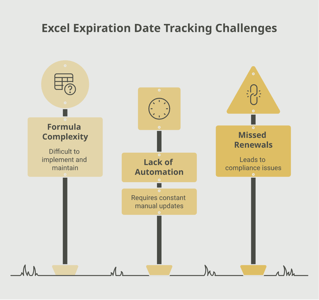
Computerized Maintenance Management Systems (CMMS) and property management platforms typically track inspection and permit data. Elevator maintenance contractors often provide their own scheduling tools.
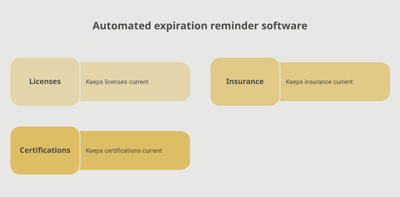
For organizations using a separate compliance tracker, a platform like Expiration Reminder stores each elevator with its identifier, location, current permit, last inspection date, next-due date, maintenance contractor, and supporting documents. Reminders fire automatically before each inspection and permit milestone.
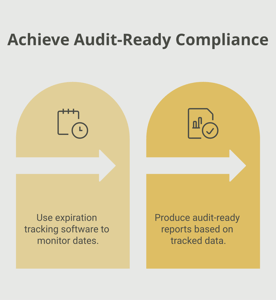
Key features include automated reminders at multiple intervals (90, 60, 30 days — and any state-specific reporting deadlines), document storage for permits, inspection reports, and maintenance records, dashboard views by site, building, or expiry window, audit-ready reports for AHJ inspections, and the ability to log new permits in one step.
Key Takeaways
- An elevator operating permit certifies that the elevator has passed annual safety inspection and is authorized to operate.
- Issued by state or local Authority Having Jurisdiction (AHJ).
- Framework: ASME A17.1 / CSA B44 Safety Code for Elevators and Escalators, adopted by states and provinces.
- Most states require annual inspection; NYC requires inspection and testing twice annually.
- Permit must typically be posted in the elevator and is visible to occupants and inspectors.
- Lapses can lead to equipment shut-down, regulatory enforcement, and operational disruption.
- Multi-building portfolios make centralized tracking essential.
Frequently Asked Questions
How often is elevator inspection required?
In most U.S. states, annually. New York City requires inspection and testing twice annually under the NYC Building Code. Some jurisdictions require more frequent inspection for specific elevator types.
Who performs elevator inspections?
State-certified elevator inspectors. The inspector may be a government employee, a third-party inspection company under contract to the state, or (in some jurisdictions) an insurance-company inspector.
What is ASME A17.1?
The consensus safety code for elevators, escalators, and similar conveyances developed by ASME (the American Society of Mechanical Engineers). The current edition is adopted (with variations) by most U.S. states and Canadian provinces.
What is the difference between an operating permit and a certificate of inspection?
The terms are used somewhat interchangeably. The certificate of inspection documents the inspection result; the operating permit is the authorization to operate based on that result. In many states a single document serves both purposes.
What happens if an elevator permit expires?
The elevator is no longer authorized to operate. AHJs can order shut-down, impose fines, and require remediation before reissuance. Building owners may face liability if an incident occurs during the lapsed period.
Who is responsible for renewing the permit?
The building owner is typically responsible. The elevator maintenance contractor may handle scheduling and inspector coordination on behalf of the owner.
Are escalators covered by the same rules?
Escalators, moving walks, dumbwaiters, lifts, and similar conveyances are covered by ASME A17.1 and equivalent state codes, though specific inspection requirements may differ from passenger elevators.
How long should permit records be kept?
Most jurisdictions require permit records to be available for the current and previous inspection cycle. Owners commonly retain inspection and maintenance records for the life of the elevator.
Conclusion
Elevator permits are the safety-and-operation foundation for every building with vertical transportation. The substantive work — inspection, maintenance, code compliance — sits with maintenance contractors, inspectors, and facilities. The administrative work — knowing every elevator's inspection due date, scheduling annual visits with lead time, and tracking permit renewals across buildings — is where most facilities programs need help.
If your team tracks elevator permits through CMMS or paper records, you already know how easy it is for one elevator's inspection to slip past. A purpose-built tracking platform like Expiration Reminder centralizes every elevator, sends reminders before each inspection date, stores the supporting documents, and produces audit-ready reports the moment anyone asks.
Inspect the elevators, post the permits, and let the system handle the calendar.