Introduction
If your business performs construction, remodeling, specialty trades, or related work, the contractor license is the state-issued authority to bid, perform, and bill for that work. Most U.S. states require general contractor, residential, or specialty trade licensure above defined project thresholds, and the consequences of operating without one range from fines to disgorgement of payments already received.
This article explains what a contractor license is, the state contractor licensing board framework, typical renewal cycles, bonding and insurance requirements, and the most practical way to track contractor licenses across a construction business.
For most general contractors and specialty trade businesses, individual license renewals are well understood. The hard part is the calendar across multiple states, multiple license classifications, and multiple insurance and bond renewals tied to each license.
What Is a Contractor License?
A contractor license is a state-issued authorization permitting an individual or business to perform construction work above defined project thresholds. Licensing is primarily a state function in the U.S., with each state's contractor licensing board administering its own program.
Major state frameworks include:
- California Contractors State License Board (CSLB) — administers Class A (General Engineering), Class B (General Building), Class B-2 (Residential Remodeling), and C-classes (specialty trades).
- Florida Construction Industry Licensing Board (CILB) — administers certified and registered contractor licenses across general, specialty, and trade categories.
- Texas Department of Licensing and Regulation (TDLR) and other state agencies — administer specific trade licensing (electrical, plumbing, A/C); Texas does not license general contractors at the state level.
- State-by-state variations — every state has its own framework, with licensing levels, project thresholds, and required exams.
Initial licensure typically requires:
- Experience — typically 2-4 years of qualifying experience.
- Examinations — trade exam plus business and law exam.
- Background check.
- Surety bond — typically $5,000-$25,000+ as a condition of licensure.
- Insurance — workers' compensation, general liability, and (in some states) auto insurance.
- Fees — application, exam, and license issuance fees.
Renewal cycles vary by state:
- Annual — common in some states.
- Biennial (2 years) — common (California is biennial, for example).
- Triennial — used in a few states.
Renewal requirements typically include:
- Renewal fee.
- Updated insurance certificates — current workers' comp, general liability, auto.
- Updated bond.
- Continuing education — required in some states for specific license types.
- Disclosure of changes — qualifying individual, business structure, ownership.
License classifications matter significantly. General contractor licenses authorize broader scopes of work; specialty trade licenses (electrical, plumbing, mechanical, roofing, swimming pool, others) authorize specific trades. Performing work outside license scope can be a violation.
Why Contractor License Tracking Matters for Your Organization
Contractor license currency protects against three concrete risks: project disqualification, payment recovery actions, and regulatory enforcement.
From a project standpoint, public-works and private commercial projects typically require current licensure as a condition of bidding and contract award. Lapsed licenses disqualify the contractor from upcoming work.
From a payment standpoint, many states allow project owners to recover payments made to unlicensed contractors — or refuse to pay for work performed without licensure. The CSLB has well-documented examples of disgorgement.
From an enforcement standpoint, state licensing boards investigate complaints, conduct compliance audits, and impose fines, license suspensions, or revocations for violations.
For multi-state contracting operations, the license calendar across states, license types, and qualifying individuals is one of the most consequential operational controls.
Common Scenarios for Tracking Contractor License Expiration Dates
Multi-State General Contractors
GCs operating across state lines manage licenses in each state of operation, often with different classifications and renewal cycles per state.
Specialty Trade Contractors
Electrical, plumbing, HVAC, roofing, and other specialty trade contractors manage trade-specific licenses with their own renewal and CE requirements.
Subcontractor and Owner-Operator Networks
Subcontractor networks and owner-operator structures manage licenses across many individual qualifying parties.
Real Estate Development
Real estate developers and construction managers verify subcontractor licenses as part of project administration and compliance.
Insurance and Bonding Agents
Insurance and surety bond agents tracking client contractor licenses for coverage administration.
How Contractor License Tracking Benefits Your Organization
A reliable program produces measurable benefits.
For the company, current licenses preserve bidding eligibility, prevent payment disputes, and support clean board interactions.
For office managers, owners, and operations teams, the license calendar becomes predictable. Insurance and bond renewals align with license renewals. CE deadlines are met with adequate lead time.
For project clients, owners, and prime contractors, current licenses on file support clean contractor management.
How to Track Contractor License Expiration Dates
State contractor licensing board databases provide license-status verification. Construction management software (Procore, Autodesk Construction Cloud, BuildBlock, others) often includes subcontractor credential tracking.
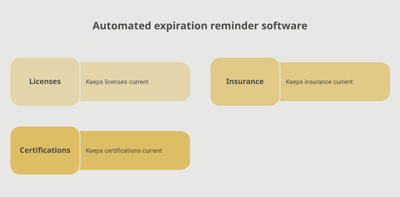
For organizations using a separate compliance tracker, a platform like Expiration Reminder stores each license with its state, classification, expiration, qualifying individual, surety bond, insurance certificates, and supporting documents. Reminders fire automatically before each renewal.
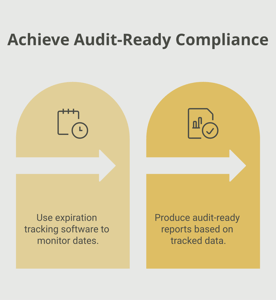
Key features include automated reminders at multiple intervals (180, 90, 60, 30 days — multi-state renewals need long lead times), document storage for licenses, bonds, and insurance certificates, dashboard views by state, classification, or expiry window, audit-ready reports for board audits and project owners, and the ability to log renewals in one step.
Key Takeaways
- A contractor license is a state-issued authorization permitting construction work above defined project thresholds.
- Administered by state contractor licensing boards (CSLB, CILB, TDLR, and others by state).
- Initial licensure typically requires experience, trade exam, business and law exam, background check, surety bond, and insurance.
- Renewal cycle varies: annual, biennial (California), or triennial depending on state.
- Renewal requires updated insurance, bond, and (in some states) continuing education.
- License classifications matter — work outside scope is a violation.
- Lapses can disqualify from projects, trigger payment recovery, and lead to regulatory enforcement.
- Multi-state operations make centralized tracking essential.
Frequently Asked Questions
Who issues a contractor license?
The state contractor licensing board in each state where the contractor performs work above defined project thresholds.
How long is a contractor license valid?
Varies by state — annual is common in some states; biennial (California) and triennial cycles also exist.
Do all states require contractor licenses?
Most do, with variations. Some states (Texas) do not license general contractors at the state level but do license specific trades (electrical, plumbing, HVAC). Project thresholds and licensing requirements vary widely.
What are the typical insurance requirements?
Workers' compensation (mandatory in nearly all states), general liability (commonly required for licensure), and (in some states) commercial auto. Specific minimums vary by state.
What is a contractor's bond?
A surety bond required as a condition of licensure, providing financial protection to customers and the state in the event of contractor violations. Bond amounts vary by state and license type.
What happens if I work without a license?
Fines, project disqualification, payment recovery actions (some states allow owners to recover all payments made), criminal charges in some cases, and bonding/insurance complications.
How does multi-state licensure work?
Each state issues its own license. A contractor working in multiple states needs separate licensure in each. Some states allow license-by-reciprocity for contractors licensed in compatible states.
What is a qualifying individual?
The individual designated as the qualifying party for the contractor license — typically an officer, employee, or owner who passed the licensing exam and has the requisite experience. A change in qualifying individual requires reporting to the board.
Conclusion
Contractor licensing is the foundation of legal construction work. The substantive work — passing exams, building experience, maintaining bonding and insurance — sits with the contractor and qualifying individuals. The administrative work — knowing every state license expiration, every insurance and bond renewal, and every CE deadline — is where most contracting businesses need help, particularly multi-state operations.
If your team tracks contractor licenses through state-board sites or paper records, you already know how easy it is for one license, bond, or insurance certificate to slip past. A purpose-built tracking platform like Expiration Reminder centralizes every license and supporting credential, sends reminders before each renewal, stores the documents, and produces audit-ready reports the moment anyone asks.
License the work, maintain the bonds, and let the system handle the calendar.