Introduction
If your organization employs commercial drivers — long-haul trucking, last-mile delivery, passenger transportation, hazmat transportation, vocational fleets — the Commercial Driver's License (CDL) is the foundation of every driver's authorization to operate. The federal framework dates to 1992, states administer the license, and a lapsed CDL immediately disqualifies the driver from operating a commercial motor vehicle.
This article explains what a CDL is, the FMCSA federal framework, Class A/B/C classifications, endorsements, the Entry-Level Driver Training (ELDT) requirement, typical renewal cycles, and the most practical way to track CDLs across a commercial driver workforce.
For most fleet safety and DOT compliance teams, CDL verification at hire is well understood. The hard part is the calendar — knowing every driver's CDL expiration, related credentials (Medical Card, hazmat endorsement TSA renewal), and self-certification status.
What Is a CDL?
A Commercial Driver's License is a state-issued license authorizing an individual to operate a commercial motor vehicle (CMV). The CDL framework is federally mandated under 49 CFR Part 383, with state Driver Licensing Agencies (SDLAs) administering issuance and renewal.
Three classes:
- Class A — combination vehicles with gross combination weight rating (GCWR) of 26,001 pounds or more, with a towed unit weighing more than 10,000 pounds. The most common CDL for long-haul trucking.
- Class B — single vehicle with gross vehicle weight rating (GVWR) of 26,001 pounds or more, or such a vehicle towing a unit not exceeding 10,000 pounds. Common for straight trucks, dump trucks, school buses, transit buses.
- Class C — vehicles designed to transport 16 or more occupants (including the driver) or to transport hazardous materials requiring placarding, where the vehicle does not meet Class A or B GVWR. Common for HAZMAT delivery and certain passenger vehicles.
Endorsements add authority for specific operations:
- H — Hazardous materials (HAZMAT). Requires TSA Security Threat Assessment, renewed every 5 years.
- N — Tank vehicles.
- P — Passenger vehicles.
- S — School bus.
- T — Doubles/triples.
- X — Combined HAZMAT and tank.
Restrictions limit the driver to specific equipment (no manual transmission, intrastate only, etc.).
Entry-Level Driver Training (ELDT) — required since February 2022 for first-time CDL applicants. Drivers seeking initial Class A or B CDL, upgrading from B to A, or obtaining first-time H, P, or S endorsements must complete ELDT through a registered training provider before taking the skills test.
Self-certification: CDL holders must self-certify the type of operation they perform:
- Interstate non-excepted (subject to FMCSR medical requirements).
- Interstate excepted (specific exemptions).
- Intrastate non-excepted.
- Intrastate excepted.
The self-certification determines which medical certificate requirements apply.
Renewal cycles vary by state:
- 4-8 years is the typical range.
- South Carolina issues CDLs valid 8 years.
- Other states range 4-6 years.
- HAZMAT endorsement typically renews on a 5-year cycle tied to TSA Security Threat Assessment renewal.
The CDL is closely linked to the DOT Medical Card — most CDL drivers must hold a current Medical Examiner's Certificate (up to 24 months) reported to the SDLA.
Why CDL Tracking Matters for Your Organization
CDL currency protects against three concrete risks: driver disqualification, DOT compliance findings, and insurance/liability exposure.
From a driver-qualification standpoint, an expired CDL immediately disqualifies the driver. The carrier cannot legally allow the driver to operate the CMV.
From a DOT compliance standpoint, missing or expired CDLs in driver qualification (DQ) files are among the most common findings during compliance reviews.
From an insurance and liability standpoint, an accident involving a driver with an expired CDL creates substantial exposure for the carrier — both regulatory and civil litigation.
For motor carriers of all sizes, the CDL calendar across the driver workforce is one of the most consequential operational controls.
Common Scenarios for Tracking CDL Expiration Dates
Long-Haul and Regional Trucking
TL and LTL carriers manage CDLs for hundreds or thousands of drivers, with concentrated renewal cycles and HAZMAT endorsement renewals.
Local Delivery and Last-Mile
Local delivery and last-mile operations with CDL drivers face frequent driver turnover and continuous onboarding.
Bus, Coach, and Passenger Transportation
Bus and coach operators manage CDLs with P (passenger) and S (school bus) endorsements.
HAZMAT and Tank Operations
HAZMAT and tank carriers manage H, N, and X endorsements with their separate 5-year TSA renewals.
Vocational Fleets
Construction, utilities, telecom service fleets manage CDL drivers operating heavy equipment alongside non-CDL drivers.
How CDL Tracking Benefits Your Organization
A reliable program produces measurable benefits.
For the company, current CDLs maintain driver qualification, support DOT compliance, and reduce insurance/liability exposure.
For safety, fleet, and HR teams, the CDL calendar becomes predictable. Renewals are scheduled with adequate lead time, particularly the 5-year HAZMAT endorsement TSA renewal.
For drivers, predictable tracking supports their continued employment.
How to Track CDL Expiration Dates
State DMV and DLA portals provide individual CDL status. Driver qualification file (DQF) management software tracks CDLs alongside other DQ documents.
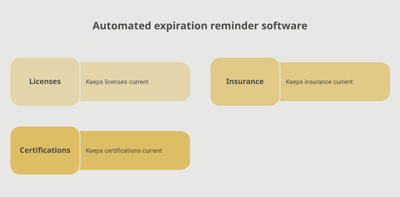
For organizations using a separate compliance tracker, a platform like Expiration Reminder stores each driver with their CDL class, endorsements, restrictions, state of issuance, expiration, self-certification status, and supporting documents. Reminders fire automatically before each renewal and endorsement milestone.
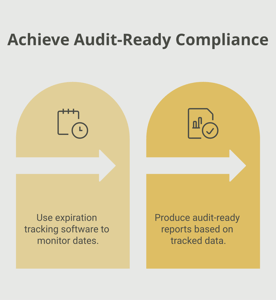
Key features include automated reminders at multiple intervals (180, 90, 60, 30 days — the 5-year HAZMAT cycle benefits from longer lead times), document storage for CDL copies and TSA certificates, dashboard views by terminal, route, or expiry window, audit-ready reports for DOT compliance, and the ability to log renewals in one step.
Key Takeaways
- A CDL is a state-issued license authorizing operation of commercial motor vehicles, federally mandated under 49 CFR Part 383.
- Three classes: A (combination, 26,001+ lbs GCWR with 10,000+ lb towed), B (single vehicle 26,001+ lbs GVWR), C (HAZMAT placarded or 16+ passenger vehicles below Class A/B).
- Endorsements: H (HAZMAT), N (tank), P (passenger), S (school bus), T (doubles/triples), X (HAZMAT + tank).
- Entry-Level Driver Training (ELDT) required since February 2022 for first-time applicants.
- Self-certification: interstate non-excepted/excepted or intrastate non-excepted/excepted.
- Renewal cycle: typically 4-8 years; SC uses 8 years.
- HAZMAT endorsement renews on a 5-year cycle tied to TSA Security Threat Assessment.
- Lapses immediately disqualify the driver.
Frequently Asked Questions
Who issues a CDL?
The state Driver Licensing Agency (DLA) — typically the DMV or equivalent — under federally mandated FMCSA requirements.
How long is a CDL valid?
Typically 4-8 years depending on the state.
What is the difference between Class A, B, and C?
Class A: combination vehicles 26,001+ lbs GCWR with 10,000+ lb towed. Class B: single vehicle 26,001+ lbs GVWR. Class C: vehicles designed for 16+ occupants or HAZMAT placarded, below Class A/B GVWR.
What is ELDT?
Entry-Level Driver Training — required since February 2022 for first-time CDL applicants (Class A or B initial, or B-to-A upgrade) and for first-time H, P, or S endorsements. Completed through a registered training provider.
What is the HAZMAT endorsement?
The H endorsement permits operation of vehicles transporting placarded hazardous materials. Requires TSA Security Threat Assessment (fingerprinting and background check) renewed every 5 years.
What does self-certification mean?
CDL holders must declare to the SDLA the type of operation they perform — interstate non-excepted, interstate excepted, intrastate non-excepted, or intrastate excepted. This determines medical certificate requirements.
How does the Medical Card interact with the CDL?
CDL holders subject to FMCSR medical requirements must maintain a current Medical Examiner's Certificate (typically 24 months) and report status to the SDLA, which adds it to the CDL record.
What happens if a CDL expires?
The driver is immediately disqualified from operating a CMV. The carrier cannot legally allow the driver to drive. Renewal requires application at the SDLA, often with vision exam and (in some states) updated knowledge or skills testing depending on the lapse length.
Conclusion
The Commercial Driver's License is the gatekeeper credential for every commercial driver. The substantive work — passing the CDL skills test, completing ELDT, maintaining endorsements, and supporting daily safe operation — sits with drivers and safety leadership. The administrative work — knowing every driver's CDL expiration, related endorsement renewals, and the cascade with Medical Card and self-certification — is where most carriers need help.
If your team tracks CDLs through DQF software or paper records, you already know how easy it is for one driver's CDL or HAZMAT endorsement to slip past. A purpose-built tracking platform like Expiration Reminder centralizes every driver's CDL and related credentials, sends reminders before each renewal, stores the supporting documents, and produces audit-ready reports the moment anyone asks.
License the drivers, manage the endorsements, and let the system handle the calendar.