Introduction
If your company is registered with a U.S. state — as an LLC, corporation, partnership, or nonprofit — you almost certainly owe an annual report. Miss the deadline, and the state can dissolve the entity, revoke the charter, and effectively end the legal existence of the business overnight. Most owners discover this only when a bank, an investor, or a customer flags the lapsed status.
This article explains what an annual report is, why it matters, who must file, when it is due in different states, what franchise tax obligations come with it, and what happens when filings fall behind. You will also see the most practical way to track every filing deadline across every state, entity, and subsidiary without juggling spreadsheets or hoping the registered agent remembers.
For most companies, the report itself is straightforward — a short form with updated information and a check. The hard part is keeping track of dozens of deadlines, in different formats, across different states, year after year.
What Is an Annual Report?
An annual report is a state-required filing that updates the state's records on a registered business entity. The filing typically includes the registered agent's name and address, the principal office address, the names of officers or members, the business activity, and a filing fee or franchise tax payment.
The exact form, deadline, fee, and required content vary dramatically by state. Some states call it an "annual report," others "annual statement," "biennial report," "decennial report," "statement of information," or "periodic report." Currently, every U.S. state except Ohio requires some form of periodic filing for registered entities, though some require it every two years (biennial) or every ten years (decennial) rather than annually.
Common deadline patterns include:
- Delaware corporations — file by March 1, with annual report and franchise tax due together.
- Delaware LLCs, LPs, GPs — pay the $300 annual tax by June 1 (no separate report).
- Texas — most entities file by May 15.
- California — corporations file every year, LLCs every two years, on the anniversary of formation.
- Florida — file by May 1.
- Other states — anniversary-based, fixed calendar dates, or fiscal-year linked.
Some states bundle franchise tax payments with the annual report; others treat them as separate obligations. Paying franchise tax does not automatically satisfy the annual report requirement, and missing either can trigger penalties.
For nonprofit corporations, the annual report is separate from IRS Form 990 — the IRS filing reports financial activity at the federal level, while the state annual report keeps the corporate registration active at the state level.
Why Annual Reports Matter for Your Organization
Annual reports are the formal mechanism by which a registered entity stays in "good standing" with the state. Good standing is not just paperwork — it is a precondition for nearly every important business activity.
When an entity falls out of good standing, the consequences cascade quickly. The state typically charges late fees and penalty interest, suspends the entity's authority to do business, and — if the report stays unfiled long enough — administratively dissolves the entity or revokes its charter. Once dissolved, the business legally ceases to exist as a registered entity, which can expose owners to personal liability that the corporate or LLC structure was designed to prevent.
Banks routinely require evidence of good standing before opening accounts, extending credit, or processing significant transactions. Investors and acquirers conduct entity status checks during diligence — a lapsed filing in the data room can derail a transaction or reduce valuation. Customers in regulated industries often require proof of good standing in vendor onboarding. Insurance carriers may invalidate coverage if the insured entity is administratively dissolved.
For multi-entity organizations — holding companies with operating subsidiaries, franchise systems, real estate portfolios — the obligation multiplies. Each entity in each state has its own filing, its own deadline, and its own consequence of lapse.
Common Scenarios for Tracking Annual Report Due Dates
Annual report tracking touches almost every kind of registered business. Here are the contexts where keeping the calendar straight matters most.
Multi-State Operating Companies
A company doing business across multiple states typically registers as a foreign entity in every state where it operates. Each state then has its own annual report. A mid-sized company operating in 15 states has 15 annual reports to file, with 15 different deadlines.
Holding Companies and Subsidiaries
Holding-company structures often include dozens of legal entities — the parent, operating subsidiaries, IP holding entities, real estate entities, and special-purpose vehicles. Each is a separate registration with its own annual report.
Real Estate and Franchise Portfolios
Real estate investors with multiple property-level LLCs and franchise systems with location-level entities both face high-volume annual report obligations. A franchisor with 200 locations across multiple states may oversee hundreds of annual reports across the network.
Nonprofit Organizations
Nonprofits must file state annual reports (or equivalent registration renewals) on top of IRS Form 990 and state charitable solicitation registrations. Each filing has its own deadline, fee, and required disclosures.
Startups and Newly Formed Entities
Founders often form an entity in year one, file the first annual report on time, and then miss the second-year filing because the work has shifted to other priorities. By year three, the entity is administratively dissolved, and the cleanup costs (reinstatement fees, back filings, possible refilings) far exceed what the original filings would have cost.
How Annual Report Tracking Benefits Your Company and Employees
A reliable annual report tracking program produces measurable benefits.
For the company, current filings preserve good standing, protect the corporate liability shield, support banking and credit relationships, and prevent dissolution. They also support clean diligence in financings, acquisitions, and major contracts.
For finance, legal, and operations teams, knowing the filing status across every entity removes a recurring source of uncertainty. Compliance leads can confirm good standing on demand. Operations teams can validate entity status before signing new contracts or opening new accounts.
For investors, acquirers, and partners, clean filing records demonstrate organizational discipline and reduce diligence friction. Lapsed filings — even when easily curable — are a red flag that signals broader operational gaps.
How to Track Annual Report Due Dates
Most organizations track filings one of three ways: the registered agent's reminder, a spreadsheet, or counsel's tickler system. Each has a failure mode.
Registered agents do send reminders, but the reminders go to the registered address on file — which is often the registered agent itself, not the actual business owner. The reminder bounces around internal email or sits in a shared inbox until the deadline passes.
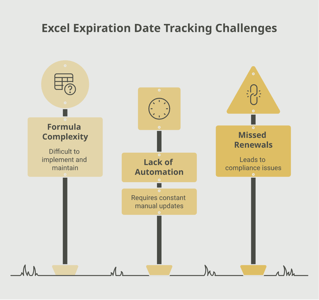
Spreadsheets centralize the data but do not send reminders, do not survive employee turnover, and do not handle the many small variations between states (deadline tied to formation date, deadline tied to fiscal year, fixed calendar date, etc.).
Counsel's tickler system works for a small portfolio but becomes expensive at scale and depends on the law firm's internal processes.
A dedicated tracking platform like Expiration Reminder stores each entity with its state, type, formation date, annual report deadline, fee, and responsible owner. Reminders fire automatically — 90, 60, and 30 days before each deadline — to whichever roles need notice. Overdue filings appear on a dashboard the moment they cross the deadline.
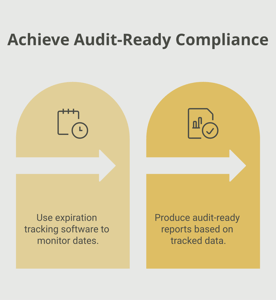
The features that matter most for annual report tracking include automated reminders at multiple intervals, document storage so the filing confirmation is attached to the entity record, dashboard views by state, entity type, or status (good standing, due soon, overdue), audit-ready reports that show compliance across the entire entity portfolio, and the ability to log the next due date the moment a filing is confirmed.
The result is a compliance program that runs in the background — the right person gets the right reminder before the right deadline, every time.
Key Takeaways
- An annual report is a state-required filing that updates the state's records on a registered business entity and keeps the entity in good standing.
- All U.S. states except Ohio require some form of annual or periodic filing; deadlines, fees, and content vary widely by state.
- Failure to file can result in late fees, loss of good standing, administrative dissolution, and loss of the corporate liability shield.
- Good standing is a precondition for banking, credit, contracts, financings, and most major business activities.
- Multi-state, multi-entity organizations face multiplied compliance burdens — each entity in each state has its own filing.
- Manual tracking through spreadsheets or registered-agent reminders fails at scale; automated tracking with multi-step reminders is the reliable approach.
Frequently Asked Questions
When is my annual report due?
Deadlines vary by state and entity type. Delaware corporations file by March 1, Delaware LLCs pay by June 1, Texas entities file by May 15, Florida entities by May 1, and many states tie the deadline to the entity's formation anniversary. Check each state's Secretary of State website for the specific requirement.
What happens if I miss the annual report deadline?
Most states impose late fees and penalty interest. If the report stays unfiled, the state can place the entity in "not in good standing" status, suspend its authority to do business, and ultimately administratively dissolve the entity. Reinstatement requires back filings, back fees, and additional paperwork.
Is the annual report the same as a franchise tax?
No. Some states bundle franchise tax payment with the annual report, but they are separate legal obligations. Paying franchise tax does not satisfy the annual report requirement, and vice versa. Always confirm both have been filed.
Do I need to file an annual report if my LLC is inactive?
Yes, in most cases. If the entity remains registered with the state, the annual report is required regardless of revenue or activity. To stop the filing obligation, the entity must be formally dissolved through the state.
Does my registered agent file the annual report for me?
Some registered agents offer annual report filing as a paid service, but most simply forward reminders. The legal obligation to file rests with the entity, not the agent.
How much does it cost to file an annual report?
Fees vary dramatically — from under $10 to over $300 — depending on state, entity type, and authorized shares. Texas charges no fee for the public information report. Delaware franchise tax for corporations can run into thousands of dollars based on authorized shares.
What information does an annual report require?
Typical content includes registered agent name and address, principal office address, names of officers or members, type of business, and the filing fee. Some states require additional disclosures (authorized shares, capital structure, beneficial ownership).
Can I file annual reports online?
Yes. Nearly all states offer online filing through the Secretary of State's website. Some states accept paper filings, but most require or strongly prefer electronic filing.
Conclusion
Annual reports are administrative — but the consequences of missing one are not. A single missed filing can suspend a business's authority to operate, dissolve the entity, and expose owners to liability the entity structure was meant to prevent. The work of staying current is small, predictable, and entirely calendar-driven, which makes it the easiest part of corporate compliance to automate.
If your team is tracking annual report deadlines on a spreadsheet, through your registered agent's email reminders, or through outside counsel, you already know how fragile that is. A purpose-built tracking platform like Expiration Reminder centralizes every entity, sends reminders before each deadline, stores filing confirmations, and produces good-standing reports the moment anyone asks.
Keep the filings current, keep the entity in good standing, and let the system handle the dates.